Table of Contents
The automotive industry is currently navigating two simultaneous revolutions: the transition to electrification and the shift toward software-defined intelligence. While many manufacturers are struggling to adapt legacy supply chains to this new reality, Rivian has taken a distinct approach by betting its future on vertical integration. In a recent discussion, Founder and CEO RJ Scaringe detailed how the company completely rebuilt its autonomy stack, why legacy electronic architectures are destined to fail, and how the upcoming R2 platform aims to solve the American EV market’s "lack of choice" problem.
Key Takeaways
- The Shift to Neural Networks: Rivian scrapped its original rule-based autonomy code to build a clean-sheet, end-to-end neural network architecture capable of handling complex corner cases.
- Vertical Integration is Mandatory: Scaringe argues that only companies controlling the full stack—sensors, compute, and data loops—will survive the transition to autonomous driving.
- In-House Silicon: To make autonomy affordable on mass-market vehicles, Rivian developed proprietary chips to handle the high costs of onboard inference.
- The Trap of Legacy Architecture: Traditional "domain-based" electronic architectures make modern software updates nearly impossible, necessitating a move to "zonal" architectures.
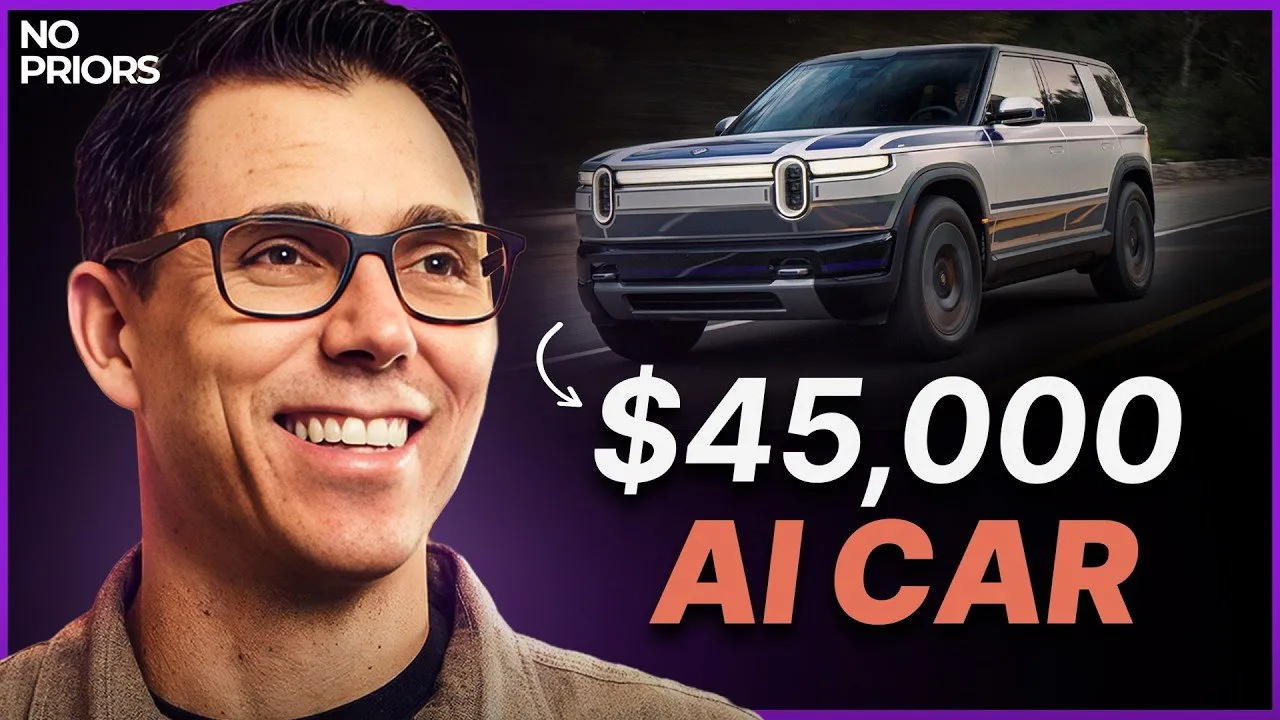
- Solving for Choice: The R2 platform is designed to break the "Model Y monopoly" by offering a distinct, adventure-focused alternative in the $45,000–$55,000 price range.
The Pivot to End-to-End AI Architecture
In the early days of autonomous vehicle development, the industry relied heavily on rule-based systems. These "1.0" approaches separated perception (identifying a stop sign) from planning (deciding to stop). However, Rivian recognized early on that this approach had a hard ceiling on performance.
Consequently, the company made the difficult decision to scrap its initial work and rebuild from scratch. The result is a system based on neural networks where the vehicle learns from vast amounts of video data rather than hard-coded rules. This shift allows the system to handle the "long tail" of driving scenarios—rare, unpredictable events that rule-based systems struggle to navigate.
"By 2030, it'll be inconceivable to buy a car and not expect it to drive itself. Every single one of our cars, we want to have the ability for it to operate at very high levels of autonomy."
This transition mirrors the broader AI industry's move toward transformer-based models. Just as Large Language Models (LLMs) ingest the internet to understand language, autonomous vehicles must ingest millions of miles of driving data to understand physical space. Scaringe notes that the rate of progress between now and 2030 will look fundamentally different from the last five years due to this architectural shift.
The Necessity of Vertical Integration
One of the most contentious points in the auto industry is the "build vs. buy" debate regarding software and sensors. Scaringe is adamant that for autonomy, an arms-length relationship with suppliers is a path to obsolescence. To build a functioning data flywheel, a manufacturer needs direct access to the raw sensor data and the ability to trigger specific recording events across the entire fleet.
The Hidden Cost of Inference
While the cost of sensors like cameras, radar, and LiDAR has dropped precipitously, the computational cost of processing that data has risen. Running powerful neural networks requires significant onboard compute power.
"Radars are extremely cheap. LiDARS are very cheap, but the really expensive part of the system is actually the onboard inference... My view is EV adoption in the United States is a reflection of the lack of choice."
To solve this, Rivian developed its own inference chips. By bringing chip design in-house, they can optimize the hardware specifically for their neural networks, driving costs down enough to include high-level autonomy hardware as standard equipment on every vehicle, including the lower-priced R2.
The "Ingredients" for Survival
Scaringe predicts a massive consolidation in the industry, suggesting that fewer than five companies outside of China currently possess the necessary ingredients to succeed in autonomy. These ingredients include:
- Control over the perception stack (cameras/sensors).
- A large, active car park (fleet) to generate training data.
- Massive GPU clusters for training models.
- Proprietary onboard inference hardware.
Companies relying on "black box" solutions from third-party suppliers will likely find themselves unable to compete with the rapid iteration cycles of vertically integrated competitors.
Zonal vs. Domain Architectures
Beyond autonomy, the fundamental layout of vehicle electronics is undergoing a revolution. Traditional internal combustion vehicles utilize a "domain-based" architecture. In this legacy model, specific functions (door locks, HVAC, windows) are controlled by separate Electronic Control Units (ECUs) provided by different suppliers. A modern legacy car might have over 100 isolated ECUs, creating a nightmare for software integration.
Scaringe traces this complexity back to the 1960s, when fuel injection introduced the first computers to cars. Over decades, this grew into an unmanageable "field of weeds."
"It's inconceivable for a car company to continue to operate at scale... without a software defined architecture... Imagine you have a 100 different islands of software written by 100 different teams that all have to coordinate."
Rivian, alongside Tesla, employs a "zonal architecture." This approach uses a handful of powerful central computers to control all vehicle functions based on their physical location in the car rather than their function. This allows for rapid Over-the-Air (OTA) updates that can fundamentally change vehicle behavior—something impossible with legacy architectures.
The R2 and the "Lack of Choice" Problem
Despite the media narrative regarding a slowdown in EV demand, Scaringe argues that the core issue is not a lack of interest, but a lack of variety. The current market is dominated by the Tesla Model Y, and competing automakers have largely responded by producing clones that offer little differentiation.
The upcoming R2 platform is Rivian’s attempt to inject personality into the mass market. Priced between $45,000 and $55,000, it targets the heart of the US auto market.
Designing for Identity
Rivian’s philosophy centers on the idea that vehicles are not just appliances; they are extensions of identity that enable adventure. While the R2 is smaller and more affordable than the flagship R1, it retains the brand's focus on utility and exploration.
"The world doesn't need another Model Y. The world needs another choice... We self-identify with the thing we drive."
By offering a vehicle that feels distinct from the existing options—focused on capability, storage, and a specific "adventure" aesthetic—Rivian aims to pull buyers out of internal combustion vehicles who previously felt that existing EVs didn't match their lifestyle.
Conclusion
Rivian’s strategy relies on the belief that the future of transportation belongs to those who control the technology stack from the silicon up. By rejecting the traditional supplier model and investing heavily in proprietary autonomy and zonal architecture, the company is positioning itself to survive the industry's "extinction event." As the R2 prepares to launch, it will test whether high-tech vertical integration can scale into the mass market, offering consumers a technologically advanced vehicle that still retains a distinct human soul.