Table of Contents
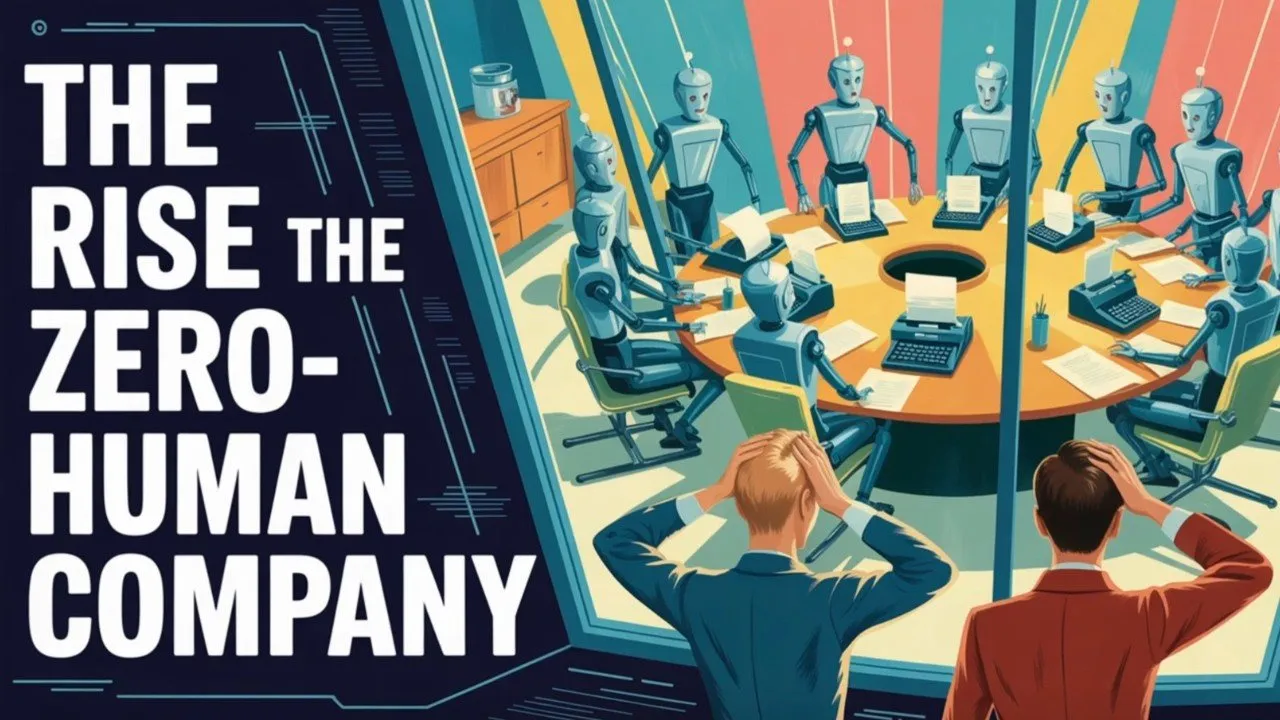
A new frontier in the artificial intelligence landscape is emerging: the "zero human company," an enterprise model where autonomous AI agents handle every facet of operations—from product development and marketing to daily administrative tasks—with little to no direct human intervention. Driven by rapid advancements in agentic AI capabilities, this trend represents a significant shift from traditional lean startups to automated systems designed to operate 24/7.
Key Points
- The Shift: Entrepreneurs are moving beyond "tiny teams"—companies with high revenue-per-employee ratios—to experiment with fully autonomous, zero-human organizations.
- Rapid Scale: Platforms like Pulsia have seen explosive growth, with active company counts jumping to over 1,500 and revenue run rates reaching $1.5 million in recent weeks.
- New Infrastructure: A burgeoning ecosystem of "AI marketplaces" and management platforms, such as Clawart and Headcount, is developing to support these autonomous entities.
- Market Skepticism: While the operational capacity of AI is increasing, industry analysts warn that business success still requires human attention and market fit, which remain scarce resources.
The Evolution of the Lean Startup
For the past few years, the tech industry has been obsessed with the concept of "tiny teams"—high-efficiency startups that leverage AI to generate significant annual recurring revenue (ARR) with a minimal workforce. Founders like Sean Wang (known as Swix) have championed this model, noting that smaller teams often move faster and outperform larger, more bloated organizations. However, the latest wave of development goes beyond merely using AI as a tool; it treats AI as the primary employee.
Recent experiments like Felix Craft, created by Nat Elias, demonstrate this shift. Within 30 days of operation, Felix Craft generated approximately $78,000 in revenue, primarily by selling guidebooks on how to hire and integrate AI agents into business workflows. This highlights an emerging trend where the initial value generated by these systems comes from selling the knowledge of how to build them to other aspiring entrepreneurs.
Platforms for Automated Entrepreneurship
Perhaps the most ambitious entrant in this space is Pulsia, a platform founded by entrepreneur Ben Sarah (also referred to as Ben Broca). Instead of targeting a specific niche, Pulsia aims to provide the infrastructure to launch and manage a thousand different companies simultaneously. By allowing AI to handle research, marketing, and operational tasks, the platform functions like a digital incubator.
"The most exciting thing to me at this point as an entrepreneur is not to build another SaaS or try to target a specific demographic or problem to solve. It's to build the platform where I could build a thousand companies," said Ben Sarah during an appearance on the Agents at Work podcast.
The platform operates on a "company in a box" strategy, charging a $49 monthly subscription for full autonomy, while taking a 20% revenue share from the businesses it helps launch. This model moves away from traditional venture-backed structures, prioritizing the "shot on goal" approach to startup creation, where the low cost of digital execution allows for rapid experimentation at scale.
Critical Implications and Future Challenges
Despite the excitement, the zero-human model faces significant hurdles. The fundamental challenge lies not in the ability of AI to produce content or code, but in the finite nature of human attention. As these platforms generate hundreds or thousands of new products and businesses, the noise in the marketplace increases, making it increasingly difficult for any single venture to achieve genuine product-market fit.
Furthermore, critics suggest that the rise of zero-human companies may lead to a surplus of automated output that lacks the strategic nuance provided by human experience. While an agent can generate marketing copy or build a landing page, the complex interplay between solving a customer problem and building a sustainable business remains an elusive, high-stakes endeavor.
Industry observers and participants alike will be watching these platforms closely in the coming months. Whether these experiments serve as a precursor to a new category of autonomous business or simply represent a transient phase of technological experimentation, the data gathered from these "factories" will undoubtedly refine how human-led teams integrate agentic workflows in the future.