Table of Contents
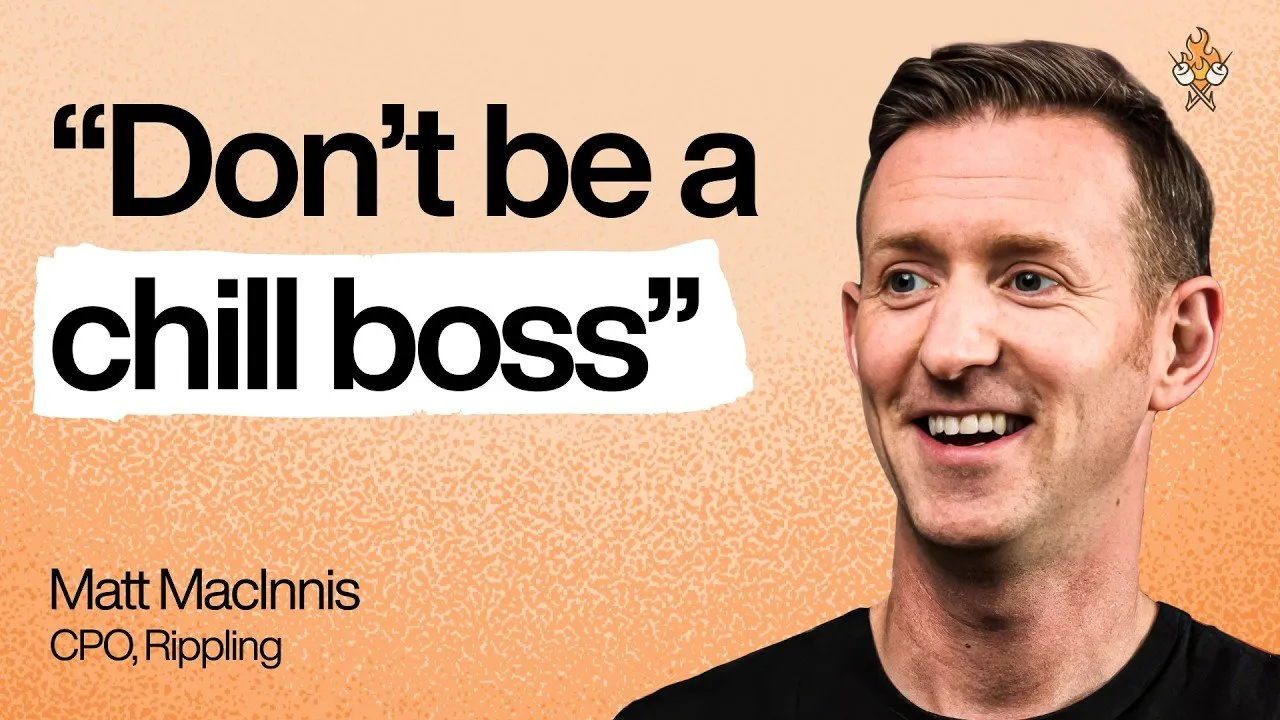
Building extraordinary companies requires more than just talent and good ideas—it demands extraordinary effort, relentless intensity, and the wisdom to know when conventional Silicon Valley advice might be leading you astray. Matt McInness, Chief Product Officer at Rippling, has learned these lessons through both spectacular success and painful failure, and his insights challenge many of the feel-good narratives we hear in the startup world.
Key Takeaways
- Extraordinary results require extraordinary efforts: If you want 99th percentile outcomes, you must be comfortable with being uncomfortable—there should be no "comfort zone" at work
- Always understaff deliberately: Overstaffing leads to politics, wasted resources, and people working on lower-priority tasks that create organizational "crust"
- You learn more from success than failure: Contrary to popular Silicon Valley wisdom, studying winning teams and successful outcomes provides more actionable insights than analyzing mistakes
- Product-market fit is unmistakable: If you're not absolutely certain you have it, you don't—and it's often better to quit and start fresh than persist without clear traction
- Feedback and escalations are gifts: Withholding feedback to avoid discomfort is fundamentally selfish, and customer escalations provide invaluable opportunities for systemic improvement
The Philosophy of Extraordinary Effort
McInness attributes this framework to Dan Gil, CPO at Carvana, but has made it central to his leadership philosophy at Rippling. The concept is deceptively simple: extraordinary outcomes aren't just correlated with extraordinary effort—they require it.
If you ever find yourself in the comfort zone at work, you are definitely making a mistake. It's supposed to be really freaking exhausting.
This isn't about single heroic moments or grand gestures. As McInness explains, the story is told through "a thousand Jira tickets, not through a thousand grand events." It's about showing up on Friday night when the escalation comes in, triaging bugs over the weekend, and maintaining intensity when competitors are looking for any crack to exploit.
The Competitive Reality
The harsh truth is that in valuable markets, competition is inevitable and fierce. McInness draws from his experience at Apple under Steve Jobs, where the famous "death march" meant engineers immediately moved from shipping one iPhone version to building the next, with no break.
There's a crucial caveat to this philosophy: it only works when you're winning. As McInness notes, if your company isn't growing rapidly, if your growth rate is mediocre, it's nearly impossible to ask people for that last ounce of effort because they don't believe it will yield meaningful results.
The Art of Strategic Understaffing
One of McInness's most counterintuitive management frameworks challenges the instinct to throw more people at problems. He advocates for deliberately understaffing every project, based on a simple principle: you'll never get resource allocation exactly right, so you need to choose your error.
Why Overstaffing Is Poison
When you overstaff a project, several harmful things happen:
- Politics emerge as people compete for relevance
- Teams work on lower-priority items before completing essential tasks
- The system becomes bloated with unnecessary "crust"
- Decision-making slows as more stakeholders get involved
It is really important to me that we feel that we've deliberately understaffed every project at the company. If you overstaff, you get politics. You get people working on things that are further down the priority list than necessary. That is poison.
The key is finding the line between deliberate understaffing and dangerous under-understaffing—having just enough constraint to force prioritization without creating burnout or system failures.
Learning from Success, Not Failure
McInness challenges one of Silicon Valley's most cherished beliefs: that failure teaches us more than success. Having spent nine years building Inkling (which struggled to find product-market fit) before joining the rocket ship that is Rippling, he has a unique perspective on both experiences.
The False Comfort of "Learning from Mistakes"
While acknowledging that failure does provide some learning, McInness argues it's often feel-good rhetoric that masks the superior value of studying success:
I've learned so much more in seven years at Rippling because I've seen success. I've seen rapid, wild, crazy, off-the-charts success of the business. And it's more informative. There's more to glean from seeing how it's done right than there is to glean from seeing how it's done wrong.
He uses a vivid analogy: if you're boarding an airplane, would you rather have it serviced by a maintenance technician who has seen it done right 100 times, or one who has seen it done wrong 100 times but "learned from his mistakes"?
Career Implications
This insight has practical implications for career decisions. When evaluating candidates, McInness looks for people who joined great companies during periods of rapid growth and excitement. These individuals have internalized patterns of success that are difficult to replicate through failure alone.
The Transition from COO to CPO
McInness's move from Chief Operating Officer to Chief Product Officer at Rippling is unusual—most executives specialize in one domain throughout their careers. His transition offers insights into both the challenges of scaling organizations and the universal principles of management.
The "Injured Birds" Pattern
At Rippling, McInness became known for taking on whatever function was in disarray—what colleagues called "McInness's injured birds." He successfully rehabilitated various parts of the organization, from sales teams to recruiting functions, but had never tackled R&D.
When Rippling faced consecutive hiring mistakes in engineering and product leadership, McInness saw an opportunity:
Parker sort of slumped down in his seat and said, "I have to run another search." And I said, "No, the gig's up. I'm going to go do it."
The Hierarchy of Product Needs
Jumping into the product role was humbling for McInness. From the outside, he had criticized the team for not measuring adoption metrics carefully or tracking the right data. Once inside, he realized they were skipping foundational steps.
Before worrying about sophisticated metrics, the team needed basic standards for test coverage, product quality checklists, and fundamental processes. This led to one of his key insights about product management: everything must be done in its time and order.
The Alpha-Beta Framework for Teams and Processes
McInness borrows concepts from finance to think about people and processes. In financial markets, alpha represents outperformance relative to an index, while beta represents volatility—essentially unpredictability that isn't necessarily valuable.
High Alpha vs. Low Beta People
When building teams, you need to understand what kind of person and what kind of process each situation demands:
- High Alpha people: Valuable for zero-to-one products where you need outsized creative returns and are willing to accept unpredictability
- Low Beta people: Essential for mature products where consistency and reliability matter more than breakthrough innovation
The key insight is that processes exist solely to lower beta—to reduce volatility in system outputs. But processes also suppress alpha by limiting creativity and risk-taking. The art is knowing when and where to apply process.
The Pickle: A Case Study in Process Design
At Rippling, McInness created what they call "the pickle"—their Product Quality List (PQL). This lightweight checklist articulates standards for shipping products without applying to every product or stifling innovation.
The name itself was deliberately chosen to be memorable and create cultural meaning:
If you want to bring about cultural change in a team, you got to create an entity, a vessel for meaning, and then you got to fill that vessel with your meaning.
The pickle evolves based on real failures. When CEO Parker Conrad installed a new feedback app and encountered a blank screen due to a forgotten feature flag, McInness added a line limiting products to one feature flag at ship time.
The Brutal Truth About Product-Market Fit
Having experienced both the struggle to find product-market fit at Inkling and the rocket ship growth at Rippling, McInness has strong opinions about when entrepreneurs should persist and when they should quit.
The VC Propaganda Problem
McInness argues that Silicon Valley's "never quit" mentality serves venture capitalists, not entrepreneurs:
The incentive of a venture capitalist is to put money into your company and milk you dry. They never get their money back. There is no way for them to take that investment back. And so the only logical desire that they would have is for you to keep trying against all odds.
While pivot stories like Slack (originally a gaming company) exist, they're extraordinarily rare. Most entrepreneurs would be better served by recognizing when they don't have product-market fit and starting fresh with a clean cap table.
The Drug-Receptor Analogy
McInness uses a powerful analogy from pharmaceutical development to explain product-market fit. Just as drug companies can't market their way to better biological binding, startups can't market their way to product-market fit if the underlying receptors don't exist:
The market's either going to latch onto your product and run with it or it's not. Do not ship the product, find a lack of success, and then try to market your way through that because the binding receptors likely don't exist.
This perspective is liberating because it shifts focus from convincing the market to want your product toward discovering what the market naturally craves.
When to Call It
Based on his experience, McInness suggests that if you're four to five years into an entrepreneurial journey without obvious traction, it's time to seriously consider starting fresh. Companies that achieve massive success typically show clear signs relatively quickly, and timing plays a crucial role that's difficult to control.
The Science of Organizational Intensity
McInness has developed a framework combining three universal principles: power laws, compounding, and entropy. Understanding these forces, he argues, is essential for building and maintaining high-performing organizations.
Power Laws and the 99th Percentile
Power law distributions appear everywhere in business and life. The implications are profound: small improvements in inputs can yield disproportionately large improvements in outputs. If you build something to 80% or 90%, you haven't reached the inflection point where rewards become exponential.
This means people in the top 5-10% don't just get slightly better rewards—they get 10x or 100x better outcomes.
Entropy: The Universal Decay Function
The second law of thermodynamics isn't just physics—it's a business principle. Every system tends toward disorder without constant energy input:
Teams will always optimize for local comfort over company outcomes. Your job as an executive, as a leader, is to fight that entropy tooth and nail every single day.
This manifests in countless ways: bugs that don't get escalated, hiring standards that slip, processes that become sloppy. The only antidote is relentless energy injection.
Preserving Founder Intensity
McInness identifies a dangerous pattern in growing organizations: each layer of management represents a potential order-of-magnitude drop in intensity from the founder CEO. If this compounds across multiple layers, the organization becomes dysfunctional.
The solution isn't to buffer people from the CEO's intensity—it's to mirror and preserve that intensity at every level while letting buffering happen elsewhere in the organization.
The Gift of Feedback and Escalations
McInness has an unusual relationship with problems and criticism: he actively seeks them out and treats them as gifts rather than inconveniences.
The Selfishness of Withholding Feedback
Fundamentally, the most selfish thing you can do is withhold feedback from someone. When you think a thought that would help someone improve and you avoid giving it to them because it would make you uncomfortable, well, you're optimizing for your own comfort. And it's fundamentally selfish.
This principle applies both to giving feedback to others and encouraging feedback about your own work and organization. Rippling even has a dedicated escalations team skilled at finding root causes and driving systematic improvements.
Customer Escalations as Intelligence
Rather than viewing customer complaints as problems to minimize, McInness sees them as invaluable intelligence about systemic issues. Each escalation provides an opportunity not just to fix the immediate problem, but to improve the processes that created the problem in the first place.
The Future of Business Software and AI
From his vantage point at Rippling, McInness sees major shifts coming in how business software gets built and delivered, with AI serving as both a catalyst and a selection pressure.
The Bundling Moment
McInness believes we're entering a period of bundling, where point solutions struggle because they lack the data context necessary to build compelling AI features:
Point solutions don't have enough data in the age of AI to be useful. You got to be able to provide the AI with a lot of context about a lot of data so it can do things.
Companies like Rippling, which have built comprehensive business data graphs across multiple functions, are positioned to create AI experiences that point solutions can't match.
The Shovel-Mine Problem
McInness sees the AI landscape stratifying into three layers: shovel providers (OpenAI, Google), mine owners (companies with comprehensive first-party data), and everyone in between. The middle layer faces challenging unit economics because they must rent both shovels and data, leaving little room for sustainable margins.
Conclusion
Matt McInness's insights challenge much of the conventional wisdom in Silicon Valley, from the value of learning from failure to the wisdom of never quitting. His frameworks—from deliberate understaffing to the alpha-beta model to the drug-receptor analogy for product-market fit—provide practical tools for leaders building in competitive markets.
Perhaps most importantly, McInness offers a balanced perspective on intensity and ambition. While demanding extraordinary effort and relentless focus, he maintains that work is ultimately a sport—meaningful while you're playing it, but not worth forgetting the broader context of being conscious beings on a "blue marble drifting through space and time."
You have to never forget that number one, none of this matters and number two, it is an absolutely beautiful and amazing phenomenon that we get to be alive doing this right now. So play the sport, play it with everything you've got, but never forget that it's just a sport.
For leaders building ambitious companies, McInness's message is clear: embrace the intensity, fight entropy every day, learn from success, and remember that we're participating in what may be the most creative period in human history. Just don't forget to enjoy the game.