Table of Contents
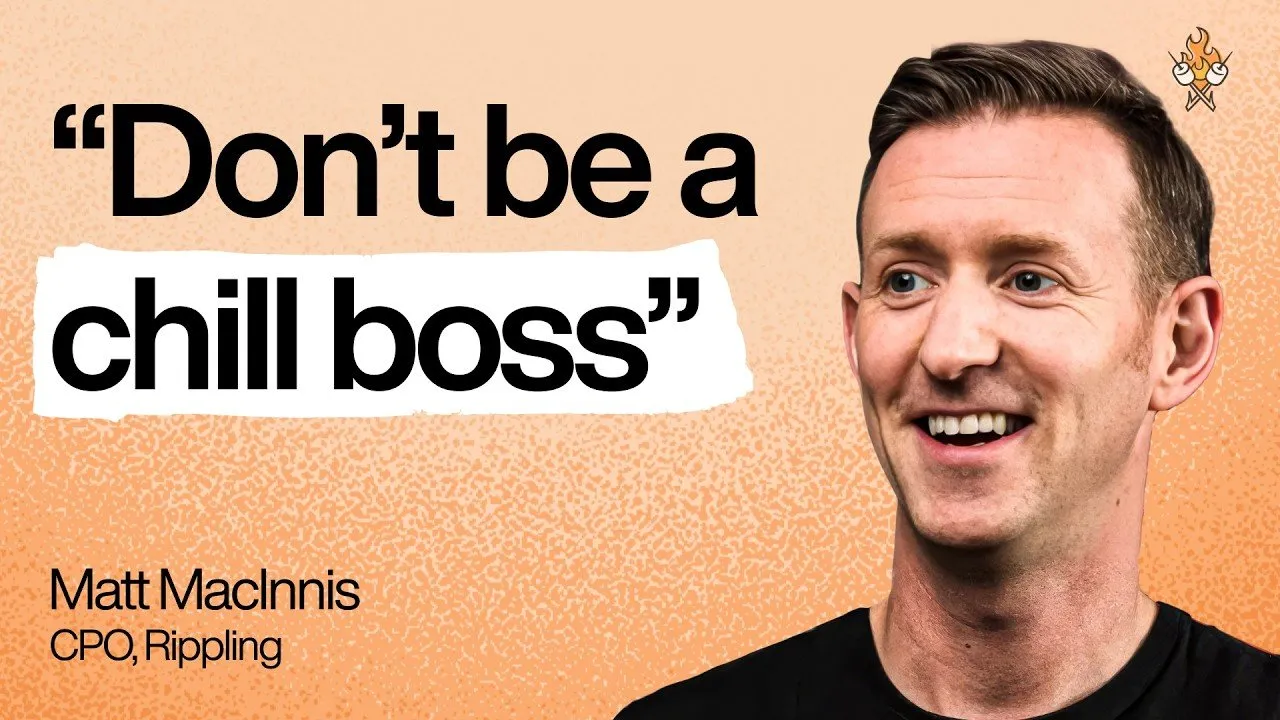
In the fast-paced world of business leadership, conventional wisdom often falls short of delivering extraordinary results. Matt McInness, Chief Product Officer at Rippling, has built his leadership philosophy on a simple yet powerful principle: if you want to achieve something truly exceptional, you must be willing to embrace discomfort, maintain relentless intensity, and deliberately understaff every project. His approach has helped scale Rippling to a $16 billion valuation with over 5,000 employees, making it one of Silicon Valley's most successful companies.
Key Takeaways
- Extraordinary results require extraordinary efforts - if you're comfortable at work, you're making a mistake
- Always deliberately understaff projects - overstaffing leads to politics, waste, and work on lower-priority items
- Escalations and feedback are gifts - withholding feedback is fundamentally selfish and optimizes for personal comfort over team success
- Product market fit is unmistakable - if you're not absolutely certain you have it, you don't, and persistence without clear signals can be dangerous
- Success teaches more than failure - join winning teams to learn what excellence looks like in practice
The Philosophy of Deliberate Understaffing
One of McInness's most counterintuitive leadership principles centers on resource allocation. Rather than ensuring teams have everything they need, he advocates for a different approach.
It is really important to me that we feel that we've deliberately understaffed every project at the company. If you overstaff, you get politics. You get people working on things that are further down the priority list than necessary. That is poison. It's wasteful. It slows you down. It creates crust.
This philosophy stems from a fundamental management framework: when you can't get resource allocation exactly right, you must choose whether to over-steer or under-steer. McInness firmly believes understaffing is the lesser evil because overstaffing leads to teams working on items ranked 15th on the priority list before completing the top five essentials.
The Wisdom of Knowing When to Add Resources
The key distinction lies between deliberate understaffing and harmful under-understaffing. Great leaders must develop the wisdom to recognize when their teams have crossed from productive pressure into counterproductive exhaustion.
Extraordinary Results Demand Extraordinary Efforts
McInness attributes this core principle to Dan Gil, Chief Product Officer at Carvana, but has made it central to his leadership philosophy at Rippling.
The Reality of the 99th Percentile
If you want to achieve outcomes in the 99th percentile, the effort required isn't just 1% more than average—it's exponentially more demanding. This connects to power law distributions that govern business outcomes.
If they ever find themselves in the comfort zone at work, they are definitely making a mistake. It's supposed to be really freaking exhausting.
This doesn't mean grinding individuals into the ground, but rather maintaining organizational intensity where the team collectively stays engaged and ready to capitalize on opportunities.
When Extraordinary Effort Makes Sense
The crucial element that makes this philosophy sustainable is success itself. When a company is growing rapidly and winning in the market, team members can see their extraordinary efforts translating into extraordinary outcomes. Without this connection, asking for maximum effort becomes much more difficult to justify.
The Gift of Escalations and Feedback
McInness has built a culture where problems and negative feedback are welcomed rather than avoided.
Why Withholding Feedback is Selfish
Fundamentally, the most selfish thing you can do is withhold feedback from someone. When you think a thought that would help someone improve and you avoid giving it to them because it would make you uncomfortable, well, you're optimizing for your own comfort. And it's fundamentally selfish.
This philosophy extends to customer escalations. Rather than viewing complaints as inconveniences, McInness sees them as opportunities to identify and fix systemic issues.
The Escalations Team
Rippling has dedicated escalation specialists who are skilled at finding root causes—not just surface-level fixes, but the systems that created the problems and the processes that created those systems.
Learning From Success Rather Than Failure
Contrary to popular Silicon Valley wisdom about learning from mistakes, McInness argues that success is far more instructive than failure.
The Problem with "Learning From Mistakes"
While reflecting on his nine years building Inkling (which eventually sold to a private equity firm), McInness notes that his seven years at Rippling taught him exponentially more because he could observe what success actually looks like.
You don't really learn from your mistakes, you learn from your successes. If I tell you you're going to get on an airplane and one maintenance technician has seen it done right 100 times and the other maintenance technician has seen it done wrong 100 times but he learned from his mistakes, there's not even a comparison which plane you're going to feel more comfortable on.
The Hiring Implication
This insight shapes McInness's approach to recruiting. He looks for candidates who were part of winning teams during exciting growth periods, as they've observed excellence in action.
Product Market Fit: You Know It When You Have It
Drawing from his experience building Inkling for nine years without achieving true product market fit, then experiencing it at Rippling, McInness offers stark advice about recognizing this crucial milestone.
The Dangerous Myth of "Never Quit"
We talk in Silicon Valley about never quit, but that is complete absolute venture capital propaganda. The incentive of a venture capitalist is to put money into your company and milk you dry. They never get their money back.
McInness argues that VCs are incentivized to encourage persistence because they can't recover their investment—they can only hope for the rare pivot that succeeds. But for founders, time is finite and precious.
The Timeline Reality
Based on his experience, McInness suggests that companies that achieve significant success typically show clear signs relatively quickly. If you're four or five years in without obvious traction, the probability of success becomes extremely low.
The Alpha-Beta Framework for Teams and Processes
McInness applies financial concepts to organizational design, distinguishing between alpha (outperformance) and beta (volatility).
When to Optimize for Alpha vs. Beta
In early-stage products or innovative projects, you want high alpha—the possibility of outsized returns even if it comes with volatility. For mature products like payroll systems, you want low beta—consistent, reliable performance with minimal surprises.
Processes in a business exist for the sole purpose of lowering beta. The downside of a process is that it suppresses alpha.
The art of leadership involves knowing when to implement rigid processes (to reduce volatility) and when to preserve flexibility (to enable breakthrough performance).
The Product Quality List: "The Pickle"
At Rippling, McInness implemented a lightweight checklist system called "the pickle" (Product Quality List) that establishes standards for shipping products. The memorable name serves as a vessel for meaning and becomes part of the team's common vocabulary.
Fighting Entropy in Organizations
McInness connects business leadership to fundamental physics principles, particularly the second law of thermodynamics.
Energy as the Antidote to Organizational Decay
Just as physical systems tend toward disorder without energy input, teams naturally drift toward local optimization and comfort rather than company-wide excellence. Leaders must constantly inject energy to maintain high performance.
Teams will always optimize for local comfort over company outcomes. Your job as an executive, as a leader, is to fight that entropy tooth and nail every single day.
Preserving Founder Intensity
The founder-CEO represents the purest form of ambition in a business. Each management layer has the potential to dilute this intensity by an order of magnitude, which becomes dangerous for organizational performance.
Rather than buffering teams from the founder's intensity, executives should mirror and preserve it, allowing buffering to happen at other organizational levels.
The Transition from COO to CPO
McInness's recent move from Chief Operating Officer to Chief Product Officer at Rippling offers insights into executive versatility and product leadership.
The "Injured Birds" Pattern
Throughout his tenure at Rippling, McInness became known for taking on struggling functions and bringing them back to health. When the product organization needed leadership after hiring mistakes, he stepped in to fill the gap.
Lessons from Inside Product
Moving into product taught McInness about the hierarchy of needs in product development. Teams must establish foundational elements like test coverage and quality processes before focusing on advanced metrics like adoption tracking.
Product teams have a hierarchy of needs and we like to point at the failures to meet elements higher up the triangle. When I jumped in, I was like, man, we need to establish some basic standards for test coverage first.
The Future of SaaS and AI
McInness sees the software industry entering a period of bundling rather than unbundling, driven largely by AI's data requirements.
Why Point Solutions Are in Trouble
AI systems need comprehensive context to be truly useful. Point solutions that lack sufficient first-party data will struggle to build compelling AI features, as they'll be forced to rely on integrations that provide limited data access.
If you're selling the shovels like OpenAI, you can make money. And if you own the mine like Rippling with the data, you can make money. If you're somewhere in the middle, you are in a very difficult place from an economic standpoint.
Conclusion
McInness's leadership philosophy challenges many conventional management practices by embracing intensity, scarcity, and discomfort as pathways to extraordinary results. His experience scaling Rippling from startup to $16 billion valuation while transitioning between executive roles demonstrates the power of first-principles thinking and relentless focus on outcomes over comfort.
The key insight threading through all his advice is that extraordinary outcomes are governed by power law distributions—they require exponentially more effort than average results, but the rewards are similarly exponential. For leaders willing to embrace this reality and build systems that channel intensity productively, the potential for breakthrough success becomes significantly higher.
As McInness reminds us, we're living through an unprecedented period of innovation and creativity. The opportunity to participate in building transformative businesses has never been greater—but only for those willing to compete at the highest levels of intensity and excellence.