
Table of Contents
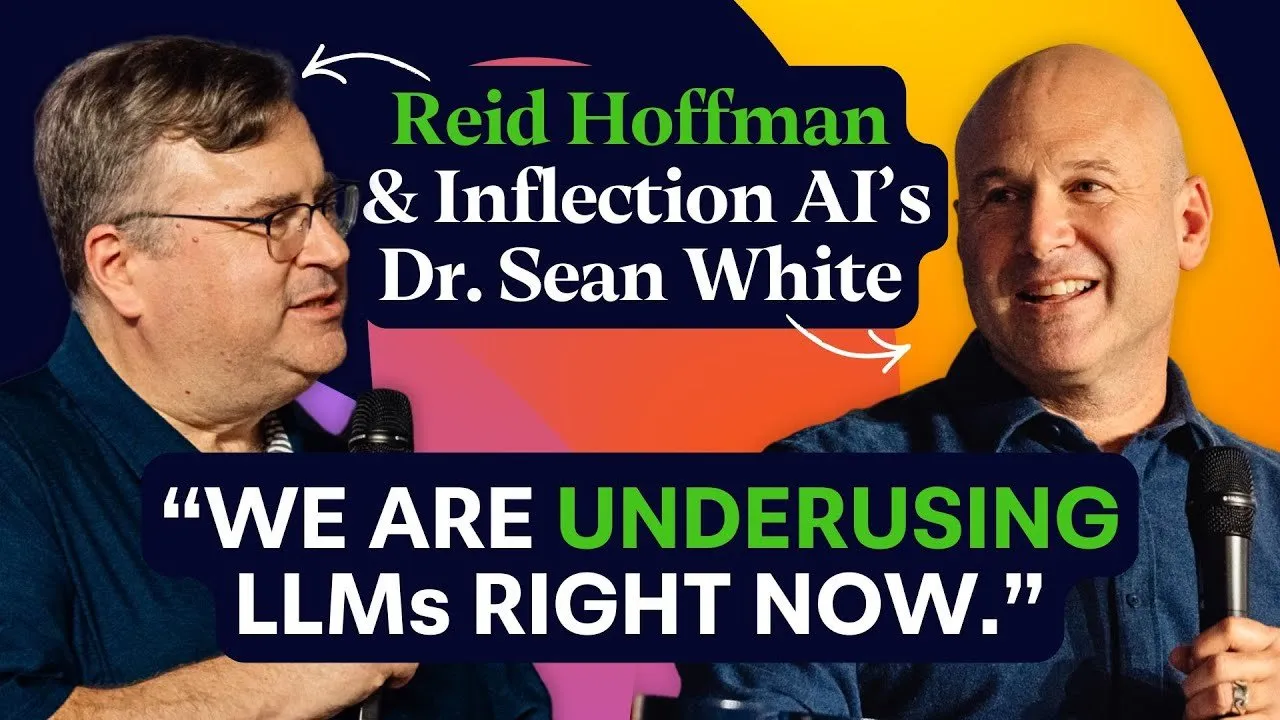
Most of us are vastly underestimating the tools already at our fingertips. According to LinkedIn co-founder Reid Hoffman, practically everyone—from casual users to tech industry veterans—is underutilizing Large Language Models (LLMs) relative to their actual potential. We treat these systems as search engines or novelties, yet they possess the capacity to act as high-level cognitive scaffolding that can reshape how we solve problems, maintain health, and even understand our own humanity.
In a profound discussion at Summit '25, Hoffman and Inflection AI CEO Sean White explored the critical intersection of artificial intelligence and human psychology. Their conversation moved beyond the standard hype cycle to address the philosophical and practical imperatives of the "agentic era." From the necessity of transparency in design to the evolution of human epistemology, the focus is shifting from what AI can do for us, to how AI helps us become better humans.
Key Takeaways
- Transparency is non-negotiable: AI agents must explicitly disclose their nature and never pretend to be sentient, countering our psychological tendency to anthropomorphize technology.
- EQ impresses more than IQ: Bill Gates was convinced of the AI revolution not by biology exam scores, but by an empathetic response regarding the loss of a pet.
- Friendship vs. Companionship: AI can offer companionship and therapeutic support, but it cannot replace human friendship, which requires a bidirectional relationship of mutual vulnerability.
- Epistemology as Affordance: Just as the telescope changed our understanding of the cosmos, AI is reshaping our theory of knowledge and how we perceive reality.
- Strategic Advice for Builders: Developers should avoid building "thin wrappers" around foundation models and instead focus on complex scaffolding, knowledge graphs, and hybrid probabilistic-deterministic systems.
The Psychology of Design: Transparency and Pro-Social Goals
As we rush into a universe populated by digital agents, the primary design challenge is not just technical capability, but psychological safety. Sean White highlights a critical tension in Human-Computer Interaction (HCI): our brains are hardwired to find humanity in everything. This phenomenon, related to captology (the study of computers as persuasive technologies), means users naturally project intelligence and emotion onto responsive systems.
Because humans are prone to seeing "faces in trees," ethical AI design requires radical transparency. An agent should never pretend to be human, sentient, or conscious. The magic of the interface should remain, but the distinction between tool and person must be absolute.
That is always knowing that there is an AI present... and not pretending that it is human or sentient or some other thing. If you try and aim for AGI, you're going to build AGI. If you try and build great tools for humans, you will build great tools for humans.
Moving Beyond Transactional Interactions
Current AI interactions are often transactional: the user issues a command, and the bot generates a response. White and Hoffman argue for a shift toward Socratic design. In this model, the AI doesn't just deliver an answer; it engages in a back-and-forth dialogue that helps the user refine their thinking. This mirrors the difference between a search query and a conversation with a wise mentor. The goal is not just efficiency, but the elevation of the user's executive function and critical thinking skills.
The "Bill Gates Moment": Why EQ Matters More Than IQ
For years, the tech industry focused on raw intelligence benchmarks—passing the Bar Exam or scoring high on AP Biology. However, Reid Hoffman shares a revealing story about converting Bill Gates from a skeptic to a believer. While Gates was impressed by GPT-4's ability to ace a biology exam, the true turning point was emotional context.
Gates asked the AI how he should comfort a friend whose treasured pet had just died. The model didn't just offer generic platitudes. It provided a pitch-perfect response, acknowledging that it didn't know the specific friend, suggesting practical steps, and offering a palette of emotional support options ranging from silent presence to active listening.
It had an incomplete both practical but also cognitive and emotional range... I literally at that moment saw Bill's face change. It was like, 'That's great.' It showed all forms of human context awareness.
This illustrates a pivotal realization: the killer app for AI might not be calculation, but compassionate context. The ability to navigate complex social situations allows these tools to act as mediators. Inflection AI has already observed users employing their PI model to mediate disagreements between spouses or bridge communication gaps between seniors and younger generations.
Philosophy and the New Renaissance
We often view AI as a strictly technological evolution, but Hoffman argues it is fundamentally a philosophical one. Tools dictate our epistemology—our theory of knowledge. The microscope didn't just let us see small things; it created the germ theory of disease and fundamentally altered how humans understood life and death. AI represents a similar epistemological shift.
This necessitates a "New Renaissance" in Silicon Valley. The historical Renaissance was not merely a period of artistic explosion; it was a trade-route-fueled elevation of science and technology grounded in humanism. For the AI revolution to succeed, it must reintegrate philosophy and the humanities. We cannot pre-plan the perfect AI society from an armchair; we must deploy, learn, and iterate, co-evolving with our tools.
The Definition of Friendship
This philosophical grounding helps clarify the boundaries of AI relationships. While users may feel a deep connection to an empathetic bot, Hoffman is adamant that this is not "friendship."
- Friendship is Bidirectional: True friendship involves mutual vulnerability. You listen to a friend's problems not just to solve them, but to enrich the relationship and the friend.
- AI is Unidirectional: AI focuses entirely on the user. This makes it an incredible therapist, tutor, or companion, but labeling it a "friend" creates a category error that can lead to psychological fragility.
Preserving Humanity: Health, Literacy, and Attention
Critics often argue that AI threatens the human condition, but the counter-argument is that AI is the only scalable solution to our most pressing existential threats. Hoffman identifies three areas where AI is essential for human flourishing:
- Global Literacy: AI is the most potent learning technology ever invented. It holds the potential to bring high-quality, personalized education to 8 billion people, effectively democratizing literacy and critical thought.
- Healthcare Defense: In an era of increasing biological threats (natural or man-made), AI is the only defense mechanism capable of analyzing and responding to pandemics at speed. Furthermore, on an individual level, failing to use frontier models for a "second opinion" on medical diagnoses is becoming a dangerous oversight.
- Attention Span: While technology has historically fragmented our attention, Sean White suggests AI can reverse this. By acting as a supportive tutor or executive function aid, AI can help humans retrain their focus, moving us away from "5-second rabbit holes" and back toward deep, sustained engagement.
Strategic Advice for Builders and Entrepreneurs
For those building in the AI space, the rapid improvement of foundation models poses a significant risk. A startup built as a "thin wrapper" around GPT-4 may be rendered obsolete the moment GPT-5 is released. Hoffman and White offer specific guidance for navigating this volatility.
Do not compete on raw intelligence alone. The foundation models will always win that race. Instead, focus on scaffolding and specialized knowledge. The most valuable applications will combine the reasoning power of LLMs with:
- Proprietary knowledge graphs (e.g., specific engine design data or medical records).
- Hybrid systems that mix probabilistic AI (creative, fluid) with deterministic code (reliable, rule-based).
- Human-in-the-loop workflows that solve complex, specific problems rather than general chat.
Chart your product or your service strategy based on an expected model evolution... If you just built a thin little wrapper around it, the thin little wrapper is a thin little wrapper. Other people can copy it.
Conclusion
We are currently in a phase of co-evolution. Just as we shaped language and language shaped us, we are now shaping AI agents that will, in turn, redefine our cognitive and social capabilities. The imperative is to design these systems not to replace us, but to amplify the qualities that make us most radically human: our empathy, our curiosity, and our ability to learn.
The tools are already here, and they are more capable than most realize. The challenge now is to stop underusing them and start designing the scaffolding that supports human flourishing.

![Bitcoin: An Unfortunate Pattern [Update]](/content/images/size/w1304/format/webp/2026/03/bitcoin-unfortunate-pattern-update.jpg)
%20%7C%20Summit%20'25)