Table of Contents
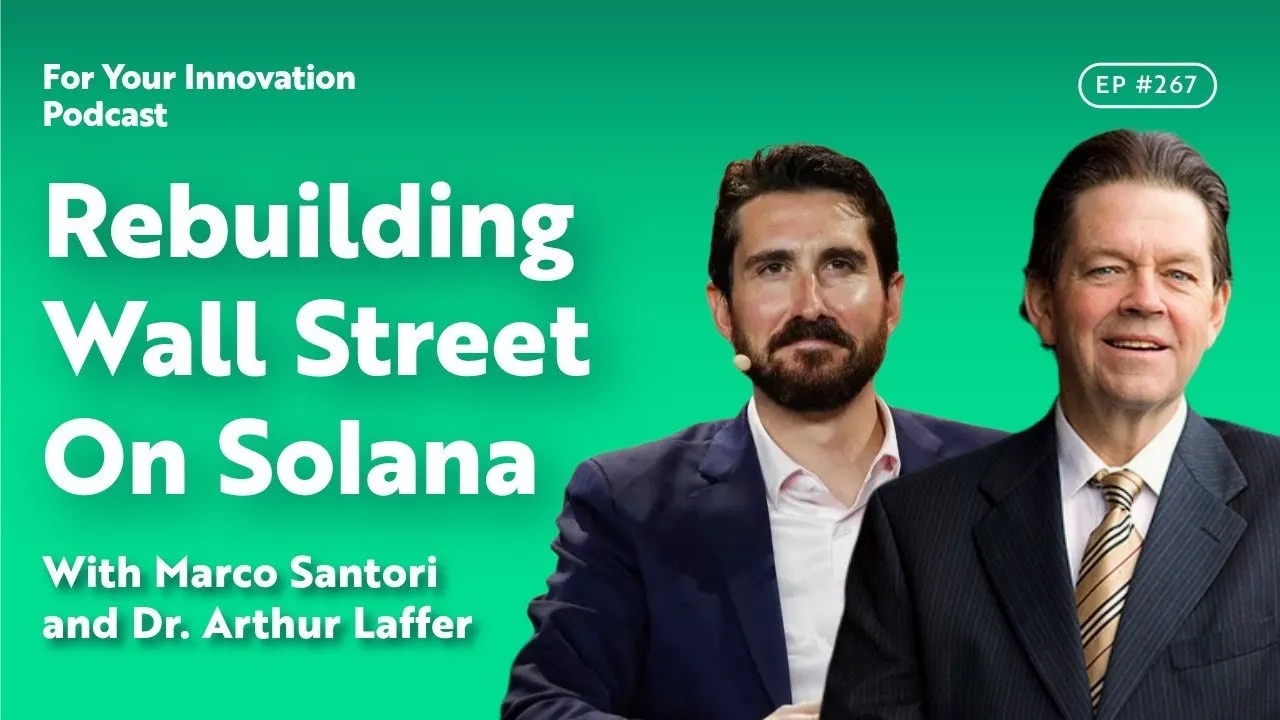
The intersection of traditional economic theory and next-generation blockchain infrastructure offers a rare glimpse into the future of global finance. In a recent discussion featuring ARK Invest’s Cathie Wood, legendary economist Dr. Arthur Laffer, and Solmate CEO Marco Santori, the conversation moved beyond typical market speculation to address fundamental structural shifts. From the evolving regulatory landscape in the United States to the rise of the Middle East as a crypto hub, the focus is shifting toward building tangible, high-performance infrastructure capable of handling the demands of a modernized Wall Street.
Key Takeaways
- The Regulatory Tide Has Turned: After years of "regulation by enforcement" driving innovation offshore, the U.S. political landscape is shifting toward a pro-innovation stance, potentially reversing the brain drain of crypto talent.
- Solana’s Infrastructure Advantage: While Ethereum prioritizes decentralization through Layer 2 scaling, Solana’s monolithic architecture offers the high throughput and low latency required to rebuild Wall Street’s trading engines at the base layer.
- The UAE as a Strategic Latency Hub: Beyond tax benefits, the UAE serves as a critical geographic bridge between Tokyo and Western financial centers, filling a void in global transaction processing speeds.
- Solmate’s Vertical Integration Strategy: Moving beyond the passive "Digital Asset Treasury" model, Solmate is merging with RockawayX to build "bare metal" infrastructure, generating operational earnings from colocation and computing rather than relying solely on token appreciation.
The U.S. Regulatory Renaissance
For the past four years, the crypto industry in the United States faced an adversarial environment that many industry leaders describe as a game of political football. Regulatory ambiguity and aggressive enforcement actions forced legitimate innovation to the periphery, driving talent and capital toward jurisdictions with clearer rules.
However, the political winds are shifting. The administration’s new stance suggests a pivot from hostility to strategic embrace, recognizing that losing financial innovation to overseas competitors poses a long-term economic risk. This "flipping of the script" is not merely about price action; it is about opening a playing field where legitimate businesses can build without fear of retroactive punishment.
The regulatory process had become so politicized... I saw so much of American innovation and potential American innovation get drained out to the periphery of the world.
This shift comes at a critical moment. Had the U.S. continued on its previous path, regions like the Middle East—specifically the UAE—were poised to permanently capture the leadership mantle in digital asset infrastructure. Now, with a renewed focus on keeping innovation onshore, the U.S. has an opportunity to reclaim its position, though the competitive pressure from forward-thinking global hubs remains fierce.
Monetary History Meets Digital Innovation
To understand the trajectory of Solana and stablecoins, one must look back at monetary history. Dr. Arthur Laffer points to 1913—the creation of the Federal Reserve—as a pivotal moment where the U.S. moved from an era of stable prices and private currencies to a century of managed inflation. Since that shift, price levels have risen approximately 33-fold, eroding purchasing power and distorting capital allocation.
Cryptocurrency, and specifically the stablecoin market, represents a private sector attempt to regain control over money. By offering an alternative to government-monopolized fiat, these assets aim to restore the price stability that characterized the pre-1913 era. The synthesis of Bitcoin (as a fixed-supply store of value) and high-performance blockchains like Solana (as the transaction layer) creates a comprehensive alternative to the legacy central banking system.
Solana vs. Ethereum: Optimizing for Wall Street
The debate between Ethereum and Solana is often framed ideologically, but from an infrastructure perspective, it is a question of trade-offs. Ethereum prioritizes extreme decentralization and censorship resistance. However, this comes at the cost of speed, necessitating complex "Layer 2" networks to handle volume. For traditional financial institutions, this fragmentation introduces latency and complexity.
Solana, conversely, optimizes for performance. By concentrating validation in high-power data centers ("bare metal"), Solana sacrifices some degree of decentralization to achieve the throughput necessary for global finance. This architecture allows all transactions—whether buying a coffee or executing a high-frequency trade—to occur on a single, synchronized global state.
The Latency Imperative
Rebuilding Wall Street requires more than just a blockchain; it requires speed. In traditional finance, high-frequency traders spend billions to shave microseconds off transaction times. Solana is the only major chain where this "payment for order flow" and high-frequency trading model can be replicated on-chain without relying on slower, centralized intermediaries.
If you want to rebuild Wall Street on a blockchain, actually I think you're going to do it on Solana, not Ethereum.
Anatoly Yakovenko, Solana’s co-founder, envisions a future where trading is not separated from daily commerce. On Solana, a consumer purchase and an arbitrage trade happen in the same block, on the same layer. This unification of liquidity and commerce is something Ethereum’s layered approach struggles to replicate efficiently.
The Middle East as a Global Crypto Nexus
While the U.S. grappled with regulatory gridlock, the UAE established itself as a "capital of capital" for the digital age. This was not accidental. Abu Dhabi and Dubai implemented technology-neutral, risk-based regulations that attracted major players, including the Solana Foundation.
The Geographic "Bridge"
There is a commonly overlooked physical advantage to the Middle East: geography. In the world of high-frequency trading, the speed of light is a hard constraint. The globe currently has massive transaction hubs in Tokyo (Asia) and New York/Frankfurt (West). There is a significant latency gap between these two poles.
By placing high-performance validators in the UAE, networks like Solana create a physical bridge. This central location reduces latency for global transactions, creating a more efficient network topology. Solmate’s deployment of bare metal validators in the region is not just a regulatory play; it is a latency arbitrage strategy designed to serve the future of 24/7 global trading.
Solmate’s Evolution: From Treasury to Infrastructure
Initially conceptualized as a Digital Asset Treasury (DAT)—a company holding Solana (SOL) on its balance sheet—Solmate has pivoted toward a vertically integrated operating model. Passive treasury management, while effective in bull markets, lacks the resilience of an operating business. The "MicroStrategy model" of using capital markets to accumulate coins is powerful, but Solmate aims to go further by generating yield through infrastructure.
Through its merger with RockawayX, Solmate is building the physical piping of the Solana network. This involves:
- Bare Metal Validators: Running proprietary hardware in data centers rather than relying on cloud providers like AWS.
- Colocation Services: Allowing traders and applications to place their servers directly next to the validator for microsecond advantages.
- RPC Services: Providing the data access points required for applications to interact with the blockchain.
We want Wall Street to see us for the earnings machine that we really are... We want to have an actual operating business that will generate cash flow.
This shift focuses on generating earnings (EBITDA) rather than just Net Asset Value (NAV) growth. By controlling the hardware, Solmate avoids the "moral hazard" of acquiring unrelated businesses just to boost revenue, instead ensuring every operational decision reinforces their core thesis: accumulating and utilizing SOL.
The Future: High-Frequency Transacting
The ultimate vision for Solana and infrastructure providers like Solmate is the evolution from high-frequency trading to "high-frequency transacting." In this paradigm, prediction markets like PolyMarket, which currently rely on hybrid off-chain models, could move entirely on-chain.
Imagine a global prediction market where millions of participants are betting on outcomes in real-time, or a supply chain where payments settle instantly upon delivery confirmation. These applications require massive throughput and stability. By establishing a validator network capable of processing millions of transactions per second—and offering colocation for the entities that need to be closest to the ledger—Solana is positioning itself as the execution layer for the next generation of the internet economy.
Conclusion
The convergence of a friendlier U.S. regulatory environment, the strategic rise of the Middle East, and the maturation of Solana’s technology creates a unique moment for investors and builders. The industry is moving away from purely speculative phases toward infrastructure build-out. Companies like Solmate are proving that the value of a blockchain lies not just in holding the token, but in owning the machinery that powers the new global financial system.