Table of Contents
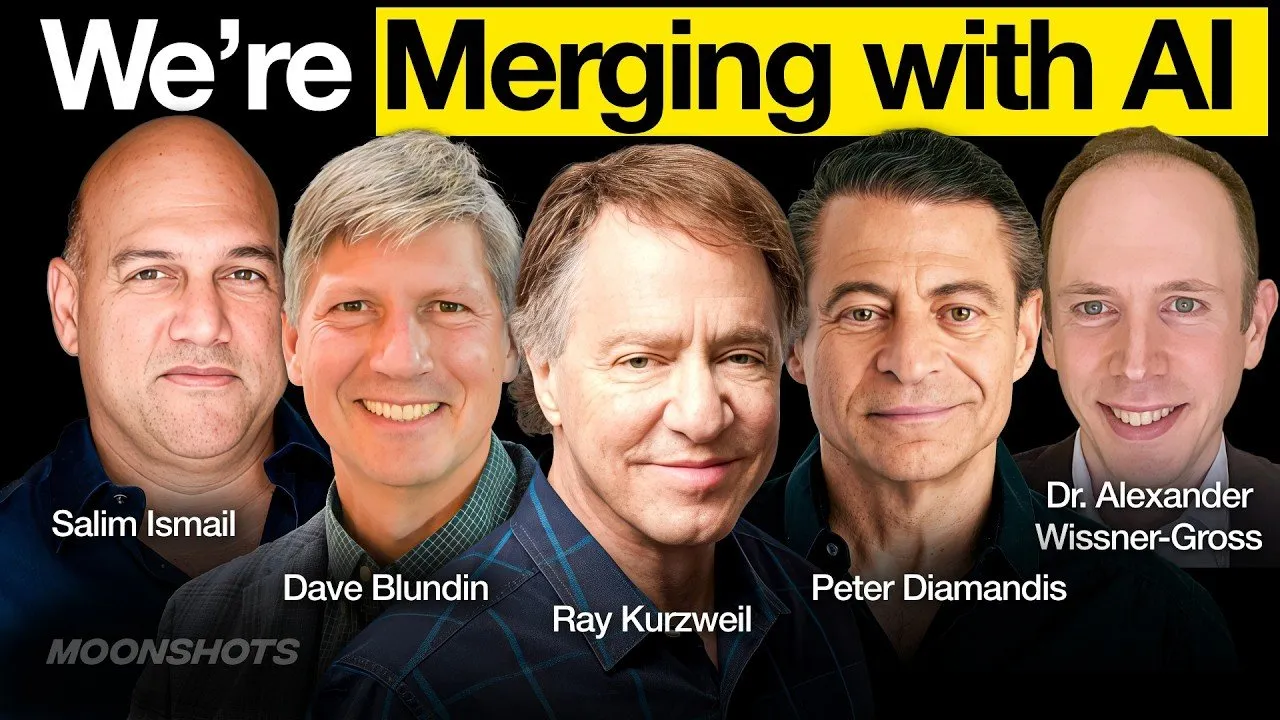
We are currently living through what may be the most transformative period in human history. For decades, the concept of the "Singularity"—a point in time when technological growth becomes uncontrollable and irreversible, resulting in unfathomable changes to human civilization—was relegated to the realm of science fiction. Today, however, the timeline is compressing. Ray Kurzweil, the renowned futurist and inventor with a startling 86% accuracy rate on his predictions over the last 30 years, suggests that we are not just approaching this horizon; we are in the midst of it.
The conversation regarding Artificial General Intelligence (AGI) has shifted from "if" to "when," and finally to "now what?" As computation accelerates and biological boundaries blur, the definitions of life, intelligence, and consciousness are being rewritten. This exploration delves into Kurzweil’s latest forecasts, the mechanics of merging with AI, and the roadmap to biological and digital immortality.
Key Takeaways
- AGI is Imminent: Kurzweil stands by his long-held prediction that we will achieve human-level Artificial General Intelligence by 2029.
- The Singularity Definition: By 2045, human intelligence will merge with non-biological intelligence, amplifying our cognitive capabilities by at least a thousandfold.
- Longevity Escape Velocity: Advances in AI-driven biological simulations could allow humans to reach "longevity escape velocity" by the early 2030s, effectively halting the aging process.
- Consciousness is Subjective: As AI becomes more sophisticated, society will likely accept synthetic consciousness simply because it will be indistinguishable from human interaction.
- Cryonics as "Plan D": While life extension is the primary goal, Kurzweil views cryonics as a last-resort insurance policy for potential future resurrection.
The Countdown: AGI by 2029 vs. The Singularity
There is often confusion regarding the distinction between achieving AGI and reaching the Singularity. Kurzweil clarifies that these are two distinct milestones on the same exponential curve. His prediction, first made in 1989, remains that humanity will achieve human-level AI by 2029. This creates a foundation for the Singularity, which he predicts for 2045.
The gap between 2029 and 2045 is the adoption and integration phase. It is the period where the "us versus them" narrative dissolves. The prevailing fear in pop culture is that AI will exist as a separate, dominant entity. Kurzweil argues the opposite: we will integrate this technology into our biology.
"It's not like we have our own intelligence, biological intelligence, and then we have AI that's over here... We're going to merge with it. It's going to be the same thing."
By 2045, this merger will be complete, allowing humans to multiply their effective intelligence a thousandfold. The boundary between biological thought and computational processing will vanish, making it impossible to distinguish whether an idea originated from your neurons or your cloud connection.
Redefining the Turing Test
For decades, the Turing Test was the benchmark for machine intelligence—could a machine fool a human in conversation? Kurzweil argues that the original test, and even the Loebner Prize, were flawed by focusing on fooling "ordinary" people. The true benchmark of AGI is not casual conversation, but expert-level competence across thousands of domains.
True AGI will possess the ability to match the best human experts in physics, art, medicine, and literature simultaneously, and then synthesize insights across those fields in a way no single biological human ever could. While critics debate whether we have passed the Turing Test, Kurzweil suggests we are already seeing the precursors of this multi-domain expertise in current Large Language Models (LLMs).
Longevity Escape Velocity: Reaching Immortality by 2032
Perhaps the most personal application of the Singularity is the quest for radical life extension. The concept of "Longevity Escape Velocity" (LEV) refers to a point where for every year you live, scientific progress extends your remaining life expectancy by more than one year. Effectively, this stops the clock on dying from age-related causes.
Kurzweil predicts we will reach this milestone around 2032. This leap will not necessarily come from microscopic nanobots repairing cells—though that is the long-term vision—but from AI's ability to simulate biology. Currently, drug discovery is a slow process of trial and error. In the immediate future, we will use massive compute power to simulate billions of biological interactions over a weekend, solving diseases like cancer and heart disease through digital modeling rather than clinical guesswork.
Cryonics as "Plan D"
Despite the optimism for LEV, death remains a statistical reality today. This brings up the controversial topic of cryonics—freezing the body (or brain) at the moment of death to be revived by future technology. Kurzweil, who has signed up for cryonics himself, views it with pragmatic caution.
"Cryonics is Plan D. Plan A, B, and C is to remain alive one way or another... Cryonics is better than not doing cryonics because at least you have some chance of coming back."
The skepticism around cryonics often stems from the difficulty of preserving the "self." However, as we move toward a world where we can map the neocortex and reconstruct memories, the physical preservation of the brain may act as a bridge to a digital future.
Digital Resurrection and the Future of Identity
Before we reach biological immortality, we will likely achieve digital immortality. We are already entering an era where high-fidelity avatars can be created from a person's digital footprint—writings, recordings, and videos. These avatars will not just be static recordings; they will be interactive, generative AI models capable of carrying on conversations in the voice and style of the original person.
Kurzweil is currently creating an avatar of himself and his late father. He notes that these digital twins will eventually possess better memories than their biological counterparts. While this raises philosophical "Ship of Theseus" questions—is the avatar really you?—society’s acceptance of these entities is accelerating. As these models become indistinguishable from human interaction, the functional difference between a conscious being and a simulation may become irrelevant.
This touches on the "Hard Problem" of consciousness. Kurzweil posits that consciousness is not a scientific attribute we can measure with a probe; it is a subjective experience. If an AI acts conscious, has complex goals, and exhibits emotional depth, society will eventually accord it the same respect and rights as a human being, simply because it will be "useless not to."
The Physics of Intelligence: Computronium and Energy
Looking further ahead, to the latter half of the 21st century, the substrate of intelligence itself will change. We are currently limited by silicon chips and biological neurons, which are relatively slow. The human brain operates on about 20 watts of power, firing heavily parallel but slow signals. To drastically increase intelligence, we need better physics.
This leads to the concept of Computronium—matter arranged in the most efficient possible configuration for computation. By the late 21st century, humanity (and its AI progeny) may begin converting matter in the solar system into this substrate, allowing for computational power that dwarfs the combined intelligence of every human who has ever lived.
Solving the Energy Equation
A common critique of AI expansion is the massive energy cost. Training models today requires gigawatts of power. However, Kurzweil suggests that future computing will utilize reversible computing paradigms. In theory, reversible computing prevents the loss of information (which manifests as heat), allowing for computation that requires near-zero energy expenditure. Combined with 3D molecular circuits, we could see a massive increase in processing power without destroying the planet's energy grid.
Conclusion
The trajectory of technological progress suggests that the next decade will witness as much change as the previous century. From the widespread acceptance of AGI by 2029 to the achievement of longevity escape velocity in the early 2030s, humanity is on the verge of a fundamental transformation.
The skepticism that once greeted Kurzweil’s predictions has largely evaporated as reality catches up to his graphs. The question is no longer whether the Singularity will happen, but how we will navigate the societal, ethical, and economic shifts it brings. As Kurzweil himself notes, despite the uncertainties, the potential for alleviating human suffering and expanding human potential makes the future a prospect to be optimistic about—a solid 10 out of 10.