Table of Contents
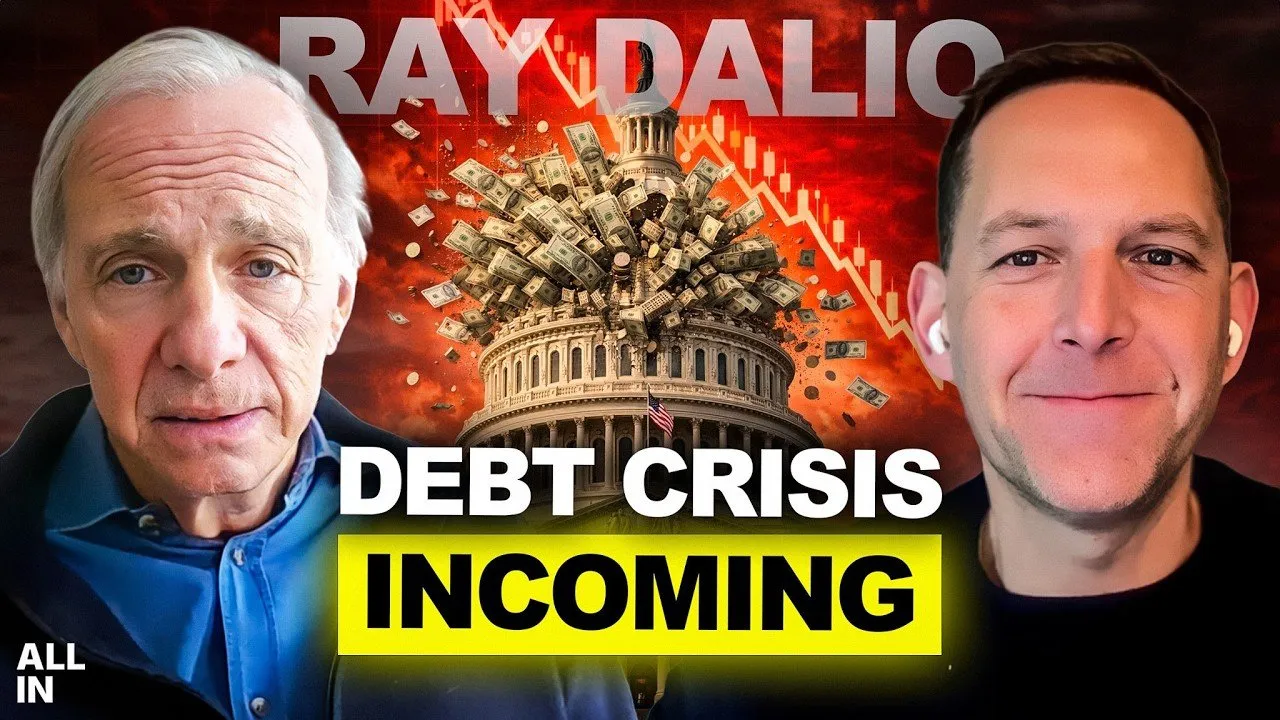
In a world characterized by rapid technological advancement and shifting geopolitical alliances, legendary investor Ray Dalio warns that we are entering a precarious chapter of history. Drawing on 500 years of data regarding the rise and fall of empires, Dalio argues that the United States is currently navigating a convergence of five historic forces: debt cycles, internal wealth and value gaps, international power conflicts, technological disruption, and environmental challenges. Understanding these cycles is no longer just an academic exercise—it is essential for anyone trying to navigate the current financial landscape.
Key Takeaways
- The Debt Cycle: The U.S. faces a $2 trillion annual deficit, compounded by the need to refinance $9 trillion in maturing debt, creating a structural "plaque" that stifles economic productivity.
- The Role of Gold: As central banks globally move away from U.S. Treasuries, gold remains the ultimate store of value and a necessary hedge, with experts suggesting a 5% to 15% portfolio allocation.
- The AI Paradox: While AI will undoubtedly revolutionize technology, investors should distinguish between the success of the technology itself and the long-term profitability of the companies building it.
- Societal Fragility: The combination of extreme wealth inequality and "irreconcilable differences" between political factions threatens the stability of the democratic system, mirroring historical precursors to civil unrest.
The Anatomy of the Debt Crisis
Dalio compares a country’s finances to those of a company or an individual, noting that the federal government is currently spending far beyond its means. With a deficit reaching roughly 6% of GDP, the U.S. is essentially running on a model that is structurally unsustainable. The danger lies in the "debt service" burden, which acts like plaque in the circulatory system of the economy.
The Sustainability Gap
When debt grows faster than the income needed to service it, spending on vital government functions gets squeezed out. Dalio notes that a deficit-to-GDP ratio of 3% is the threshold for stabilization, a mark the U.S. is currently missing by a wide margin. As foreign buyers become increasingly wary of dollar-denominated debt due to geopolitical tensions, the federal government faces a difficult choice between raising interest rates—which hurts debtors—or continuing the cycle of printing money, which devalues the currency.
The economics of a country are basically the same as the economics of a company or an individual except the government has an ability to print money.
The Strategic Turn Toward Gold
As faith in fiat currency fluctuates, gold has re-emerged as the asset of choice for central banks. Dalio clarifies that gold is not merely a speculative metal; it is the world’s oldest form of money, untethered from the promises of any single government.
Money vs. Wealth
A crucial distinction exists between wealth and money. Wealth is represented by assets like buildings and companies, but these cannot be spent directly. To spend, one must convert wealth into liquid money. In an era where central banks are prone to printing currency to solve debt crises, holding hard assets that have a physical, known limitation—like gold—provides a necessary safety net. Unlike Bitcoin, which Dalio notes remains a smaller, more volatile, and less private asset class, gold is the long-term standard for institutional stability.
The AI Bubble and Global Competition
Artificial Intelligence is eating the world, but it may also be on the verge of consuming its own profitability. Dalio draws a parallel to the tech bubble of the year 2000, noting that while the technology will undoubtedly change society for the better, the companies racing to build it may not all survive the competitive fire.
The Profit-Based Disconnect
A major risk involves the difference in economic philosophy between the United States and China. While the U.S. relies on a profit-based model that requires AI companies to generate significant returns, China has experimented with treating AI as a public utility—essentially making it free and open-source to drive national productivity. This creates a systemic risk for American firms that must compete against lower-cost, state-supported alternatives.
Navigating Societal Fissures
Dalio suggests that the biggest threat to the United States is not external, but internal. When citizens begin to prioritize their ideological causes over the survival and integrity of the system itself, democracy becomes endangered. He points to historical cycles, such as the Roman Republic, to illustrate that deep political polarization often leads to demands for strong, singular leadership to force order upon a fragmented society.
The Path to Prosperity
For a country to thrive, Dalio argues, it must adhere to three foundational pillars:
- Educating the youth to be productive and civil.
- Maintaining an orderly environment where competition is fair.
- Avoiding the trap of both civil and international conflict.
We’re in what I call stage five of a cycle. When there are bad finances combined with large wealth and values gaps and irreconcilable differences, you have this dynamic.
Conclusion
Ray Dalio’s perspective is that of a "mechanic" of the global economy. He emphasizes that the challenges we face today—debt, political infighting, and the transition to a new world order—are not new, but are instead recurring patterns in human history. While the situation is undoubtedly complex, he suggests the path forward requires a return to financial discipline and a focus on long-term productivity. As investors and citizens look ahead, the ability to read history and recognize these cycles may be the most valuable skill one can possess.