
Table of Contents
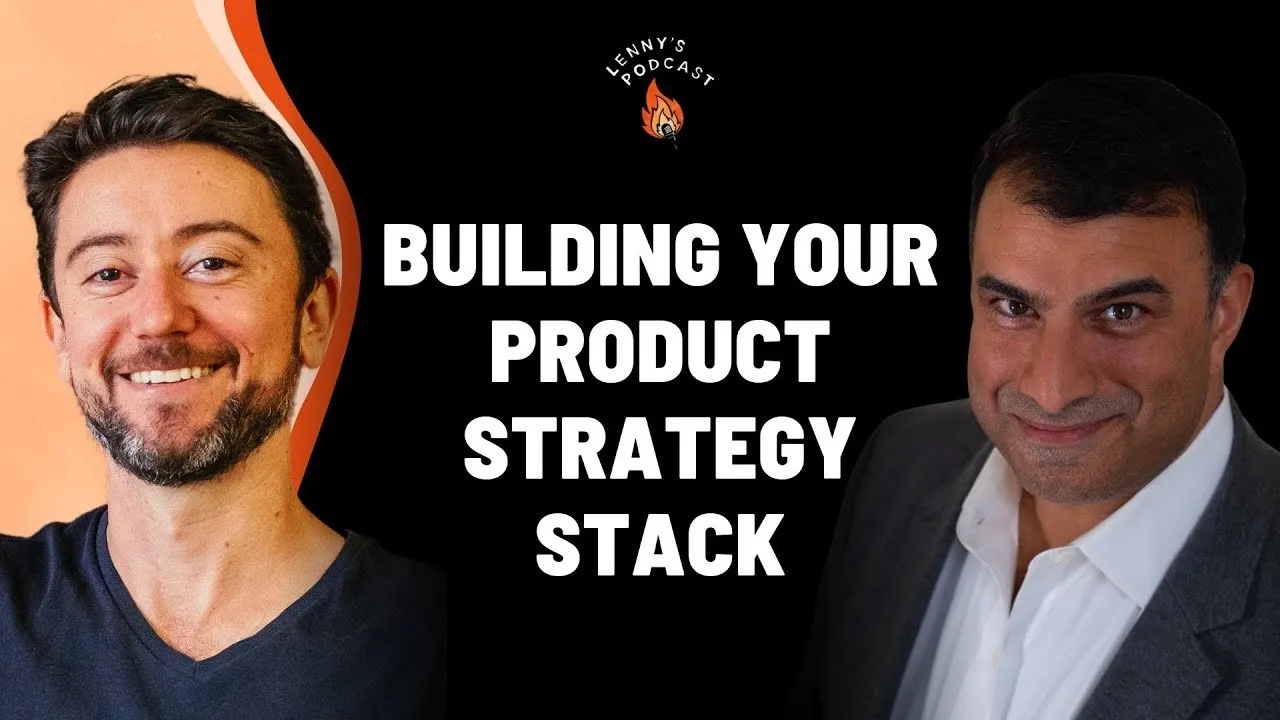
Product strategy often feels like a nebulous concept—a buzzword that every product manager wants to master but few can concrete define. When stripped of the jargon, however, strategy is the logical plan that bridges the gap between a company's aspirational mission and the day-to-day goals of a product team. Ravi Mehta, the former CPO of Tinder and product leader at Facebook and TripAdvisor, has spent his career codifying these abstract concepts into actionable frameworks.
Currently the co-founder and CEO of Outpace, Mehta helped architect the reforge product leadership programs. His approach moves beyond simple feature lists, focusing instead on the rigorous logic required to build scalable products. From the "Product Strategy Stack" to the nuances of "Selective Micromanagement," Mehta offers a blueprint for navigating the complexities of modern product leadership.
Key Takeaways
- The Product Strategy Stack: Strategy must be the connective tissue between a company’s mission and its roadmap. Goals should be the output of a strategy, not the starting point.
- Visualizing Strategy: Text-based strategy documents create ambiguity. Using wireframes and "blueprints" during the strategic phase aligns teams faster than words alone.
- Speed vs. Latency: Startups cannot compete with big tech on velocity (volume of work), but they win on latency (speed of decision-making and pivoting).
- The 12 Product Competencies: Career growth requires balancing Product Execution, Customer Insight, Product Strategy, and Influencing People.
- Selective Micromanagement: Effective leadership isn't always hands-off. Great leaders dip into the details tactically to correct course before returning to scalable autonomy.
The Product Strategy Stack
One of the most common friction points in product management is the disconnect between high-level company goals and the feature roadmap. Mehta addresses this with the Product Strategy Stack, a framework designed to deconstruct these elements into clearly defined layers. When a team struggles with prioritization—deciding between Feature A and Feature B—it usually indicates a gap in the strategy layer, not a roadmap issue.
The Components of the Stack
- Company Mission: This is the aspirational, qualitative change the company wants to bring to the world. It defines the purpose.
- Company Strategy: Unlike the mission, this must be rigorously logical. It is the specific plan the company will use to achieve its mission.
- Product Strategy: This serves as the connective tissue. It translates the company’s logical plan into a product-specific approach.
- Product Roadmap: The sequence of features and themes that execute the product strategy.
- Product Goals: The metrics used to measure the success of the roadmap and strategy.
Whereas a mission is aspirational, strategy is rigorously logical. The strategy is the logical plan that your company is going to use to bring that mission into being.
Case Study: Tinder vs. Hinge
To illustrate how strategy dictates product decisions, consider the difference between Tinder and Hinge. Both are dating apps with a similar underlying use case—helping people meet—but their strategy stacks lead to fundamentally different user experiences.
- Tinder: The mission is to make single life fun and spontaneous. The product strategy focuses on a lightweight, fast, and serendipitous experience. Consequently, Tinder historically resisted granular filters (height, religion, income) to prevent the app from becoming a "search engine for people," preserving the magic of unexpected matches.
- Hinge: The mission is "designed to be deleted." The strategy focuses on getting users into long-term relationships quickly. This drives a product strategy centered on friction—prompts, detailed profiles, and mechanics that encourage slowing down to facilitate deeper connection.
Visualizing the Strategy
A fatal flaw in many strategic planning cycles is the reliance on written documents. When a strategy is described purely in words, every stakeholder creates a different mental image of the outcome. To solve this, product leaders should treat strategy like architecture.
You would never hire an architect who refused to provide blueprints. Similarly, a product strategy is incomplete without conceptual wireframes. These do not need to be high-fidelity designs; they can be sketches or low-fidelity mockups using tools like Balsamiq. The goal is to force alignment on the "nav bar" of the strategy—identifying exactly how the strategic pillars manifest on the screen.
When you force the strategy into a visual medium, you inevitably encounter the constraints of the screen (e.g., you can only have five items on a navigation bar). This forces the team to make the hard trade-off decisions that text documents allow them to ignore.
Startup Agility: Velocity vs. Latency
There is a common misconception that startups are faster than big companies. In reality, large tech companies like Meta or Google have immense velocity—they can ship more code and deploy more resources than any startup. However, startups possess a critical advantage: low latency.
If a car is going really, really fast it can’t turn as quickly... startups have a really tight turning radius.
Latency refers to the time it takes to go from an idea to a decision or a validated learning. A startup can have a hypothesis in the morning and test it by the afternoon. Large companies, burdened by momentum and process, have high latency.
Conviction Over Experimentation
Because startups lack the massive user bases required for rapid statistical significance, they cannot rely on the same A/B testing playbooks as giants like TripAdvisor or Facebook. Trying to be overly experimental too early leads to paralysis.
Startups must shift from "data-driven" to "conviction-driven" decision-making. Founders and early PMs should gather enough data to form an informed conviction, execute, and then validate. Waiting for perfect data in an early-stage environment negates the latency advantage.
The "Frontier of Understanding" in Goal Setting
The industry obsession with "Outcomes over Outputs" often leads teams to set goals they have no realistic way of achieving. Setting a goal to "increase retention by 5%" is useless if the team does not understand the levers that drive retention.
Mehta proposes a framework for goal setting based on the team's Frontier of Understanding. Goals should match the team's current knowledge state:
- Understanding Risk: If you don't know the levers, the goal should be to gain insight (e.g., "Identify the top three drivers of churn").
- Dependency Risk: If you know the levers but lack the tools, the goal is to build the infrastructure.
- Execution Risk: If you have the tools and the knowledge, the goal is to execute a set volume of experiments or features.
- Strategic Risk: Only when the previous steps are solved should you set a hard metric outcome goal.
Forcing an outcome goal when a team is still facing "understanding risk" results in "throwing spaghetti at the wall"—random activity with no strategic learning.
The 12 Product Competencies
To professionalize the growth of product managers, Mehta developed a competency framework at TripAdvisor that has since been adopted by many organizations. It breaks the role down into four key areas:
1. Product Execution
This is the baseline. Can the PM work with a team to ship quality software? It includes functional specification (PRDs), delivery management, and ensuring product quality (QA and UX polish).
2. Customer Insight
This pillar focuses on empathy and data. It requires fluency with data (SQL, analytics), owning the voice of the customer (qualitative research), and user experience design (interaction design capabilities).
3. Product Strategy
Moving beyond shipping, this involves owning business outcomes, roadmapping (sequencing for impact), and ensuring strategic alignment with the broader company mission.
4. Influencing People
The soft skills required to lead without authority. This covers stakeholder management, team leadership (mentoring), and managing up to senior leadership.
Exponential Feedback
Using this framework allows managers to move from symptom-based feedback to root-cause feedback. Instead of telling a PM, "This project is late," a manager can use the framework to identify that the PM struggles with "Stakeholder Inclusion," causing late-stage misalignment. addressing the root competency leads to exponential growth rather than temporary fixes.
Leadership and Selective Micromanagement
New leaders often oscillate between two failure modes: trying to be "one of the team" (refusing to direct) or being completely hands-off to avoid the stigma of micromanagement. Mehta argues that "hands-off" leadership often becomes "micro-mismanagement," where a lack of guidance leads to a team drifting off course, necessitating a painful, sudden correction later.
The ideal state is Scalable Leadership, where the team has autonomy and the leader has confidence. However, when confidence dips, the correct response is Selective Micromanagement.
The right answer is not to be hands off and to let them go in that wrong direction. The right answer is to micromanage but do it in a very tactical, in a very temporary way... so that you can then pull back.
Leaders should view micromanagement not as a character flaw, but as a temporary tool. If a team is misaligned, the leader must dive deep into the details—even rewriting copy or adjusting pixels—to reset the trajectory. Once the team understands the standard and the direction, the leader must retreat back to a scalable, autonomous mode.
Conclusion
Product management is maturing from a generalist role into a disciplined profession with specific frameworks and competencies. Whether it is distinguishing between the speed of a startup and the velocity of a corporation, or understanding that a roadmap is useless without a rigorous strategy behind it, success lies in the logic and structure applied to decision-making.
By visualizing strategy, diagnosing the team's frontier of understanding, and applying selective leadership pressure, product leaders can move their teams from simply shipping features to driving genuine business impact.



)