Table of Contents
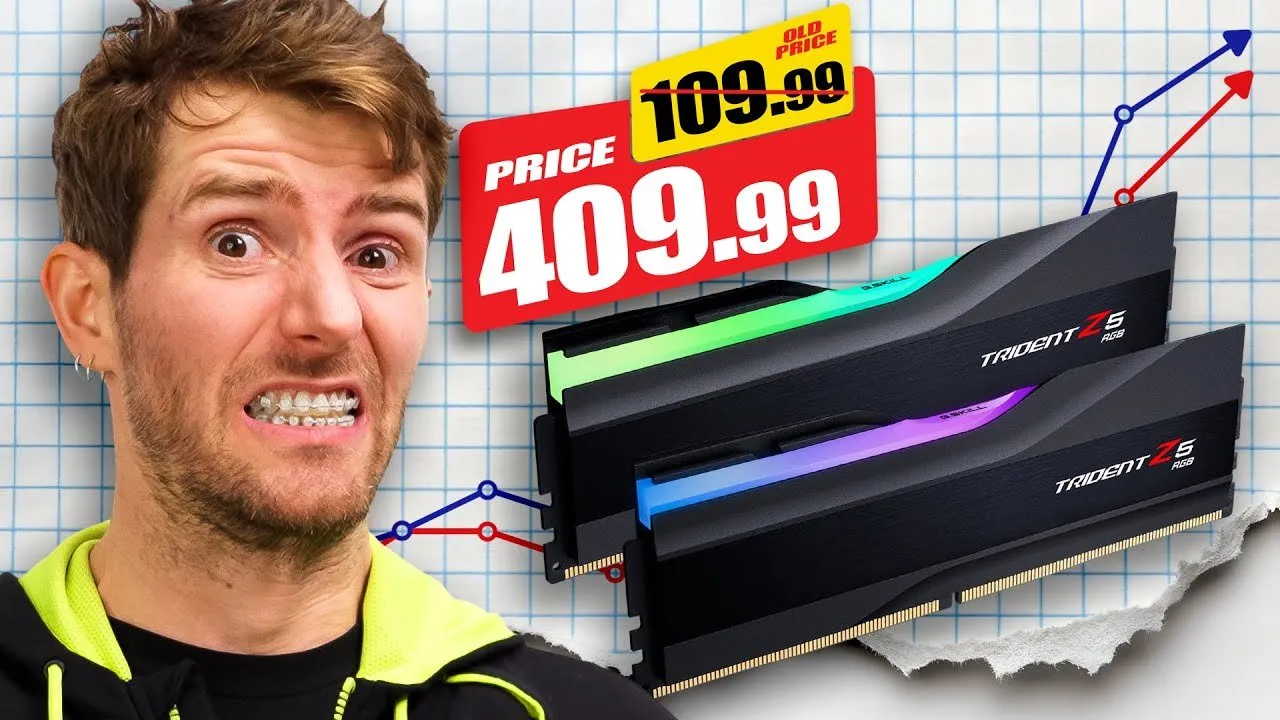
RAM prices have surged dramatically in recent months, with consumers facing costs up to $800 for memory modules that previously sold for half that amount. The primary driver behind this unprecedented increase is the explosive demand from AI companies like OpenAI and tech giants building data centers to support large language models, creating a supply shortage that industry experts warn will persist through 2026.
Key Points
- Micron Technology completely discontinued its consumer RAM line to focus on AI demand, while SK Hynix announced production is sold out through 2026
- Samsung doubled its contract pricing by 100% as AI companies outbid individual consumers for limited chip supply
- Only three major manufacturers—SK Hynix, Samsung, and Micron—control global DRAM chip production, creating a supply bottleneck
- Building new fabrication facilities takes years and costs billions, with manufacturers reluctant to invest due to concerns about AI demand sustainability
- Chinese manufacturer CXMT offers potential relief but remains 2-3 years away from meaningful production capacity
AI's Insatiable Memory Appetite
Large language models like ChatGPT, DeepSeek, and Gemini require massive amounts of RAM for both training and inference operations. During training, these models process enormous datasets of text, images, video, and audio files over periods ranging from hours to months for the largest models.
RAM's superior speed compared to SSDs and greater capacity than CPU cache makes it essential for AI data centers. For inference—when users interact with trained models—more RAM enables faster access to conversation context, improving response quality during extended interactions.
Companies generating billions in AI revenue and funding can afford to pay premium prices for memory, creating an environment where individual consumers cannot compete with corporate budgets.
Supply Chain Stranglehold
While dozens of manufacturers assemble RAM modules, the actual DRAM chips come from just three companies: SK Hynix, Samsung, and Micron. These giants operate multi-billion dollar fabrication facilities that supply virtually every industry requiring processors.
This oligopoly means gaming RAM and server memory ultimately compete for the same finite chip supply. Micron's decision to pivot away from consumer markets through its Crucial brand exemplifies how manufacturers are prioritizing their wealthiest customers.
The same factors that make it hard to ramp up production at a moment's notice also make it challenging to slow it down at a moment's notice.
Current fabrication facilities already operate at maximum capacity with round-the-clock production overseen by highly trained engineers. Boosting output isn't simply a matter of adding shifts or "turning machines up to 200%" due to the delicate nature of chip manufacturing processes.
Historical Context and Corporate Caution
DRAM demand previously spiked during the mid-2010s when affordable cellular plans launched in India alongside surging mobile device adoption. Manufacturers increased production to meet that demand, but when it eventually subsided, they faced costly overstock situations that sometimes forced below-cost selling.
Both SK Hynix and Samsung have publicly stated they won't boost production for the current surge, having learned from past boom-bust cycles. This conservative approach protects profit margins but exacerbates current shortages.
Limited Relief on the Horizon
Building new semiconductor fabrication facilities requires years of planning and construction, plus billions in investment. Beyond the physical structures, companies must secure seismic activity mitigation, water and power access, staffing, logistics, and supplies of specialized chemicals and high-purity silicon wafers.
Chinese manufacturer CXMT recently announced DDR5 chip manufacturing capability, potentially offering relief from the "big three" oligopoly. However, the company remains approximately 2-3 years away from reaching production volumes that could meaningfully impact global supply.
Trade tensions between the US and China may also limit CXMT's ability to serve American markets, even once production scales up.
The Bubble Concern
Industry observers expect the AI investment bubble will eventually correct, but manufacturers remain hesitant to build expensive facilities that might become unnecessary by completion. No major player wants to invest billions in capacity that won't generate returns if AI demand normalizes.
Even when the bubble does correct, SK Hynix's sold-out production through 2026 means contracted prices will remain elevated. Memory module manufacturers like Kingston or Corsair will continue paying premium chip prices and passing costs to consumers.
The shortage extends beyond gaming RAM to affect all memory-dependent devices: smartphones, automotive systems, smartwatches, and countless other products. As the industry waits for supply-demand balance to restore, consumers face continued elevated prices across the technology ecosystem, with meaningful relief unlikely before 2027.