Table of Contents
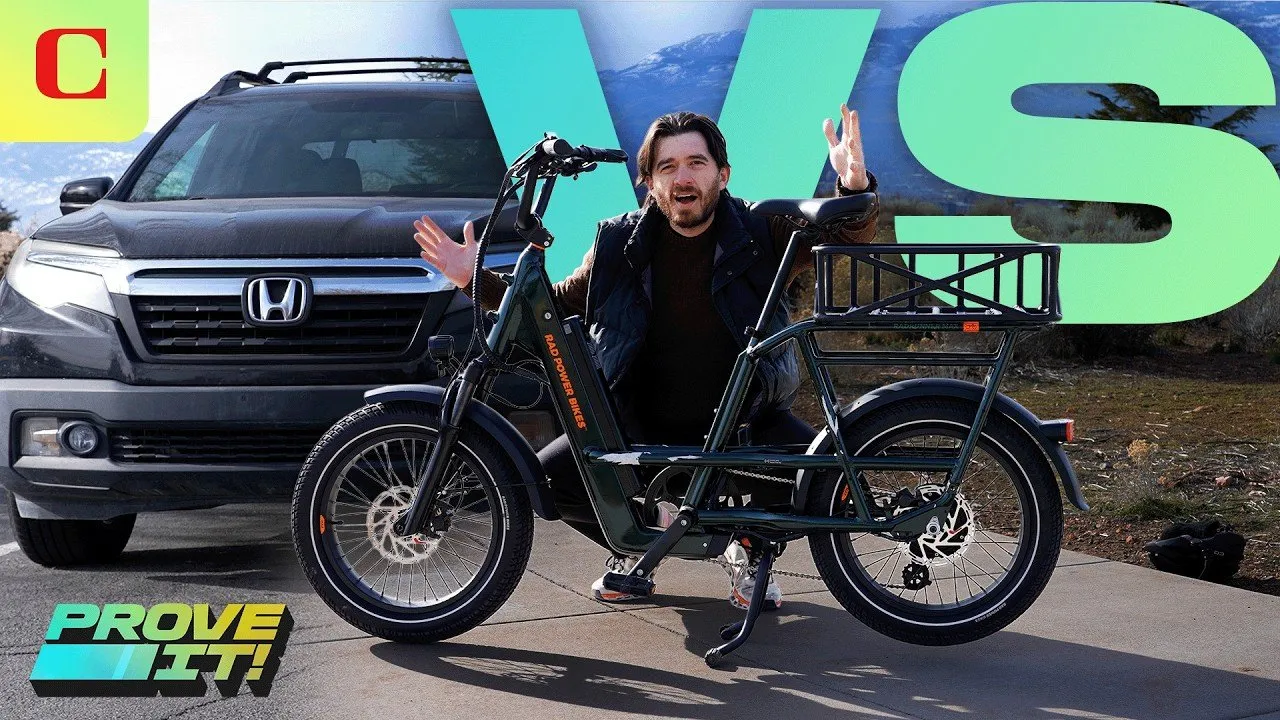
In a direct challenge to traditional urban transport, a comprehensive field test of the RadRunner Max has demonstrated that electric cargo bikes can successfully outperform automobiles in city commuting while handling substantial payloads. The test, conducted by the Prove It series, revealed that the e-bike was not only capable of hauling heavy goods but completed a standard three-mile commute over a minute faster than a passenger vehicle.
Key Takeaways
- Speed Advantage: The e-bike completed a 3-mile urban commute in 9 minutes and 17 seconds, beating a car on the same route by over a minute.
- Heavy Hauling: With a total payload capacity of 420 pounds, the bike successfully transported bulky items, including a 60-pound mattress topper.
- Advanced Safety: The unit features rear-facing radar technology to warn riders of approaching vehicles, alongside integrated turn signals and hydraulic brakes.
- Performance on Grade: Despite weighing approximately 80 pounds, the bike's pedal-assist system conquered steep inclines with minimal physical exertion from the rider.
Urban Efficiency and Speed
The core of the assessment focused on a direct time trial between the RadRunner Max and a Honda Ridgeline over a three-mile distance. While automobiles are often presumed faster, the e-bike leveraged its agility to navigate urban infrastructure more efficiently. The bike clocked a travel time of 9 minutes and 17 seconds, compared to the vehicle's 10 minutes and 28 seconds.
The test highlighted that while the e-bike caps its speed at approximately 28 mph, it avoids the typical delays associated with traffic congestion and stop-start vehicle patterns. The reviewer noted that adhering to traffic laws did not hinder the bike's ability to outpace the car in a city environment.
"Taking that exact same drive by car took ten minutes and 28 seconds, which is over a full minute faster on the bike, which is pretty remarkable. But considering having to wait for pedestrians and red lights, I think it actually makes quite a bit of sense."
Power and Cargo Capabilities
The "cargo" designation in the e-bike market implies a utility that extends beyond simple transportation. The RadRunner Max features a total weight limit of 420 pounds. During the evaluation, the bike was tested with various loads, including a full run of groceries and a queen-sized mattress topper weighing roughly 60 pounds. The reviewer reported that the ride remained stable and the load was barely perceptible during transit.
A critical component of the bike's utility is its pedal-assist system, which offers five distinct levels of power. This feature proved essential for hill climbing. When facing a steep incline, the system allowed the rider to maintain momentum without significant physical strain, draining only 10% of the battery during the strenuous segment.
"I'm pretty much feels like I'm riding on any flat surface at level five... Since this is a cargo bike, is designed to carry very heavy loads. So this bike weighs something like 80 pounds. Which would be almost impossible to ride around normally without the battery power."
Safety Technology Integration
Addressing common concerns regarding two-wheeled commuting, the manufacturer has integrated safety features typically found in the automotive sector. The standout feature is a rear-facing radar system that detects vehicles approaching from behind, providing the rider with visual warnings during lane changes or turns.
The bike also includes standard safety equipment such as robust front and rear hydraulic disc brakes, built-in lighting systems that run off the main battery, and turn signals accessible via a handlebar control panel. Security measures have also been digitized; the battery locks via key, and the bike's electronics can be disabled via a user-set security code.
Limitations and Market Outlook
While the test confirmed the e-bike could replace a car for daily commuting and errands, limitations remain for specific use cases. The reviewer noted that transporting large pets proved unfeasible compared to a standard vehicle, and the range—approximately 40 to 60 miles per charge—restricts the bike's utility for long-distance travel.
However, the economic and environmental implications are clear. The shift to an e-cargo bike significantly reduced gas consumption and vehicle wear and tear during the test period. As battery technology improves and urban infrastructure evolves to better accommodate micro-mobility, high-capacity e-bikes like the RadRunner Max are positioned to capture a larger share of the commuter market, offering a viable alternative to multi-ton vehicles for short-range logistics.