Table of Contents
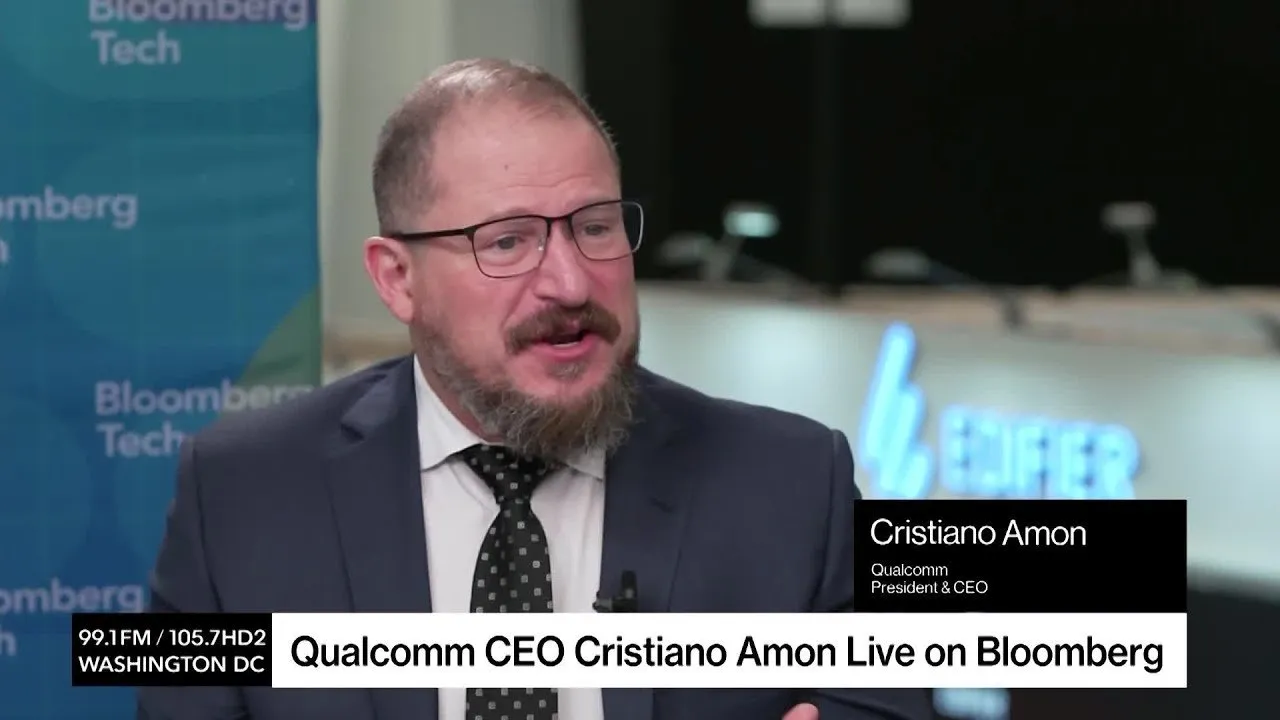
Qualcomm CEO Cristiano Amon outlined a bullish strategy for the semiconductor giant at CES, identifying robotics as the company's "next big wave" of diversification while reaffirming its dominance in the automotive and wearable sectors. Speaking from the trade show floor, Amon detailed how the chipmaker intends to leverage its legacy in low-power, high-performance mobile computing to power the next generation of physical artificial intelligence and autonomous machines.
Key Points
- Robotics Expansion: Amon positions robotics as the natural successor to Qualcomm’s expansion into automotive and PCs, predicting industrial adoption to scale by 2026.
- Automotive Growth: The company’s digital cockpit technology is now deployed in 75 million vehicles, with a strategic focus on assisted driving over immediate full autonomy.
- New Mobile Platforms: Wearables, such as smart glasses and rings, are described as the evolution of the mobile platform, designed to host always-on AI agents.
- Market Outlook: While acknowledging short-term saturation in AI investment, Amon argues the technology remains "under-hyped" regarding its long-term economic impact.
The Shift to Physical AI and Robotics
Following its expansion from mobile into automotive, PCs, and data centers, Qualcomm is now targeting robotics as a critical growth engine. Amon argues that robotics is fundamentally an "edge AI" problem—processing data locally on the device rather than in the cloud—which aligns with Qualcomm’s architectural strengths.
The company is currently collaborating with major industrial partners, including German manufacturer Kuka, to deploy these solutions. According to Amon, the constraints of robotics make them an ideal fit for mobile-derived silicon.
"You cannot put a server in a robot. You need that battery life, you need a lot of integration of sensors. And physical AI is a massive opportunity... It's perfect for you to have high performance computing and low power."
While consumer-facing "home robots" remain a longer-term goal, Amon emphasized that the enterprise sector will lead the transition. He predicts that industrial robotics will begin seeing significant implementation as early as 2026, citing specific use cases such as retail inventory robots stocking shelves overnight.
Automotive Strategy: Digital Cockpits and Autonomy
The automotive sector remains a primary revenue driver for Qualcomm. Amon revealed that 75 million cars on the road now utilize the Qualcomm digital cockpit, which he describes as a "new computing surface" akin to a phone or laptop. The company is currently designing systems with virtually every major original equipment manufacturer (OEM).
Regarding the competitive landscape of autonomous driving, Amon drew a distinction between immediate full autonomy (Robotaxis) and the mass adoption of assisted driving. Qualcomm’s strategy focuses on delivering Level 2 and Level 3 assisted driving capabilities to every car model to enhance safety, rather than betting solely on fully autonomous fleets.
Amon also addressed the competitive pressure from Tesla and NVIDIA. He acknowledged Tesla’s current leadership position, attributing it to their accumulation of real-world data.
"I think Tesla is probably ahead... One of the advantages of Tesla is they have been doing this for longer, so they have a lot of miles of real world miles, not only simulation, to perfect their solution. But it's going to happen. It's going to be a reality of many car companies in the next few years."
Wearables as the New Mobile Platform
Looking beyond traditional hardware, Amon identified wearables as the next frontier for personal computing. He suggested that while smartphones will remain essential, devices like smart glasses, pendants, and rings will serve as the primary host for AI agents. These "always-on" devices require the specific balance of form factor, battery life, and connectivity that Qualcomm provides.
"Humans already decided what they're going to wear," Amon stated, noting that integrating AI agents into jewelry and eyewear provides natural, context-aware assistance. He confirmed that every major company developing such devices is currently designing with Qualcomm chips.
Market Outlook: Hype vs. Reality
Addressing concerns from analysts that the artificial intelligence sector may be forming a bubble, Amon offered a pragmatic view. He conceded that there is likely overinvestment in the short term as companies race to build capacity, noting that "everybody's playing to win," though not everyone will.
However, drawing a parallel to the Dot-com era, Amon insisted that the long-term utility of AI is actually underestimated.
"In the long run, I still believe it's under hype... The Internet in the year 2000 was probably overhyped, but in the year 2000 [what] people thought the Internet will be... today [it] is much bigger than what they thought it would be. And I think it is going to be the same thing."
As the company moves forward, Qualcomm plans to leverage these diverse sectors—automotive, industrial robotics, and next-gen wearables—to reduce its historical reliance on the smartphone market, betting that the future of computing will be distributed, physical, and powered by edge AI.