Table of Contents
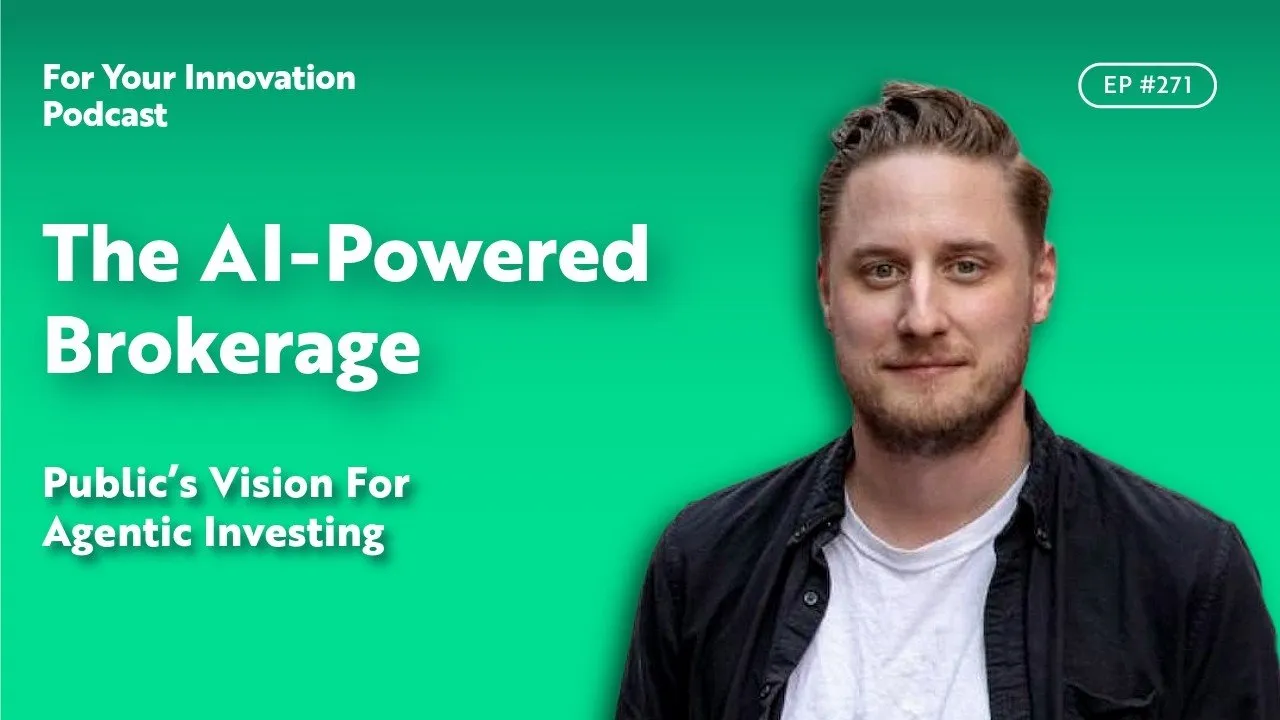
The traditional brokerage model is undergoing a radical transformation. For decades, the industry was defined by high fees, manual execution, and a strict barrier between the wealthy and the middle class. Today, the "digital wallet" is being redefined. As younger investors enter the market earlier than ever, the brokerage has emerged as the anchor product—a central hub that allows financial platforms to layer on increasingly sophisticated services. In a recent episode of the FYI podcast, ARK Invest’s Brett Winton and Nick Grous sat down with Leif Abraham, co-CEO and co-founder of Public, to discuss the platform's vision for an agentic, AI-powered future of investing.
Key Takeaways
- Targeting the Top Quartile: Public focuses on the top 25% of earners who have the capital to compound wealth, rather than the "churn-and-burn" speculative models of some competitors.
- The Rise of Agentic Investing: AI is moving beyond information retrieval to execution, with autonomous agents capable of managing money movements, trading strategies, and complex portfolio rebalancing.
- Internal Productivity Gains: AI has become a massive internal multiplier for Public, tripling engineering productivity and automating creative production for marketing.
- The End of the Traditional Advisor? AI is positioned to handle the three pillars of financial advice: grunt work (tax-loss harvesting), strategic insight (data-driven opinions), and eventually, emotional support.
- Strategic Differentiation: While some platforms lean into sports betting to monetize lower-income tiers, Public is doubling down on high-trust instruments like "Generated Assets" and private markets.
Designing for the Top-Quartile Investor
Public’s strategic positioning is rooted in the reality of a "K-shaped" economy. While a significant portion of the population lives paycheck to paycheck, the top 25% of earners—those typically making over $100,000—control the vast majority of investable capital. This demographic is also slated to inherit 85% of the $100 trillion "great wealth transfer" currently underway.
Leif Abraham notes that this focus dictates every product decision, from UI design to customer service. By prioritizing long-term lifetime value over short-term transaction fees, Public aims to be the "serious financial service" that users trust with their life savings. Notably, this contrasts with "active trader" platforms that may spend hundreds of millions of dollars annually just to replace churned users. For Public, the goal is to build a platform where users compound wealth indefinitely, moving from self-directed stock picking into managed strategies and diverse asset classes.
The Evolution of Agentic Investing
The most provocative shift discussed is the move toward "agentic" investing. This goes beyond a simple chatbot answering questions; it involves AI "agents" that can autonomously execute complex financial tasks based on user-defined criteria. One of Public's flagship features in this space is Generated Assets.
From Search to Autonomous Execution
Generated Assets allow a user to prompt their way into a custom financial product. For example, a user can request a portfolio of "founder-led companies with 30% year-over-year growth and no debt." A "swarm of agents" then scans the market, backtests the strategy, weights the assets, and creates a investable index. This lowers the friction between an investment thesis and its execution, effectively giving retail investors the tools previously reserved for family offices.
Smarter Limit Orders
Abraham describes the upcoming rollout of autonomous agents that can run sophisticated workflows, such as:
- Money Movements: Moving excess cash from a checking account into specific positions only when certain technical indicators (like a 200-day moving average) are met.
- Trading Strategies: Executing "buy the close, sell the open" strategies or managing covered call income automatically.
- Intelligent Alerts: Monitoring tax lots to suggest selling specific shares for a down payment while avoiding long-term capital gains hits.
"The distance from 'I have a thought' to 'it executes as a strategy' just becomes much more condensed."
Internal AI Productivity: The "Mac Mini" Strategy
Beyond customer-facing features, Public is aggressively adopting AI internally. Abraham reveals that engineering productivity has tripled in some areas. The company is even experimenting with having agents take product manager tickets, locate the bug in the code, write the fix, and leave it for a human engineer to review and merge.
The demand for compute is so high that Public has resorted to repurposing old hardware. Abraham mentioned that their engineers are setting up old Mac Minis and former employee computers as local servers to run agents more cost-effectively than using cloud providers for 24/7 workloads. This hands-on approach extends to marketing, where the company's recent television spots were produced entirely in-house using AI-generated voiceovers, music, and imagery.
Replacing the Financial Advisor
A central theme of the discussion was whether AI can—or should—replace human financial advisors. Abraham breaks down the advisor's role into three distinct components: grunt work, advice, and emotional support.
Automating the Three Pillars
- Grunt Work: Tasks like tax-loss harvesting and rebalancing are already being automated through agentic workflows.
- Advice: While trickier due to the subjective nature of "good" advice, AI is increasingly capable of forming data-driven opinions based on research and market movements.
- Emotional Support: This is often considered the "human" moat. However, Abraham argues that humans may be "emotionally simpler" than we think. As users build trust with AI through successful execution, the emotional bond with a digital "wealth manager" may strengthen, particularly when the AI can provide instant, data-backed reassurance during market volatility.
The Future of Market Liquidity and Prediction Markets
Public’s roadmap also includes expanding the types of assets users can trade. Abraham views blockchain and stablecoins not just as speculative assets, but as the "underplumings" that could unify disparate liquidity pools for private credit, art, and royalties. By using tokens as a unified wrapper, multiple brokerages could tap into a single, massive liquidity pool for private assets.
When asked about the burgeoning field of prediction markets, Abraham expressed a cautious but optimistic view. While he sees the value in "event contracts"—such as betting on FOMC meetings or political outcomes—he is critical of platforms that lean into sports betting. Critics argue that mixing sports gambling with retirement accounts could erode the credibility of the platform. Instead, Public envisions "decomposing" large conglomerates into specific event-based trades—allowing an investor to bet specifically on the success of a project like Tesla's Optimus, separate from the core automotive business.
Conclusion: The Platform Shift
The brokerage of the future will not be a static interface for buying and selling shares. It will be a proactive, intelligent agent that understands a user's entire financial life. For Public, the path forward involves deepening the "lock-in" not through fees, but through the creation of highly personalized, automated investment workflows that cannot be easily replicated elsewhere.
As AI continues to lower the cost of expert guidance, the "family office" experience is becoming democratized for the middle class. Whether it is through the autonomous movement of money or the AI-driven construction of bespoke indices, the goal remains the same: maximizing the compounding rate of capital for a new generation of digital natives.