Table of Contents
In the world of professional trading, the difference between spinning your wheels and scaling your account often comes down to a single, overlooked skill: the ability to grade your setups. Many traders fall into the trap of treating every setup as equal, applying the same risk and psychological energy to a common intraday move as they do to a rare, high-probability event. However, top proprietary trading desks operate differently. They understand that some windows of opportunity—like parabolic blowoffs in commodities or specific earnings catalysts—offer such overwhelming edge that being conservative becomes the biggest risk of all. Conversely, the "normal" trades require strict quality control to prevent capital leakage. Mastering this grading process isn't just a part of the strategy; for sustainable success, it is the whole game.
Key Takeaways
- Grading is essential for scaling: You cannot treat an "A+" setup the same as a "B" setup. Your risk allocation must slide on a scale based on the quality of the edge.
- The danger of "B" trades: While "A+" trades drive massive P&L growth, "B" trades are often the source of account leaks. They are common, tempting, but statistically less profitable.
- Psychological compartmentalization: Successful traders often adopt different "personas" depending on the grade—an aggressive "A+ Trader" for high-conviction plays and a defensive "B Trader" for standard setups.
- Risk percentages, not dollars: To scale effectively without psychological friction, risk should be calculated as a percentage of a daily limit, not an arbitrary dollar amount.
- Trading freely: When an A+ setup aligns, the goal is "full expression" of the trade. Seeking a singular "perfect" entry can lead to paralysis; instead, traders should attack the opportunity from multiple angles.
The Mechanics of Trade Grading
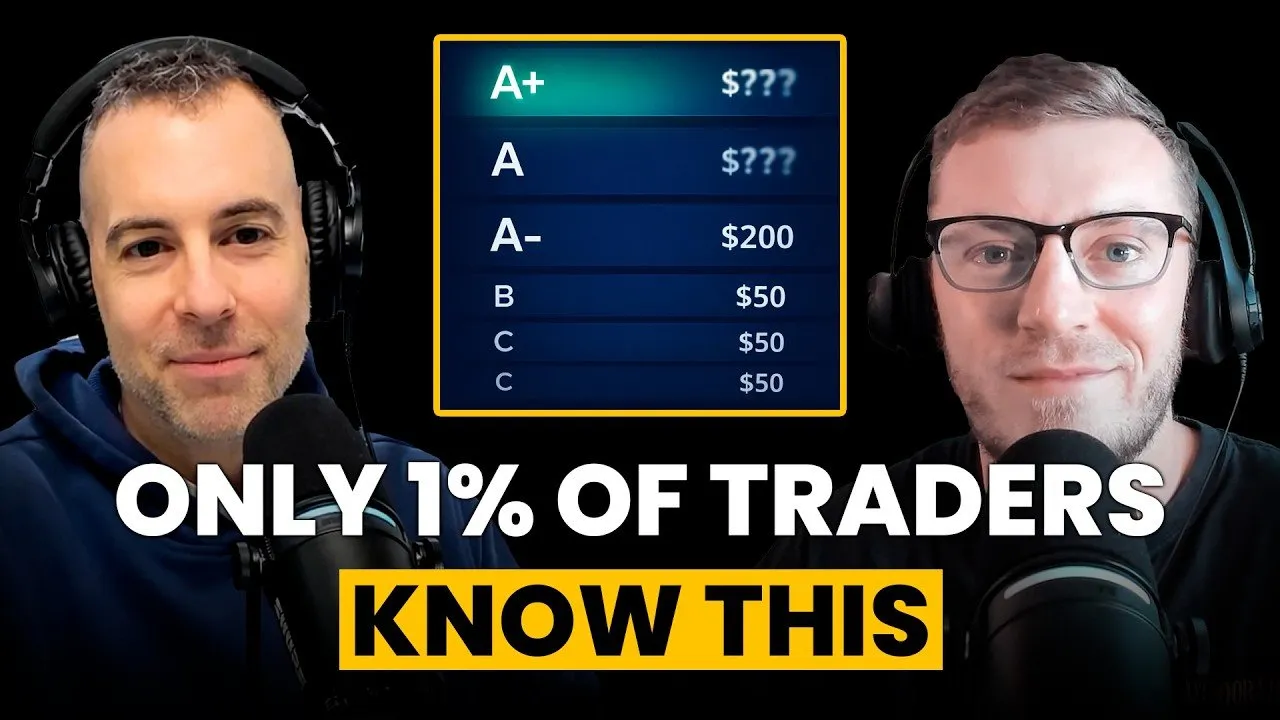
Most retail traders view trading as a binary choice: to take the trade or to pass. While passing is a valid decision—effectively a trade with zero risk—professional consistency requires a more nuanced spectrum. Between the "pass" and the "maximum aggression" lies the gradient where most trading occurs. This involves categorizing setups into specific grades—A+, A, A-, B, and C—and adjusting behavior accordingly.
The core philosophy here is quality control. An A+ trade is a rare alignment of variables—technical, fundamental, and environmental—where the checks in favor are so strong that the edge is undeniable. These are the "Trade of the Quarter" opportunities. On the other end, a "C" trade might be experimental, used solely for gathering data on a new strategy with minimal risk.
"The most undertalked about part of trading is the value of grading your setups correctly. In fact, I'd argue it's the whole game."
The Risk Matrix
Once a trade is graded, the risk allocation should follow a logarithmic curve rather than a linear one. If a trader has a maximum daily risk limit (e.g., $1,000), they should not risk that full amount on every trade. A structured approach might look like this:
- A+ (Rare Outlier): 80-100% of max risk.
- A (Trade of the Month): 40% of max risk.
- A- (High Quality/Weekly): 20% of max risk.
- B (Common/Filler): 5-10% of max risk.
This system allows for growth. When a trader is performing well and wants to size up, they don't need to change their strategy or "press" harder. They simply raise their daily max risk limit. The percentages remain the same, keeping the psychology stable even as the dollar amounts increase.
The Trap of the "B" Trade
While everyone wants to trade the A+ setups, they simply do not appear every day. The reality of the market is that traders are bombarded with "B" trades—common setups that look decent but lack a special edge. These are often referred to as "situational filler."
The danger lies in frequency. Because B trades are abundant, it is easy to overtrade them. A trader might have a high win rate on their A setups, but if they take too many B trades with mediocre expectancy, those losses act as leaks that drain the profits generated by the best ideas.
"Passing on a trade is a trade in itself. It’s easy to take every trade; you just take some with zero risk."
To combat this, many professional traders place a hard cap on the number of B trades they are allowed to take per month. This forces selectivity. If you treat a B trade with the same aggression as an A trade—perhaps due to boredom or the compulsion to grow—you risk significant drawdown on setups that never justified the exposure in the first place.
The "Multiple Personalities" Approach
One of the most effective psychological tactics for implementing a grading system is to view yourself as different traders depending on the setup. You are not just one person pushing buttons; you are a rotation of specialists.
The A+ Trader
When an A+ opportunity presents itself—such as a parabolic blowoff in gold or a massive earnings surprise in a tech stock—the "A+ Trader" takes the seat. This persona is aggressive and resilient. They are willing to take multiple stabs at the trade, use wider stops to accommodate volatility, and express the trade through various instruments (equity, options, etc.). The A+ Trader knows that being conservative is the biggest risk because the opportunity cost of missing the move is massive.
The B Trader
Conversely, when the market offers standard, run-of-the-mill setups, the "B Trader" is in charge. This persona is defensive. Their primary goal is capital preservation. They do not fire off orders in pre-market price discovery; they wait for confirmation. If the trade doesn't work immediately, they cut it. The B Trader is often the one with the worst statistics, and therefore, must be kept on a very short leash.
"It’s really not just me as one person. Each of these grades are different traders... The B trader would have been fired a long time ago."
By compartmentalizing these roles, you avoid the cognitive dissonance of trying to apply a "one-size-fits-all" mindset to a dynamic market.
Execution: Playing Tight and Trading Freely
There is a strong parallel between professional poker and graded trading. The objective in poker is to "play tight"—folding weak hands (B and C trades) so you have the chips available when you are dealt pocket Aces (A+ trades).
Avoiding "Perfect Entry" Paralysis
A common pitfall when identifying an A+ setup is the pressure to nail the perfect entry. Traders often freeze, waiting for the exact tick to deploy their maximum risk. However, because the edge in an A+ trade is so overwhelming, the exact entry price is often less important than simply being involved.
Instead of obsessing over a sniper-like entry, the goal should be "full expression" of the trade. This means:
- Trading Freely: Allowing yourself to probe the market with smaller size initially.
- Building into Strength: Adding to the position as the thesis confirms, rather than going "all in" at a blind spot.
- Accepting Imperfection: Understanding that you might take a loss on a starter position, but because the setup is A+, it is worth re-entering.
This mindset shifts the focus from anxiety ("I must not lose") to opportunity ("I must capture this move").
Conclusion
The transition from an amateur to a professional trader is marked by the ability to discern quality. It is about moving away from the compulsion to be in every move and toward a disciplined system of grading. by categorizing trades, scaling risk based on those grades, and adopting the appropriate psychological persona for each situation, you protect your capital during the noise and maximize your returns during the signal.
Ultimately, the goal is to play tight—folding the B and C trades that cause leaks—so that when the A+ opportunity arrives, you have the capital and the mental bandwidth to attack it with full conviction.