Table of Contents
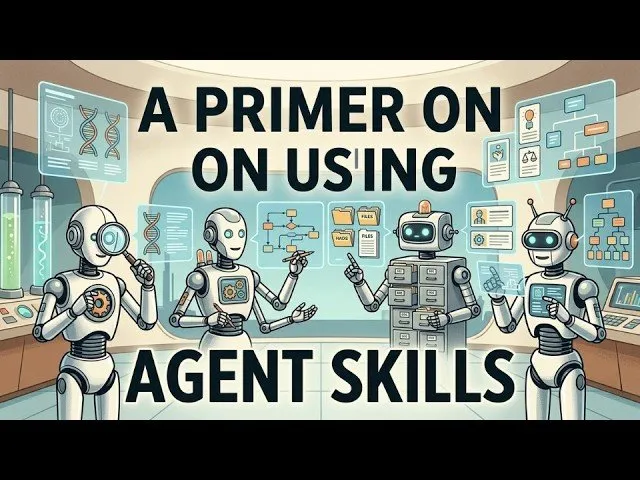
As the artificial intelligence landscape shifts toward an increasingly agentic era, developers and power users are moving beyond ad hoc prompting toward a more modular framework known as Agent Skills. Originally introduced by Anthropic in October 2026, the concept addresses the performance degradation caused by bloated system prompts, providing a standardized, scalable method for equipping AI agents with domain-specific expertise and local context.
Key Points
- Agent Skills function as directories containing instructions, scripts, and resources, allowing agents to load necessary information dynamically rather than relying on massive, all-encompassing context windows.
- The standard utilizes progressive disclosure, where an agent first reviews metadata (name and description), then reads the skill.md file, and finally accesses external scripts or data if required.
- Anthropic has expanded the ecosystem with a Skill Creator tool, which adds rigor by enabling evaluations, benchmarking, and automatic optimization of trigger descriptions.
- Industry adoption is widespread, with frameworks like OpenAI’s ChatGPT, GitHub Copilot, and even Notion integrating similar capabilities to move from "one-off conversations" to reusable, reliable AI workflows.
The Shift from Prompting to Capabilities
Throughout 2025, developers hitting the "context ceiling"—where system prompts became too large for models to manage effectively—found that agent performance often slowed or became unreliable. Agent Skills solve this by acting as an organized manual. By decoupling knowledge from the core model, agents can execute complex tasks across file systems and local environments without the overhead of processing unrelated data.
According to Anthropic’s research, most effective skills fall into nine distinct categories, including data analysis, business automation, code quality review, and verification. The latter is considered particularly high-return, as it allows engineers to encode specific testing protocols that ensure agent output meets organizational standards.
Best Practices for Skill Development
For those building or maintaining agents, the most common mistake is treating a skill as a simple text file. Experts emphasize that the true power lies in the file system, where folders can bundle assets, scripts, and documentation that the agent can manipulate. To maximize efficacy, developers are encouraged to follow these principles:
"A common misconception we hear about skills is that they are just markdown files. But the most interesting part of skills is that they're not just text files. They're folders that can include scripts, assets, data, etc. that the agent can discover, explore, and manipulate." — Tariq, Claude Code Team
Beyond technical structure, the inclusion of a "gotcha" section is cited as a vital component. These sections outline common failure points and edge cases, essentially serving as a living knowledge base that prevents the agent from repeating historical errors. Furthermore, the updated Skill Creator tool now allows authors to perform AB testing, comparing how a custom skill performs against a raw model to ensure the skill actually triggers as intended.
Implications for the AI Ecosystem
The maturation of agent skills is creating a clear divide between two types of capabilities: capability uplift, which enables models to perform tasks they otherwise could not, and encoded preference, which codifies a team’s specific, internal workflows. While capability uplift skills may decrease in necessity as base models improve, encoded preference skills are becoming essential infrastructure for enterprise automation.
As this framework gains traction, the distinction between a "power user" and a developer is blurring. Platforms like Notion have begun simplifying the interface, allowing users to turn existing documents into skills with a single click. Looking ahead, the industry is clearly moving toward a model where AI acts less like a chatbot and more like a library of repeatable, specialized tools. Whether for local coding environments or consumer productivity apps, the ability to build, test, and maintain these modular skills will be a defining factor in operational efficiency throughout the coming year.