Table of Contents
As the crypto industry barrels toward 2026, the narrative is shifting from simple market cycles to a complex interplay of artificial intelligence, institutional adoption, and regulatory friction. The once-dependable "four-year cycle" appears fractured, replaced by a chaotic macro environment where Bitcoin behaves less like a predictable clock and more like a mature macro asset.
From NASDAQ’s entry into permissioned blockchain networks to Google DeepMind’s research validating crypto rails for AI agents, the infrastructure is being laid for a radically different digital economy. However, this maturation brings growing pains: prediction markets are grappling with insider trading concerns, and the battle for Layer 1 dominance between Ethereum and Solana is intensifying.
Key Takeaways
- The Four-Year Cycle is Dead: 2025 defied historical trends, and analysts suggest 2026 is too chaotic to predict using old models, with options markets pricing equal probability for massive upside or downside.
- AI Needs Crypto Rails: Major AI research, including papers from Google DeepMind, indicates that an "agent economy" requires the programmable, machine-readable money that blockchain provides.
- Institutional Paradox: While institutions like NASDAQ are joining permissioned networks like Canton, the broader market debate continues regarding whether value will accrue to private ledgers or public chains like Solana.
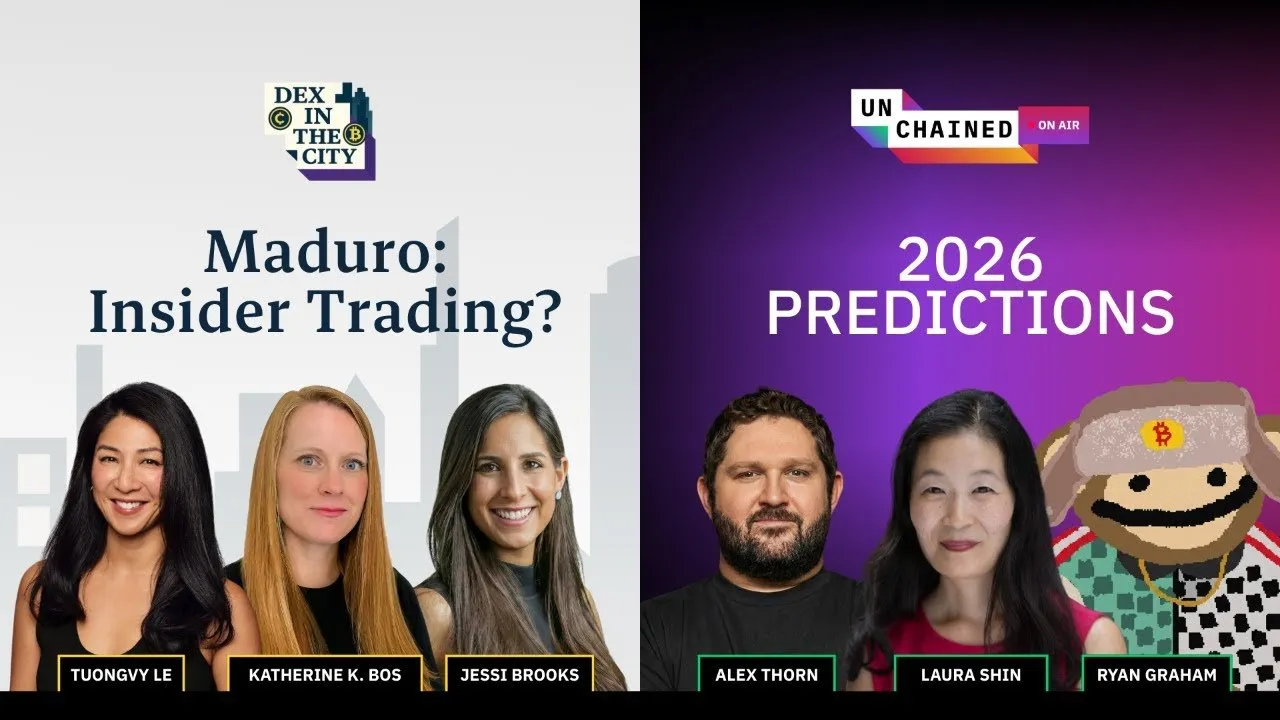
- Prediction Market Ethics: High-profile events, such as the betting on Venezuelan leadership changes, have sparked legislative pushes to regulate "insider trading" on platforms like Polymarket.
- Stablecoin Wars: The upcoming implementation of the "Genius Act" regulations could pit compliant, bank-issued stablecoins against entrenched giants like Tether and Circle.
The 2026 Market Outlook: Chaos Over Cycles
For over a decade, Bitcoin investors relied on the halving-based four-year cycle as a roadmap for profitability. However, recent market performance suggests this map is no longer reliable. The divergence in 2025, where Bitcoin hit all-time highs prior to the halving yet underperformed against gold in the fourth quarter, signals a structural shift.
Macro Uncertainty and Volatility
The consensus among Galaxy Digital and Messari researchers is that the market has graduated from predictable cyclicality to macro-dependency. Bitcoin is now inextricably linked to global liquidity, interest rates, and geopolitical stability. Current options markets reflect this uncertainty, showing significant open interest at vastly different strike prices—ranging from $50,000 to $250,000—for year-end 2026.
"I think the four-year cycle is empirically broken... It’s too chaotic to predict. You’re possibly going to see new cycle lows and new all-time highs all inside 2026."
Despite the uncertainty, the long-term levers remain bullish: dollar debasement, institutional distrust, and monetary easing. However, the days of "up only" based purely on time-based cycles appear to be over.
The Rise of the Agent Economy
Perhaps the most transformative development discussing the intersection of deep tech and finance is the emergence of the "Agent Economy." Recent research from Google DeepMind suggests that as AI agents evolve from assistants to economic actors—capable of negotiating, hiring other agents, and allocating resources—they will require a distinct financial infrastructure.
Why AI Choses Blockchain
Traditional financial rails are ill-equipped for the high-speed, micro-transaction nature of AI-to-AI commerce. Credit card fees render micro-payments (e.g., 12 cents for API access) economically unviable. This friction has revived interest in the "402 Payment Required" status code, utilizing stablecoins and blockchain networks (specifically the X42 standard) to facilitate seamless, programmable payments.
The implication is profound: this is not crypto begging for AI's attention. This is frontier AI research acknowledging that blockchain infrastructure is structurally necessary for safety, verification, and settlement in an automated future.
Prediction Markets: Information vs. Insider Trading
Prediction markets like Polymarket and Kalshi have found undeniable product-market fit, particularly surrounding elections and geopolitical events. However, their efficacy as "truth machines" is being tested by the legal gray areas of insider trading.
The Venezuelan Case Study
A recent controversy involving betting spikes on Venezuelan leadership changes hours before official announcements highlights the dilemma. In traditional equities, trading on material non-public information (MNPI) is illegal. However, prediction markets generally fall under CFTC commodities regulations (or operate offshore), where the bar for insider trading is significantly higher, often requiring proof of fraud or manipulation rather than just possession of non-public info.
"If we can't support a bill like this [banning federal officials from betting], then how can we go in there and say we want a safe market structure where everyone can operate equally?"
Legislation, such as the bill proposed by Representative Richie Torres, aims to curb federal officials from profiting on classified information. Proponents argue that without such guardrails, these platforms risk becoming venues for arbitrage by the powerful rather than sources of crowd wisdom.
The Battle for Layer 1 Dominance
The competition between Ethereum and Solana has evolved from a technological debate into a philosophical divergence on how to service the future of finance. While Ethereum continues to dominate in total value locked (TVL) and decentralization, critics argue its "rollup-centric" roadmap may be over-optimizing for a future that is losing ground to Solana’s immediate utility.
Solana's Institutional Appeal
Solana’s monolithic architecture, offering high throughput and low fees, has attracted significant attention for real-world asset (RWA) tokenization and stablecoin issuance. The narrative has shifted from Solana being a "casino for memecoins" to a potential backbone for institutional capital markets. In contrast, Ethereum’s user experience, fragmented across various Layer 2s, faces friction that some institutions find less appealing than Solana's unified state.
The "Dead" Projects of 2025
The previous cycle’s obsession with "DAO-adjacent trusts" (DATs) appears to have deflated. While giants like MicroStrategy and Bitfarms have established durable models, the long tail of copycat treasury strategies has largely failed to gain traction. The market is consolidating around clear winners rather than speculative experiments.
Conclusion
As the industry approaches 2026, the dividing lines are becoming clearer. On one side, a regulated, permissioned infrastructure represented by networks like Canton and compliant stablecoins is merging with TradFi. On the other, decentralized protocols are racing to become the native currency for the booming AI economy and the settlement layer for global prediction markets.
The "easy mode" of the four-year cycle may be gone, but it is being replaced by utility-driven value accrual. Whether through AI agents executing micro-transactions or institutions tokenizing equity, the next era of crypto is defined less by when the halving occurs, and more by what the technology actually builds.
![Bitcoin Is on Sale [How to Buy It in 2026]](/content/images/size/w1304/format/webp/2026/03/how-to-buy-bitcoin-2026.jpg)