Table of Contents
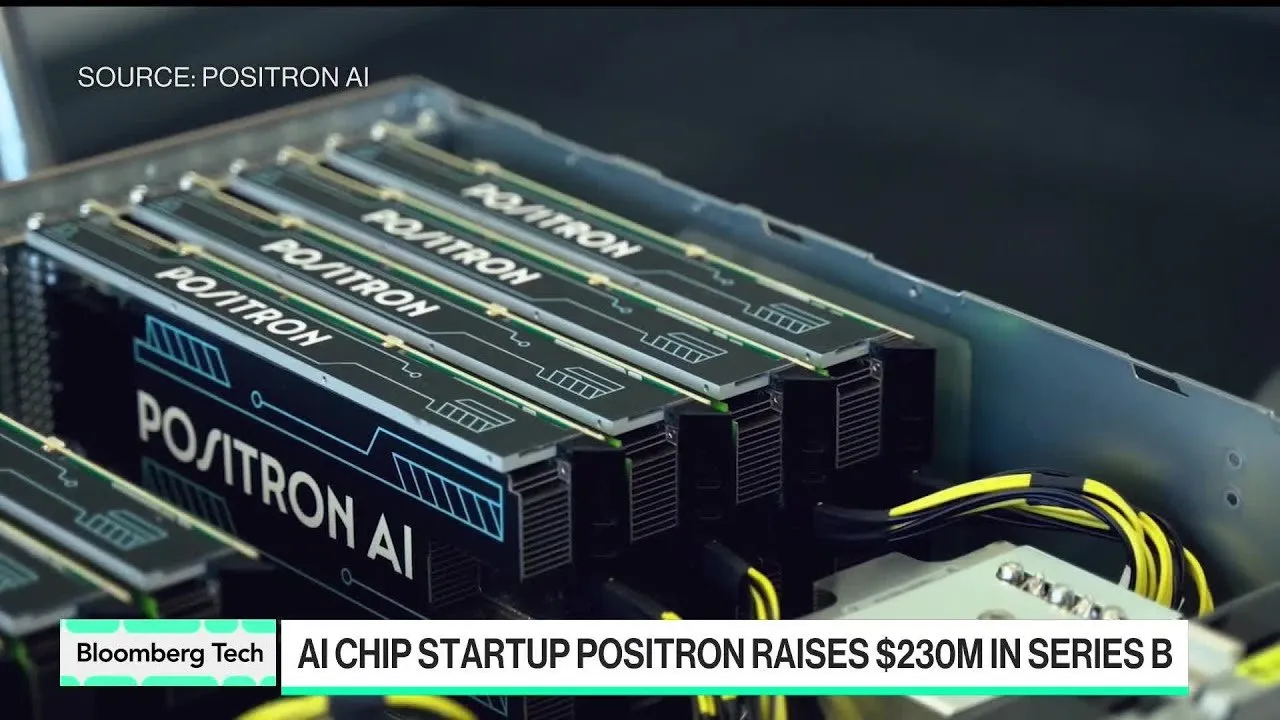
AI chip startup Positron has surpassed a $1 billion valuation following a fresh $230 million funding round designed to accelerate its challenge against industry titan NVIDIA. Backed by heavyweights including Arm, the Qatar Investment Authority (QIA), and Jump Trading, the company is deploying a novel memory-centric architecture aimed specifically at solving the bottlenecks inherent in generative AI inference.
Key Points
- Unicorn Status: Positron has secured $230 million in new capital, pushing its valuation over the $1 billion mark.
- Architectural Shift: The company's upcoming second-generation chip features up to 2.3 terabytes of attached memory, vastly exceeding current industry standards.
- Strategic Backing: High-frequency trading firm Jump Trading joined the round as a co-lead after validating the technology as an early customer.
- Target Market: The technology targets "memory-bound" workloads like video generation, code generation, and large reasoning models.
Rethinking Chip Architecture for Inference
While NVIDIA dominates the AI training landscape, Positron is carving out a niche in inference—the process of running live data through trained models. According to Positron executive Mitesh, current hardware is severely limited by memory bandwidth and capacity, creating a bottleneck for complex applications.
Positron’s approach involves building memory closer to the systolic array to accelerate decode speeds and attaching massive amounts of memory directly to the chip. The company claims this architecture is essential for next-generation workloads such as video generation and complex reasoning models.
"Our second generation will be the world's first terabyte memory chip, going up to 2.3 terabytes of attached memory. For comparison, NVIDIA Rubin will launch with 384 gigabytes... that's where we are really focused on."
This distinct approach offers a counter-narrative to NVIDIA’s strategy. While NVIDIA is investing heavily in optics to connect multiple chips across server racks ("scale-out") to achieve necessary memory, Positron is bringing that scale "inward." By placing significantly more memory on a single chip, Positron argues customers can utilize fewer chips and consume less power for large models, potentially offering a more efficient cost-per-token solution.
Strategic Validation from Finance and Tech
The $230 million funding round is notable not just for the capital, but for the composition of the investors. Jump Trading, a firm known for high-frequency algorithmic trading, co-led the round. Uniquely, Jump Trading was a user of Positron’s first-generation product before becoming an investor.
"Jump became a customer first. They looked at our first gen, they used it... and they said, look, we gotta invest in this company... Trading is obviously using a lot of language models, transformer models, autoregressive models for their applications."
The inclusion of Arm and QIA on the capitalization table indicates broader ecosystem interest beyond the financial sector. As data centers look for heterogeneous silicon deployments to handle specific inference workloads, sovereign funds and foundational tech companies are placing bets on architectures that can offer efficiency gains over general-purpose GPUs.
Scaling to Meet Hyperscaler Demand
Despite the massive valuation, Positron acknowledges the significant gap between its current operations and the market leader. While the startup has deployed chips in the thousands, NVIDIA operates on a scale of millions. Positron’s leadership emphasizes that IPOs or acquisitions are secondary to the technical goal of mass deployment.
Looking ahead, the company is explicitly targeting the hyperscalers—the massive cloud providers that drive over 80% of the world's inference workloads. As models grow toward the trillion-parameter mark, Positron bets that the market will fracture into specialized niches where specific architectures drive efficiency for specific applications.
"Each silicon architecture will have its kind of niche in terms of what application it really drives through fundamentally more efficiently," Mitesh stated, pointing toward a future of disaggregated computing where power consumption and speed are optimized through specialized hardware.