Table of Contents
New comprehensive testing of the current dashcam market reveals a significant disparity between marketing claims and real-world performance, particularly regarding night vision and license plate readability. While budget options have improved marginally, a clear "performance floor" exists, and true innovation is currently found only at the highest price points through the introduction of telephoto lens technology.
Key Takeaways
- The "Minimum Floor" is Real: Ultra-budget cameras (under $20) are functionally useless, while the $50-$100 range offers mixed results, often failing to capture legible license plates at night.
- Sensor Tech Matters: Mid-range cameras utilizing Sony’s Starvis 2 sensors significantly outperform older models, though implementation varies by brand.
- Features vs. Image Quality: High-end models like the Thinkware U3000 prioritize driver assistance features (ADAS) over raw video clarity, struggling with exposure in high-contrast scenarios.
- Telephoto is the Game Changer: The new Viofo A329T introduces a secondary telephoto lens, providing the only reliable method for capturing license plates at a distance or in low light.
The Reality of Budget and Mid-Range Recording
For consumers navigating the flooded market of automotive safety cameras, the terminology can be deceptive. Manufacturers frequently advertise High Dynamic Range (HDR) and Wide Dynamic Range (WDR) capabilities, yet testing indicates these claims are often marketing fluff rather than hardware reality. True HDR, such as that found in Sony’s Clear HDR technology, combines high and low gain images to balance exposure. However, many budget units rely on "digital WDR," a software-based solution that often fails to preserve detail in shadows and highlights.
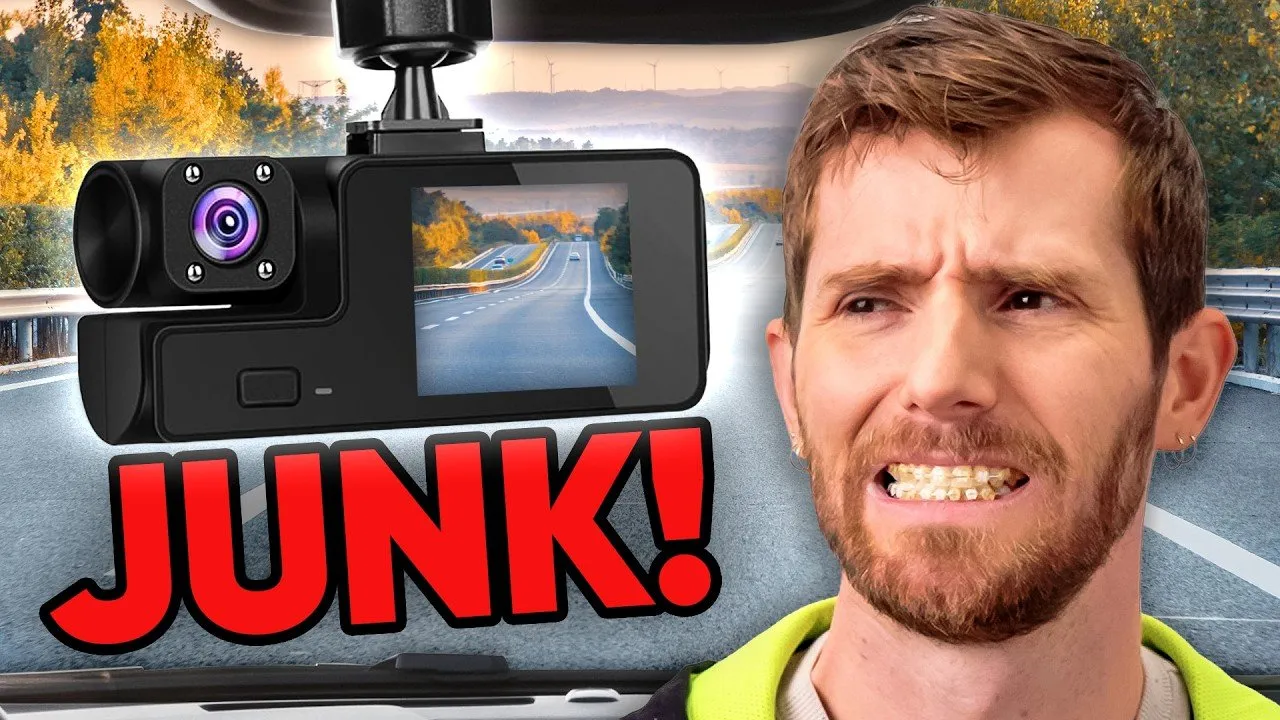
In the sub-$100 category, units like the Yanvim and Subcon offered acceptable daylight performance but crumbled under challenging lighting. While the Yanvim’s 30fps capture rate made it superior for motion clarity among budget peers, none of the entry-level options could reliably capture license plates at night. Furthermore, the testing identified a "danger zone" in ultra-cheap electronics.
"There's a minimum floor for what you should probably spend on a dash cam. The $19 Makequills... is not good. The cheap plastic mount broke before we could even install it. And the packaging is so generic that it literally says 'brand' on it."
Moving into the $100-$200 bracket, the inclusion of Sony Starvis 2 sensors marks a significant leap in quality. The Rove R24K emerged as the most well-rounded performer in this tier, managing sun flare and twilight details better than its competitors, the Red Tiger F7NP and Jzones V630. While the Red Tiger claimed 4K resolution, it suffered from unprompted frame rate drops—from 30fps down to 25fps—in low-light conditions, compromising motion smoothness.
Market Leaders and Value Propositions
When prioritizing value against performance, the Viofo A119 Mini 2 cemented its reputation as the "best bang for your buck." Despite lacking a multi-channel setup or an included SD card, its 2592 x 1944 resolution (4:3 aspect ratio) provided superior clarity compared to competitors costing significantly more. The camera avoided overexposure on bright horizons and maintained legibility on street signs during twilight and night driving.
Conversely, the Thinkware U3000, priced at roughly $380, illustrated a divergence in the premium market. While it offers a robust suite of Advanced Driver Assistance Systems (ADAS) and power-efficient radar parking modes, its core video fidelity did not match its price tag. The unit struggled with overexposure in bright sunlight and produced blurry text on license plates at night.
"It's loaded with features... but its video quality is a bit of a mixed bag, making it pretty hard to recommend for pure dash cam use. I'd almost rather have one of our budget multi-channel kits plus an A119 Mini 2 for its better forward-facing image quality."
The Future of Dashcam Tech: Telephoto Lenses
The most significant finding from the review was the performance of the Viofo A329T. Priced at approximately $600, this unit represents a new high-end tier by incorporating two separate front-facing cameras: a main wide-angle shooter and a secondary 4x optical zoom telephoto lens.
This hardware configuration solved the persistent industry-wide problem of reading license plates at a distance. In testing, the telephoto lens successfully captured legible plates of vehicles in motion, both in the same lane and in oncoming traffic—a feat no other tested camera could achieve reliably. While the price point is prohibitive for many, it demonstrates that optical zoom is the necessary solution for drivers who require evidentiary-grade footage of hit-and-run incidents.
Implications for Buyers
The disparity in performance suggests that consumers must clearly define their primary use case before purchasing:
- Liability Protection: If the goal is simply to prove who had the right of way or who drifted into a lane, a reputable mid-range camera like the Rove R24K or Viofo A119 Mini 2 is sufficient.
- Criminal Identification: For drivers needing to capture specific details like license plate numbers or facial features in the event of a hit-and-run, standard wide-angle lenses are insufficient. High-resolution sensors paired with telephoto capabilities are required.
- Parked Security: Consumers prioritizing parking surveillance should look for units with radar-based motion detection to preserve battery life, even if video fidelity is slightly lower.
As sensor technology continues to trickle down from high-end smartphones and professional cameras, we can expect features like optical zoom and true HDR to become more accessible. However, for the current fiscal year, "you get what you pay for" remains the governing rule of the dashcam market.