Table of Contents
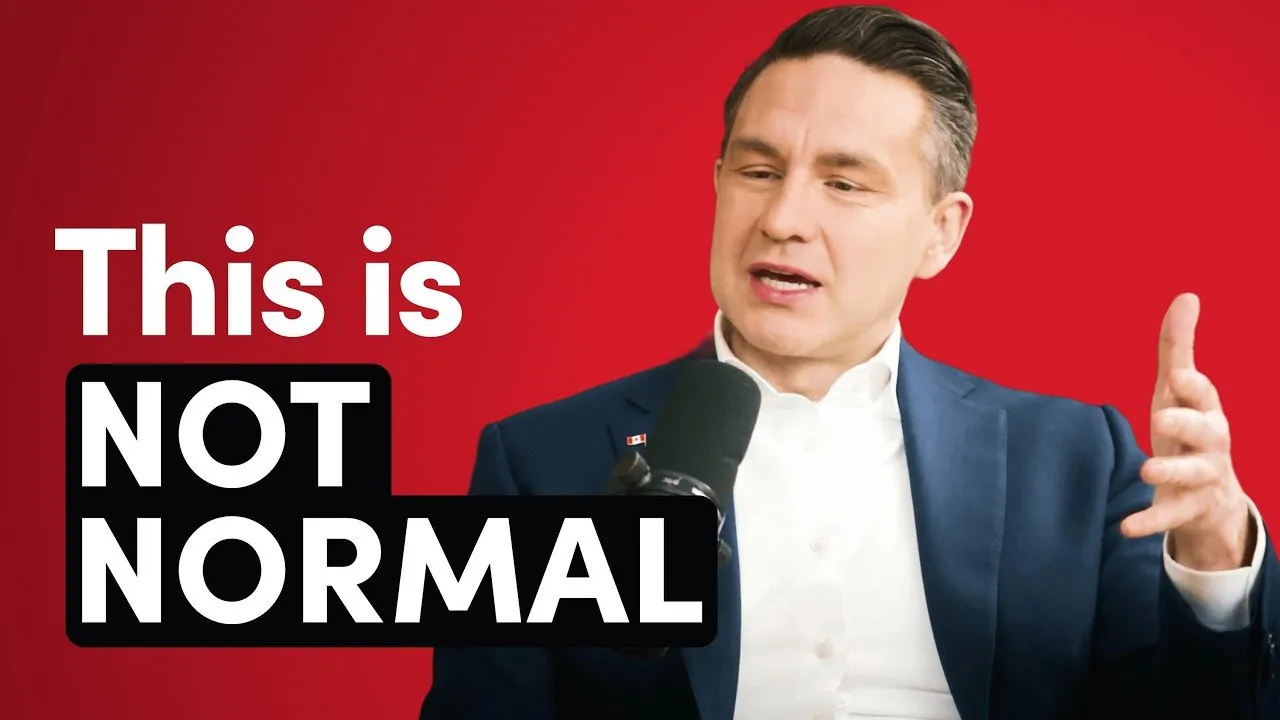
Pierre Poilievre, leader of Canada's Conservative Party, believes the country has reached a critical juncture. In this wide-ranging conversation, he outlines his vision for fundamental change—from redefining government's role to addressing the housing crisis that has left young Canadians unable to afford homes or start families. His approach centers on what he calls "generation screwed," a cohort facing unprecedented economic challenges despite their strong work ethic.
Key Takeaways
- Government should only do what people cannot do for themselves, focusing on military, policing, and basic infrastructure while avoiding business subsidies and media funding
- Canada's housing crisis stems from population growing at 3% while housing stock increases only 1%, creating impossible affordability for young people
- Economic recovery requires unlocking resource production, cutting capital gains taxes on Canadian reinvestment, and reducing government spending that drains private sector capital
- Media independence is compromised by over $3.4 billion in government subsidies since 2017, creating dependency that undermines accountability journalism
- Drug policy should focus on treatment and recovery rather than providing more pharmaceutical solutions from the same industry that created the opioid crisis
Redefining Government's Fundamental Role
Poilievre starts with a stark premise about government's essential nature:
The only thing that's unique about government is that it has the legal power to apply force.
This philosophical foundation shapes his entire policy framework. Government should handle military defense, border control, policing, basic infrastructure, and supporting those unable to provide for themselves. Everything else belongs in private hands.
The Problem with Corporate Subsidies
He views business subsidies as fundamentally misguided, pointing to developed capital and credit markets as sufficient funding sources. The recent Stellantis deal exemplifies this waste—$15 billion in taxpayer money for a company that subsequently cut Canadian jobs while expanding in the United States.
Rather than picking winners through subsidies, Poilievre proposes systemic tax cuts that benefit all businesses investing in Canada. His capital gains tax elimination for Canadian reinvestment would only reward actual domestic investment, ensuring taxpayer money stays in the country.
The Housing Crisis and Generation Screwed
Young Canadians face an unprecedented affordability crisis. Housing costs have doubled under the current government, while rent increases make basic survival increasingly difficult. The math is simple but devastating: population growth at 3% annually while housing stock grows at 1%.
Beyond Housing: The Ripple Effects
The consequences extend far beyond real estate. Poilievre met an airline attendant who, along with his wife, decided never to have children purely for economic reasons. They couldn't afford a house and refused to raise children in a small apartment while struggling with grocery and rent costs.
This decision represents a broader trend—delayed marriages, postponed families, and young people working 60-hour weeks while attending university just to survive. Despite their incredible work ethic, this generation faces barriers previous generations never encountered.
Creating Hope Through Policy
Addressing youth unemployment requires eliminating temporary foreign worker programs that depress wages and displace Canadian workers. Even in regions with double-digit youth unemployment, temporary foreign workers fill positions at below-market wages, creating a race to the bottom.
Poilievre's solution involves unlocking resource development to create high-paying trades jobs, cutting taxes on job creation, and streamlining home-building permits while reducing construction-related taxes.
Economic Strategy and Resource Development
Canada's economic challenges stem from excessive government spending that drains productive private sector investment. Every dollar borrowed for deficits comes from somewhere—either private sector capital or inflationary money printing.
Learning from International Examples
Israel's deficit reduction in the 1990s freed capital that flowed into the tech sector, transforming it into a startup nation. Canada could achieve similar results by reducing the drain on productive economic sectors.
Resource Wealth as Leverage
One blocked pipeline to Northwest British Columbia would move a million barrels daily, generating $30 billion annually—equivalent to $1,400 per Canadian family. This single project would provide 75 times more export value than the entire trade agreement with Indonesia.
Canada possesses 1,300 trillion cubic feet of natural gas that could sell for four times the domestic price in Asian and European markets. Unlocking these resources would create negotiating leverage with the United States while providing mutual benefits through reliable energy supply and critical minerals.
Media Independence and Democratic Accountability
The relationship between media and government funding raises fundamental questions about independence. Since 2017, the Canadian government has provided over $3.4 billion in subsidies, tax breaks, and grants to media organizations, excluding CBC funding and federal advertising spending.
The Dependency Problem
Poilievre poses a crucial question about this arrangement:
Can something that is dependent be independent?
Media outlets must consider these substantial subsidies when covering government policies and decisions. This financial dependency potentially compromises the adversarial relationship necessary for effective democratic oversight.
Free Speech and Information
Efforts to regulate online speech through "disinformation" policies face a logical problem. If average citizens cannot distinguish truth from falsehood, how can government officials make that determination? The solution lies not in censorship but in abundant information flow where good ideas clash with bad ones.
The most effective antidote to bad information remains good information, allowing people to judge for themselves rather than relying on government-appointed arbiters of truth.
Drug Policy and Treatment Solutions
Canada's drug crisis reflects policy failure and perverse incentives. The same pharmaceutical industry that created the opioid epidemic through drugs like OxyContin now profits from providing alternative drugs to treat addiction.
The Treatment Alternative
Successful recovery programs focus on getting people completely off drugs through treatment, counseling, physical exercise, group therapy, job placement, and housing support. A Windsor facility achieves 70% success rates using these comprehensive approaches.
One graduate started a home renovation company that exclusively hires treatment program graduates, creating a virtuous cycle of recovery and employment. This model demonstrates that recovery is possible and economically beneficial.
Criminal Justice Approach
Fentanyl dealers should face murder charges when caught with quantities exceeding 40 milligrams—enough to kill 20 people. Since 2 milligrams can be fatal, large-quantity dealing represents a form of indiscriminate killing similar to firing bullets into crowds.
A Vision for Canadian Renewal
Despite the challenges, Poilievre maintains optimism about Canada's potential. The country's people demonstrate remarkable talent and work ethic, from factory workers programming complex machinery to young people juggling multiple jobs and education.
The solution requires unleashing this potential through policies worthy of the people: sound money, free enterprise, reduced government interference, and restored opportunity for hard work to translate into good lives.
His ultimate goal remains simple but profound—restoring the promise that anybody who works hard can own a nice house and live safely. This vision, combined with concrete policy proposals and unwavering focus on results over rhetoric, forms the foundation of his political strategy. Success depends not on managing decline but on rekindling hope that better outcomes remain achievable through better choices.