Table of Contents
Every four years, the world collectively pauses to fixate on a sport that looks deceptively simple: sliding heavy stones across a sheet of ice while frantic teammates sweep the path ahead with brooms. To the uninitiated, curling is often the subject of memes and confusion. However, dismissing it as merely "shuffleboard on ice" misses one of the most intellectually depth-filled narratives in sports history. Beneath the polite surface of this "gentleman’s sport" lies a saga involving rare geological formations, high-stakes technology scandals, and a physics anomaly that has baffled scientists for over a century.
From the unique chemistry of the granite to the microscopic interactions happening between the stone and the ice, curling is arguably the most scientifically complex event at the Winter Olympics. It sits at the intersection of geology, tribology (the science of friction), and strategy, earning it the nickname "Chess on Ice."
Key Takeaways
- Geological Exclusivity: Every Olympic curling stone originates from a single, tiny Scottish island due to its unique, water-resistant granite composition.
- Technological Controversy: The sport faced a major doping-style scandal involving high-tech brooms that allowed players to steer stones like joysticks, leading to strict equipment regulations.
- The Physics Anomaly: Unlike other rotating objects, curling stones curl in the same direction they spin—a phenomenon that physicists are still debating today.
- Scientific Implications: Solving the mystery of curling physics could aid NASA in designing robots capable of drilling through ice on moons like Europa and Enceladus.
The Strategic Landscape: More Than Just Sliding Rocks
To understand the science, one must first grasp the objective. The field of play is a sheet of ice with a "house" (the bullseye) at each end. The goal is simple: get your 20-kilogram stone closer to the center "button" than the opponent. However, the execution is incredibly precise. Teams of four players deliver two stones each, totaling 16 stones per "end" (or round).
The complexity arises from the rules and the culture. Curling is unique in that players are trusted to call their own fouls and tally their own scores. It is a game built on honor, where winners traditionally buy the losers the first round of beers post-match. But on the ice, the captain—known as the "skip"—orchestrates a complex strategy involving three main shot types:
- The Draw: Landing the stone cleanly within the house to score.
- The Takeout: An offensive strike designed to knock opponent stones out of play.
- The Guard: A stone placed intentionally short of the house to protect a scoring stone behind it.
A Geological Marvel: The Ailsa Craig Granite
One of the most fascinating aspects of the sport is the equipment itself. You cannot simply use any rock for an Olympic curling stone. They must be hydrophobic (water-repellant) and incredibly durable to withstand repeated high-impact collisions without cracking. This necessitates a specific type of granite found in only one place on Earth.
The Source
Every Olympic curling stone is manufactured by a small company that has been operating for over 170 years, sourcing material exclusively from Ailsa Craig, a small island off the coast of Scotland. The island is actually a volcanic plug formed 60 million years ago. Deep underground, magma cooled slowly, and as the surrounding softer rock eroded over millions of years, the hard granite plug remained.
The chemical composition of Ailsa Craig granite is distinct due to its low aluminum content. This resulted in the formation of uncommon minerals and a very tight molecular structure during the cooling process. The result is a stone that absorbs almost no water. If a standard rock were used, water would seep into micro-cracks, freeze, expand, and eventually shatter the stone during play. These stones, which cost upwards of $600 each, glide on a specific "running band"—a concave ring on the bottom of the stone—minimizing contact with the ice.
The Science of Sweeping: Manipulating Friction
Curling is the only Olympic sport where athletes can physically manipulate the trajectory of the game object after it has been released. This is achieved through sweeping, but the mechanics are often misunderstood. Sweepers are not clearing debris; they are altering the physical state of the ice surface.
Pebbled Ice vs. Smooth Ice
Unlike figure skating or hockey ice, which is kept smooth, curling ice is "pebbled." Ice technicians spray purified water droplets onto the sheet, which freeze into tiny bumps. This pebbling reduces the surface area the stone travels on, allowing it to glide further.
When athletes sweep aggressively, they generate heat. This friction momentarily melts the tops of the pebbles, creating a microscopic layer of water. Since stone-on-water has significantly less friction than stone-on-ice, the stone travels further and straighter. Professional sweepers can extend a stone's path by up to three meters.
The "Broomgate" Scandal
The importance of sweeping led to a controversy in 2015 known as "Broomgate." A manufacturer released the "Hardline ice pad," which utilized waterproof, directional fabric and stiff inserts. The abrasive nature of these brooms allowed players to essentially scratch grooves into the ice, steering the stone with unprecedented control.
"It was damaging the ice surface too much and you could literally throw it horrible and your sweepers would make the shot for you... It essentially took the shooting skill out of the game."
The technology was deemed detrimental to the spirit of the sport. It became an arms race comparable to "tech doping" in swimming suits or cycling. The controversy ended when the World Curling Federation intervened, testing over 50 broom types and standardizing the fabric used in competitive play to restore the balance between thrower skill and sweeper influence.
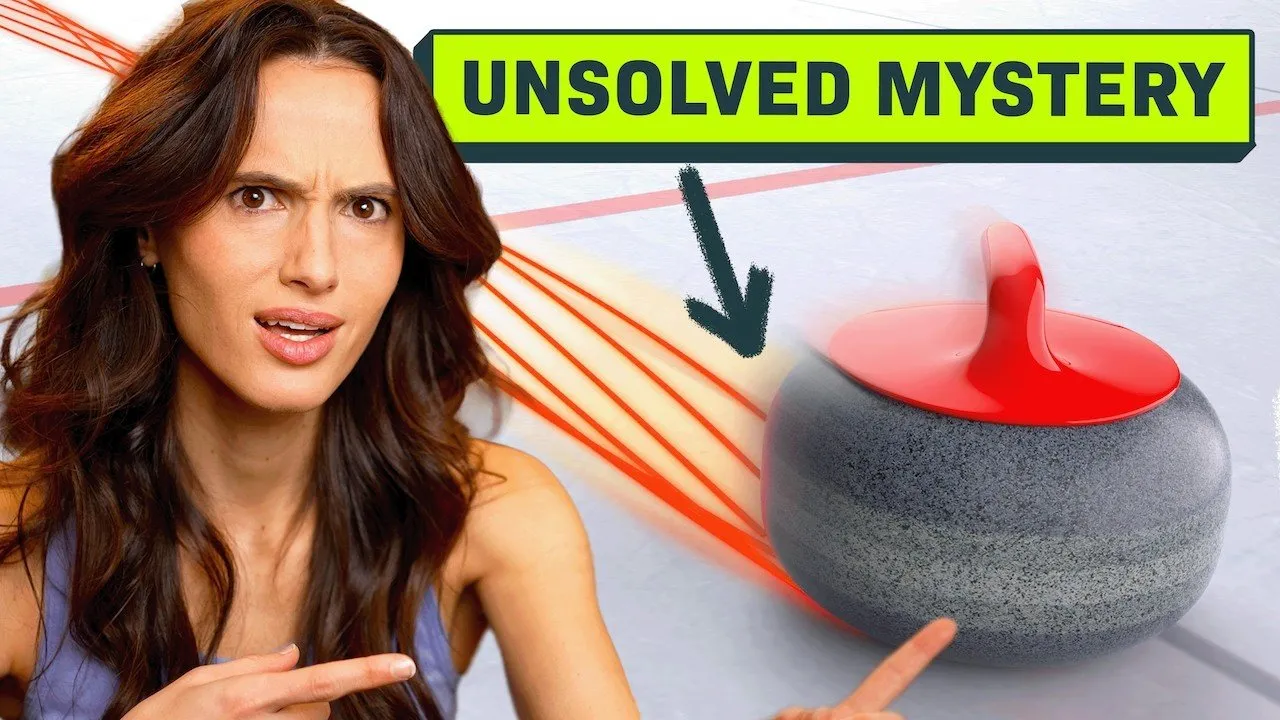
The Unsolved Physics Mystery
The most enduring enigma of curling is the "curl" itself. When you slide a standard object (like a glass on a table) and spin it, it will curl in the opposite direction of the spin. This is standard physics: as the object tips forward, the leading edge presses harder into the surface, creating more friction at the front, which pushes the object the other way.
Curling stones defy this logic. A curling stone rotating clockwise curls to the right. A stone rotating counter-clockwise curls to the left. It moves in the same direction as the spin. This anomaly has stumped physicists for a century.
Competing Theories
Currently, there is no unified consensus, but three primary theories dominate the field of tribology regarding curling:
- Asymmetric Friction: Early theories suggested the stone melted more ice at the front or back, changing friction levels. However, calculations showed the rotation speed of a curling stone is too slow to generate the necessary heat differential.
- The Scratch Guide Theory: This suggests the rough running band of the stone creates microscopic scratches on the ice pebbles. Because the stone is rotating, the scratches at the front are angled. As the rear of the stone runs over these pre-made scratches, it tracks into them, guiding the stone laterally.
- The Pivot and Snap mechanism: This theory likens the ice pebbles to the tines of a plastic comb. As the stone passes over, the pebbles deform elastically (bend) and then snap back. This "stick-slip" mechanism may cause the stone to pivot slightly toward the direction of rotation.
Recent studies from researchers in Japan suggest that the answer likely involves a combination of the Scratch Guide and Pivot mechanisms.
From Ice Rinks to Outer Space
Why does it matter how a rock moves on ice? The study of curling falls under tribology, the science of interacting surfaces in relative motion. Understanding the friction of ice has massive real-world implications beyond the Winter Olympics.
This physics applies to predicting the movement of massive glaciers over bedrock, which is essential for climate science. It informs how vehicle tires interact with icy roads, improving winter safety. Most notably, it is relevant to space exploration. NASA and other agencies are planning missions to moons like Europa (Jupiter) and Enceladus (Saturn), which are covered in thick ice sheets concealing liquid oceans.
To explore these oceans for signs of alien life, we must deploy robots capable of drilling or melting through kilometers of ice. Understanding how rotating machinery interacts with ice surfaces—the very same physics problem found in curling—is critical to the engineering of these space probes.
Conclusion
Curling serves as a perfect reminder that the world is often more complex than it appears on the surface. What is easily mocked as a slow game of sweeping is actually a masterclass in geology, high-stakes strategy, and unsolved physics.
By digging deeper into the "boring" or "weird" aspects of life, we often uncover the most fascinating stories. Whether it is the ancient magma of a Scottish island or the potential for robotic space exploration, the stone sliding down the ice represents curiosity in motion. As the Winter Olympics approach, remember that you aren't just watching a game; you are watching a 100-year-old science experiment that we are still trying to figure out.