Table of Contents
Advanced community-led modification projects are extending the lifecycle of legacy video game titles, utilizing path tracing and high-resolution texture packs to achieve photorealism that rivals modern releases. A recent technical analysis conducted by Linus Tech Tips, in partnership with ASUS, demonstrates that while visual fidelity can be dramatically improved, it often comes at the cost of extreme hardware instability and exponential video memory (VRAM) consumption.
Key Takeaways
- Hardware Demands: Achieving photorealism in titles like Cyberpunk 2077 and Skyrim can push VRAM usage beyond 18GB, necessitating top-tier consumer GPUs.
- Visual Trade-offs: While "viral" mod videos showcase curated static scenes, playable framerates often require aggressive upscaling technologies like DLSS.
- Ecosystem Fragility: Live-service updates for games like GTA V frequently render mod injectors incompatible, breaking community builds instantly.
- Market Caution: Experts advise against purchasing "premium" mod packs, noting they often repackage free tools available on public repositories like Nexus Mods.
The High Cost of Photorealism
The pursuit of photorealism in aging game engines has shifted from simple asset swaps to complex lighting overhauls. The analysis utilized an ASUS PG34W CDN, a fifth-generation QD-OLED monitor featuring a 360Hz refresh rate and an RGB stripe sub-pixel layout designed to mitigate text fringing. Testing revealed that modern display technology is often limited not by the screen itself, but by the computational load placed on the graphics processing unit.
In Cyberpunk 2077, activating roughly 72 environmental and lighting mods—including path tracing—resulted in a VRAM spike from 12GB to over 16GB at 1440p resolution. While the test system achieved approximately 111 frames per second (FPS) in low-activity zones, the stability of the simulation varied significantly based on player movement and location.
"It definitely feels like the showcase videos are very cherry-picked... You go into an area that's not necessarily set up [for the mod pack], and it doesn't look quite as good as the canal that we were driving in earlier."
This discrepancy highlights a core issue with "viral" gaming graphics: the gap between a curated screenshot and a playable open-world experience. Heavy use of depth-of-field effects and wet-surface textures often masks lower-quality assets in the periphery.
Legacy Titles and Technical Constraints
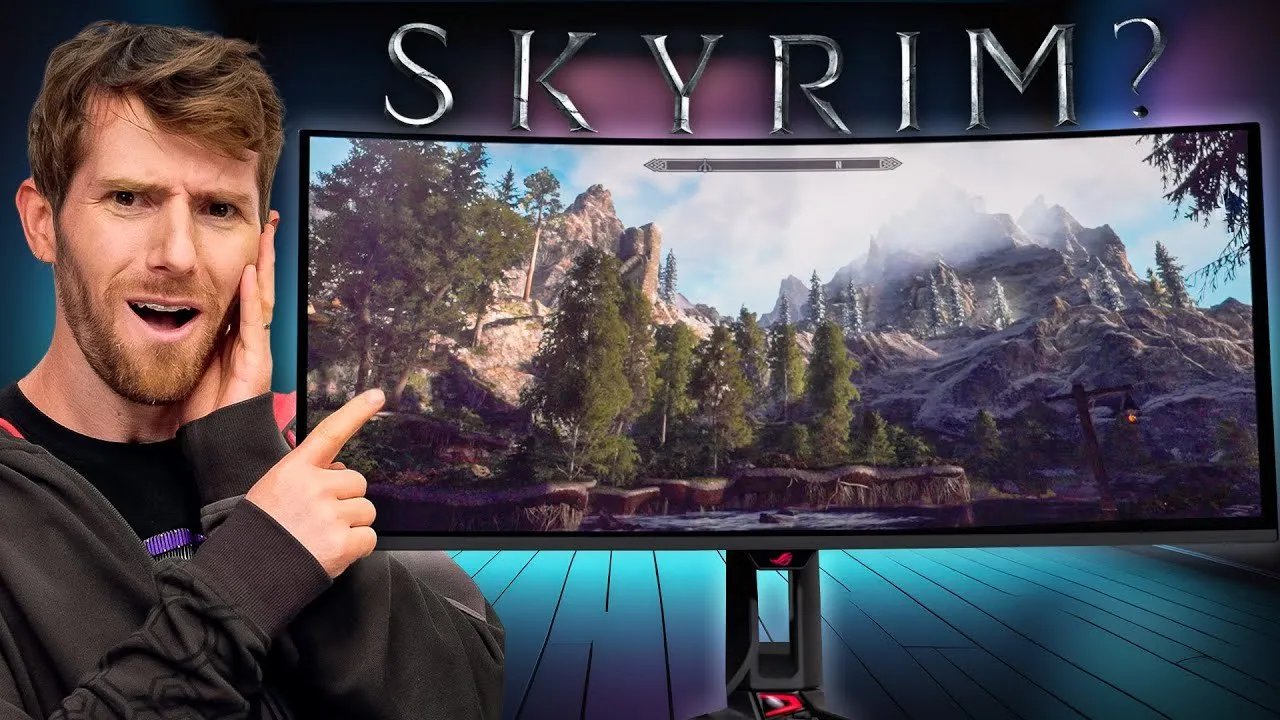
The investigation highlighted The Elder Scrolls V: Skyrim as a benchmark for successful community remastering. Utilizing the "Ultimate Immersion" mod list and ENB lighting software, technicians transformed the 2011 title with 4K assets, dense foliage, and fluid dynamics that mimic modern rendering techniques. However, this required overriding the game's native launcher and navigating complex load orders to prevent software conflicts.
Conversely, Grand Theft Auto V served as a case study in the volatility of modding live-service games. An automatic game update broke compatibility with "Script Hook V," a critical code injector, rendering the intended graphical overhaul impossible during the testing window. This underscores the risk associated with modding titles that receive frequent developer patches.
Performance Metrics on Legacy Engines
Even optimized titles like the original Crysis (2007) showed significant resource hunger when enhanced. Running the "Crysis Enhanced" replacement pack, the system utilized nearly 11.5GB of VRAM just in the menu. While the game maintained 137–140 FPS on enthusiast-grade hardware, the test revealed that older engines often struggle with modern ultra-wide aspect ratios and high dynamic range (HDR) implementation without external tweaking.
The Economics of the Modding Community
As the demand for high-fidelity gaming increases, a secondary market for "paid mod packs" has emerged. These services typically charge users for pre-configured lists of modifications. The investigation suggests that these paid services offer questionable value, as they largely consist of repackaged free content available on hubs like Nexus Mods, combined with custom ReShade presets.
"It's the ReShade preset that you're really paying for... As much as these guys aren't necessarily scamming people... we encourage you to do your own research and just try modding yourself."
Consumers are advised to exercise caution and utilize free community resources before committing funds to third-party aggregators, as the underlying assets are often identical.
Future Outlook
The integration of AI-driven visual features in monitors, such as dynamic shadow boosting and OLED protection, suggests that hardware manufacturers are attempting to bridge the gap between engine limitations and display capabilities. However, for gamers seeking to modernize classic titles, the reliance on high-VRAM GPUs and the technical know-how to manage file conflicts remains a barrier to entry. As widely available hardware catches up to these extreme software demands, community-led remastering is expected to become an increasingly viable alternative to official studio remakes.