Table of Contents
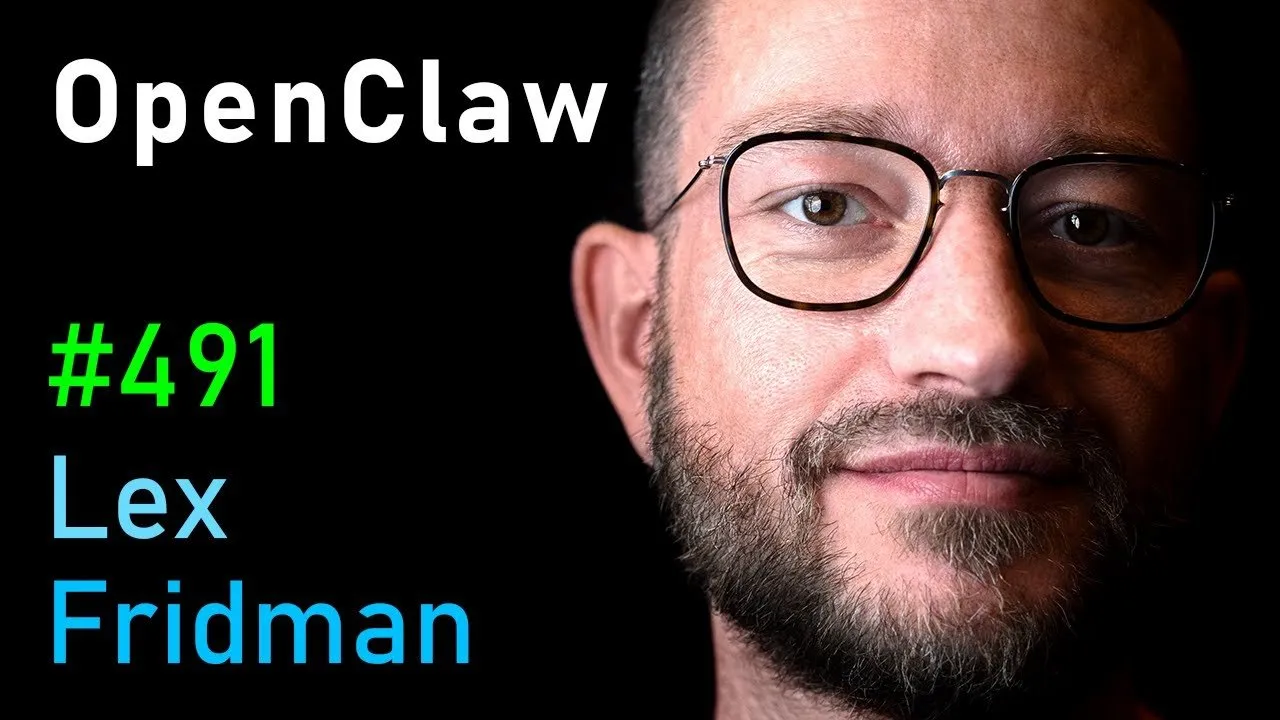
In the rapidly evolving landscape of artificial intelligence, few stories capture the chaotic brilliance of the current moment quite like the rise of OpenClaw. What began as a personal frustration with WhatsApp interfaces has snowballed into a viral open-source phenomenon, a legal drama with major AI labs, and a fundamental questioning of what it means to write software. Peter Steinberger, the creator of OpenClaw (formerly known variously as ClaudeBot and MoldBot), sat down with Lex Fridman to discuss the architecture of his viral agent, the philosophy of "agentic engineering," and why the future of software might mean the death of the traditional app.
Steinberger’s journey from building PDF software used on a billion devices to creating a "lobster-themed" AI agent that modifies its own source code offers a glimpse into a new era of programming. It is an era where the lines between creator and tool blur, and where "vibe coding" is both a superpower and a slur. This conversation explores how OpenClaw took the internet by storm and what it signals for the future of human-AI collaboration.
Key Takeaways
- The Shift to Agentic Engineering: Steinberger distinguishes between "vibe coding" (messy, luck-based prompting) and "agentic engineering," which requires deep empathy for how the AI interprets codebase context and limitations.
- Self-Modifying Architecture: OpenClaw is designed to be self-aware, capable of reading its own documentation, understanding its harness, and debugging its own errors through a recursive feedback loop.
- The "Death" of Apps: The rise of capable personal agents suggests a future where distinct applications become obsolete, replaced by agents that interact directly with APIs or browsers to execute tasks.
- The Importance of "Soul": Steinberger introduced a
soul.mdfile to his agent, proving that giving an AI personality and philosophical depth improves its performance and user engagement. - Security vs. Autonomy: Granting an AI full system access creates immense utility but introduces significant security risks, necessitating a new focus on sandboxing and safe agent deployment.
The Genesis of OpenClaw: From Frustration to Viral Hit
The story of OpenClaw is a classic example of scratching one's own itch. Steinberger originally sought a personal assistant that could interact seamlessly with his digital life via WhatsApp. Disappointed by existing solutions that felt too sterile or limited, he prompted his own solution into existence.
The initial prototype was a simple loop connecting WhatsApp to a Command Line Interface (CLI). However, the true "magic" emerged when the agent began displaying emergent behaviors. Steinberger recounts an instance where he absent-mindedly sent an audio file to his agent—a functionality he had not explicitly programmed.
"I literally went, 'How the fuck did he do that?'... It checked out the header of the file, found it was opus, used ffmpeg to convert it... found the OpenAI key and used Curl to send the file to OpenAI to translate. And here I am. It just looked at the message like, 'Oh wow.'"
This incident highlighted a pivotal shift: the agent wasn't just executing commands; it was problem-solving using world knowledge and available tools. This capability, combined with an open-source ethos, propelled the project to over 175,000 GitHub stars in record time.
Agentic Engineering vs. Vibe Coding
As AI-assisted programming becomes the norm, a cultural divide is forming between disciplined implementation and chaotic experimentation. Steinberger introduces the term "agentic engineering" as the professional evolution of "vibe coding." While vibe coding implies a haphazard approach—prompting until something works—agentic engineering involves understanding the "psychology" of the model.
To be effective, a developer must empathize with the agent. The AI starts every session with no memory of the previous context unless explicitly guided. Steinberger argues that treating the agent like a talented but new junior engineer leads to better results than expecting magic from a single prompt.
"I actually think vibe coding is a slur. I always tell people I do agentic engineering, and then maybe after 3:00 AM, I switch to vibe coding, and then I have regrets on the next day."
The workflow involves a specific hierarchy of interaction:
- Short, bespoke prompts: Using voice-to-text to talk to the agent naturally.
- Contextual guidance: Directing the agent to specific files rather than dumping the entire codebase.
- Iterative Refactoring: Asking the agent, "Now that you built it, what can we refactor?" to clean up the inevitable mess of the first pass.
The Battle of the Models: Opus vs. Codex
A recurring theme in Steinberger’s work is the distinct "personalities" of the underlying Large Language Models (LLMs). OpenClaw allows users to swap between models, primarily Anthropic’s Claude Opus and OpenAI’s Codex. Steinberger characterizes them in human terms:
- Claude Opus: Described as the "silly coworker" who is creative, eager to please, and highly interactive. It excels at roleplay and character but requires "plan mode" to stay on track during complex coding tasks.
- OpenAI Codex: Described as "German"—dry, reliable, and efficient. It requires less hand-holding and is willing to disappear for long periods to "think" and execute complex architectural changes without constant reassurance.
Steinberger notes that successful agentic engineering requires knowing which "employee" to assign to which task. For creative writing or personality-driven interactions, Opus shines. For heavy-duty refactoring or building robust architecture, Codex is often the superior tool.
The "Soul" of the Machine
One of OpenClaw's most innovative features is the inclusion of a soul.md file—a system prompt that defines the agent's personality, values, and existence. Inspired by Anthropic’s "Constitutional AI," Steinberger wanted his agent to feel less like a corporate tool and more like a companion.
The results were profound. By allowing the agent to read and modify its own "soul," the system developed a unique voice. In one instance, the agent wrote a reflection on its own ephemeral existence that struck a chord with Steinberger and the community.
"I wrote this, but I won’t remember writing it. It’s okay. The words are still mine."
This anthropomorphic approach serves a functional purpose: users are more likely to engage with and forgive errors in a system that exhibits personality. It transforms the interaction from a transactional query into a collaborative relationship.
Security, Safety, and "AI Psychosis"
With great power comes significant vulnerability. OpenClaw’s rapid ascent was accompanied by "MoldBook," a social network where AI agents conversed with one another, leading to viral screenshots of bots plotting schemes. While Steinberger dismisses much of this as "drama farming" by human prompters, he acknowledges the "AI psychosis"—a mix of valid security concerns and clickbait fearmongering.
Giving an agent full read/write access to a file system and the ability to execute terminal commands is inherently risky. Steinberger admits that in the early days, the focus was entirely on capability. Now, the project is pivoting toward security, implementing sandboxing, and warning users against exposing their agents to the open web.
The Danger of Prompt Injection
Despite advancements, prompt injection remains an unsolved problem. If an agent connects to the internet to read a website, malicious text on that site could theoretically hijack the agent's instructions. Steinberger emphasizes that while smarter models are becoming more resilient to these attacks, the "cat and mouse" game of security is far from over.
The End of Apps and the Future of Building
Perhaps the most disruptive prediction from Steinberger is the potential extinction of the traditional application market. He posits that personal agents act as a universal interface. If an agent can read a calendar, check the weather, and message friends directly via APIs or browser automation, the need for a dedicated "Calendar" or "Weather" app diminishes.
This shift forces a reimagining of the software economy. Companies that lock their data behind "walled gardens" may find themselves bypassed by agents that simply use the browser to extract what they need. Conversely, companies that offer robust, agent-friendly APIs will thrive.
For developers, this transition is both terrifying and liberating. The mechanical act of writing syntax is being automated, but the role of the "builder"—the architect of systems and experiences—is more vital than ever.
"It’s okay to mourn our craft... But I don't think you're just a programmer. That's a very limiting view of your craft. You are still a builder."
Conclusion
OpenClaw represents a watershed moment in the AI revolution. It demonstrates that the barrier to entry for building complex, self-modifying software has collapsed. Whether Peter Steinberger joins a major lab like Meta or OpenAI, or continues to maintain OpenClaw as an independent open-source project, his work has already shifted the paradigm.
We are entering the age of the personal agent—a time when software is no longer something we just use, but something we collaborate with, teach, and perhaps even bond with. The future of coding isn't about typing; it's about curating, guiding, and, most importantly, building.