
Table of Contents
For the vast majority of our lives, we operate on a script written by someone else. In the United States, this "default path" is deeply ingrained: get good grades, go to college, secure a stable job, buy a house, and save for retirement. While this formula works for some, a growing number of professionals are discovering that checking these boxes does not guarantee fulfillment. They often find themselves successful on paper but disconnected from their own vitality.
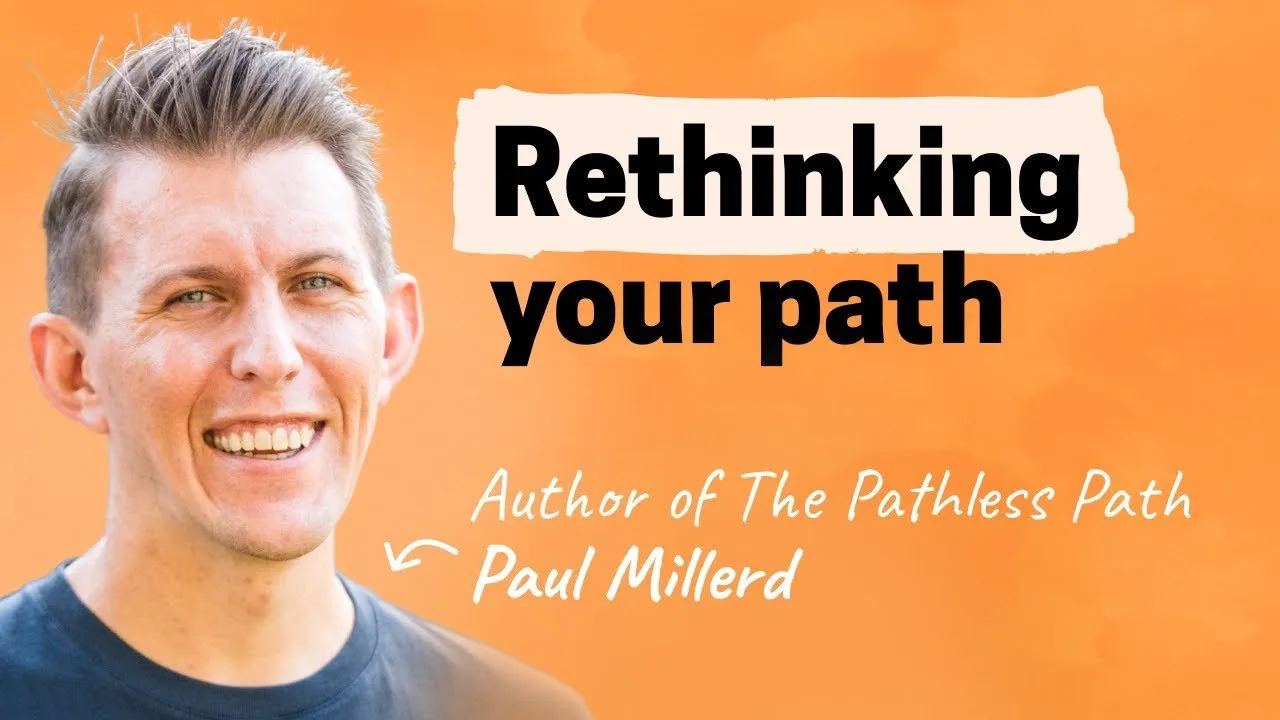
Paul Millerd, author of The Pathless Path, argues that the alternative is not necessarily reckless abandonment of responsibility, but a shift toward intentional experimentation. By prioritizing "coming alive" over merely "getting ahead," individuals can reconstruct their relationship with work, money, and success. Whether you are looking to leave the corporate world entirely or simply want to find more meaning within your current role, the journey begins with questioning the assumptions that keep us on autopilot.
Key Takeaways
- The Default Path is a script, not a law: Society provides a template for success, but sticking to it without conscious consent often leads to burnout and a loss of identity.
- Uncertainty is a feature, not a bug: The pathless path requires shifting from a mindset of scarcity and predictability to one of abundance and comfort with the unknown.
- Experimentation reduces risk: You do not need to quit your job tomorrow. Small steps—like taking an afternoon off or a short sabbatical—can provide the clarity needed to make larger moves.
- Money buys space, not just things: Viewing savings as a "runway" or a "Life MBA" transforms money from a source of anxiety into a tool for self-discovery.
- Energy is your best metric: Rather than optimizing for prestige or salary, optimize for tasks and projects that generate energy rather than drain it.
Deconstructing the Default Path
The concept of the "default path" is seductive because it offers safety and legibility. It provides a clear set of instructions for adulthood. Millerd defines this path as a series of implicit contracts we sign with ourselves and society. The danger lies not in the path itself—there is nothing inherently wrong with a steady corporate career—but in the lack of awareness with which we walk it.
Many professionals reach a point where they have achieved the metrics of success—the senior title, the salary, the reputation—yet feel a profound sense of emptiness. This is often because they have tightened the knot between their identity and their work so securely that they no longer know who they are without the job.
The goal is not to find a job, make money, build a business, or achieve any other metric. It's to actively and consciously search for the work that you want to keep doing.
Signs You Are Ready for a Shift
You do not need to be in crisis to explore a different way of living. However, specific signals often indicate that the default path is no longer serving you. These include a persistent feeling of "low-grade" burnout, a realization that you are optimizing for a life you don't actually want, or the discovery that you are envious of people who have reclaimed their time.
Millerd suggests that we are all, to some extent, already on a pathless path because the modern economy is volatile. The idea of a smooth, forty-year corporate ascent is largely a relic of the past. Acknowledging that disruption is inevitable allows you to take control of your trajectory rather than having it forced upon you by layoffs or market shifts.
The Strategic Sabbatical and Micro-Experiments
The most common objection to leaving the default path is the magnitude of the leap. It feels reckless to walk away from a paycheck. However, the transition is rarely an all-or-nothing event. It is usually the result of years of "awakening" followed by small, safe tests.
The Power of the Pause
If you assume you will work for roughly 40 years, that is approximately 500 months of labor. Taking three months—less than 1% of your career—to disconnect and recalibrate is a mathematically insignificant risk with a potentially life-altering upside. Millerd and many others have found that a sabbatical is often the catalyst for profound change.
During a sabbatical, the first phase is almost always simple decompression. It can take six to eight weeks just for the "corporate Kool-Aid" to leave your system. Only after this detoxification process can you begin to hear your own thoughts clearly. For many, including Lenny Rachitsky, this break clarifies that the visceral excitement for their previous career is gone, creating the space for new ideas to emerge.
Start with an Afternoon
If a three-month break is not financially or logistically feasible, start smaller. Millerd recommends a tactic for the risk-averse: block off three hours during a workday. Sneak out. Go for a walk without a destination or engage in a hobby you loved as a child, such as basketball or painting.
Pay attention to the emotions that arise. Do you feel guilty? Where does that guilt come from? These micro-experiments serve as a form of "work mindfulness," helping you identify the scripts running in your head about what it means to be a productive member of society.
Reframing Money and Risk
Fear of financial ruin is the primary gatekeeper of the default path. Overcoming this requires a psychological shift in how we view our resources. Instead of seeing a savings account purely as a safety net for emergencies, view it as an investment fund for your own development.
One effective reframe is the "Life MBA." Professionals rarely hesitate to spend two years and $150,000 on a business school degree because it is a socially acceptable pause in earnings. You can apply the same logic to a sabbatical or a period of independent exploration. Set a budget, define a runway, and treat that expenditure as tuition for learning what you actually want to do with your life.
You waste years by not being able to waste hours.
The "Underemployed" Advantage
There is immense value in being intentionally underemployed. When every hour of your week is maximized for efficiency and output, there is no room for serendipity or creativity. Innovation requires slack in the system.
Millerd notes that his income dropped significantly in the first few years of his journey, but his costs of living dropped in parallel. By moving to cheaper locations or cutting unnecessary expenses, he bought himself time. The trade-off was clear: he was trading excess salary for autonomy. Interestingly, many who take this path eventually surpass their previous earnings, but they do so on their own terms, leveraging work they genuinely enjoy.
The Energy Audit: Finding Your Compass
Once you have created space, how do you know what to do next? The answer lies in energy, not strategy. Traditional career advice focuses on skills and market demand. The pathless path focuses on what makes you feel alive.
Conduct an audit of your activities. After a meeting, a writing session, or a consulting call, ask yourself: Did this energize me or drain me?
- Ship: Put something out into the world (a blog post, a podcast, a project).
- Quit: If the process drains you, stop doing it. Do not create a job for yourself that you hate.
- Learn: Use the feedback from the "ship" and the feeling from the "quit" to navigate your next step.
Lenny Rachitsky used this exact method. He thought he wanted to be a consultant or an angel investor. However, he found that advisory calls drained him, while writing his newsletter—despite being difficult—gave him a buzz of energy. Following that energy led to a career he could never have planned.
Overcoming the Prestige Trap
Leaving a recognizable job at a recognizable company triggers deep insecurities about belonging and status. We fear becoming invisible or irrelevant. When you tell people you are "exploring" or "writing," you may face confusion or judgment from friends and family who view success through a traditional lens.
The "Boomer Compatible" Story
To navigate social friction, it helps to have a narrative that makes sense to the outside world. Millerd jokes about having a "Boomer compatible story." Telling your parents you are "tinkering on the internet" might cause concern, but telling them you are "starting a business" or "consulting" bridges the gap. It provides a label that others can understand while you do the messy, undefined work of figuring things out in the background.
Ultimately, the fear of judgment is often a projection of our own insecurities. The longer you stay on your own path, the more you realize that external prestige is a poor substitute for internal alignment.
Conclusion
The pathless path is not a prescription for everyone to quit their jobs and become creators. It is an invitation to take an active role in designing your life. It is about realizing that the scripts we were handed at 18 may not apply at 30, 40, or 50.
It demands a willingness to endure uncertainty and the courage to face the "dragons" of money and status. However, the reward is a life where work is no longer something to be tolerated, but a vehicle for connection and vitality. As Millerd summarizes, the mantra should always be: "Coming alive over getting ahead."



)