Table of Contents
At some point in modern existence, living entirely inside one’s own head became the default setting. An entire generation now spends its days ruminating on thoughts, reliving past errors, and mentally rehearsing future catastrophes, all while the body remains still—a mere physical scaffold for a hyperactive brain. People walk, work, and interact, yet often feel they are observing their lives from a distance, like watching a movie where they cannot intervene. While often dismissed as "overthinking" or a personality quirk, psychiatrist and trauma expert Bessel van der Kolk suggests this phenomenon is actually a symptom of dissociation. It is not a conscious choice, but a biological adaptation. The mind flees to the safety of thoughts because, at some point, the body became a dangerous place to inhabit.
Key Takeaways
- Rationality as a defense mechanism: Chronic overthinking is often a symptom of dissociation, where the mind disconnects from the body to avoid painful sensations or memories.
- The danger of the body: For those with trauma or chronic stress, the nervous system perceives the body as a threat, making "feeling" seem dangerous compared to "thinking."
- Cultural reinforcement: Modern society and digital technology prioritize cognitive productivity over somatic awareness, deepening the split between mind and body.
- Healing is physiological: Since trauma resides in the body, intellectual analysis is insufficient; healing requires somatic practices like grounding and sensing.
- From survival to existence: Living in the head is a survival strategy; true existence, connection, and intuition can only occur when one safely reinhabits the body.
The Hidden Mechanism of Dissociation
To understand why so many remain trapped in their heads, we must abandon the superficial idea that people think too much simply out of habit. According to Bessel van der Kolk, author of The Body Keeps the Score, this disconnection arises primarily from fear. Dissociation occurs when the body ceases to be a safe harbor. In scenarios involving trauma, neglect, or prolonged stress, the organism enters survival mode.
When physical sensations begin to carry the weight of terror, helplessness, or shame, the nervous system makes a strategic decision: it disconnects. The mind seizes absolute control because navigating the abstract world of thoughts feels infinitely safer than confronting the raw reality of physical sensation. This is an intelligent, evolutionary adaptation. The brain is doing exactly what it was designed to do—protect the individual’s integrity.
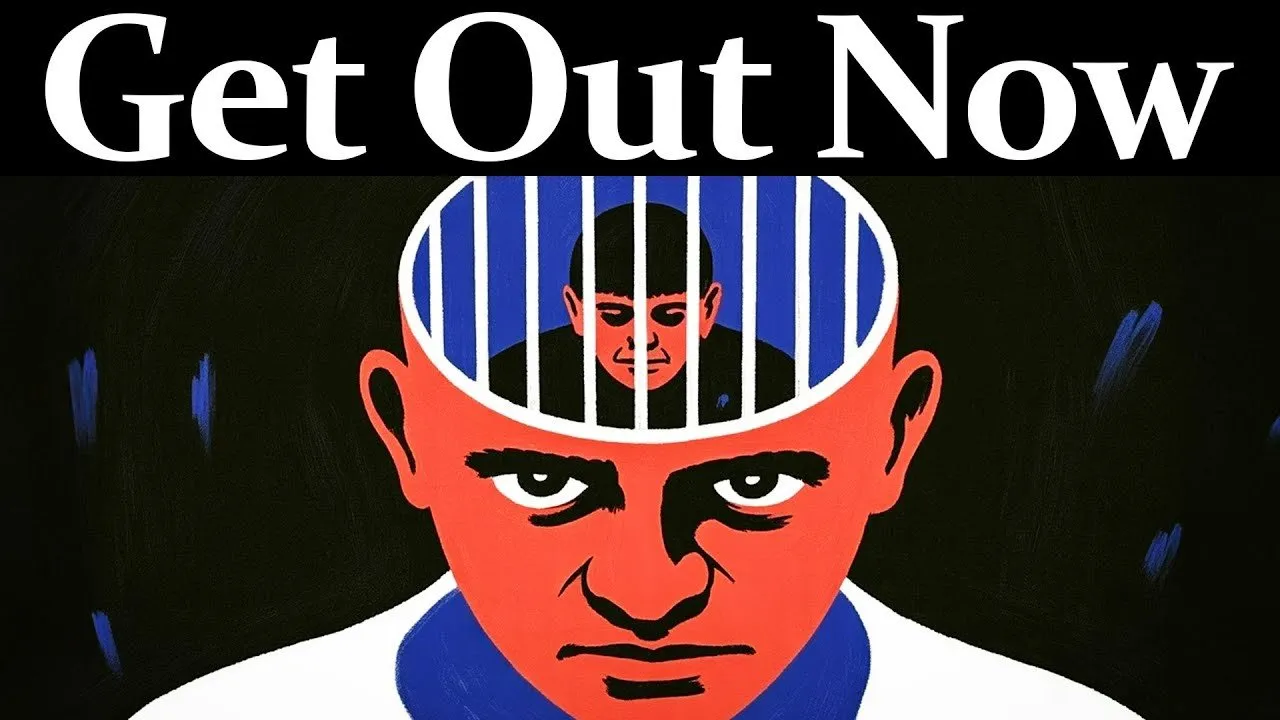
However, the nervous system does not perceive time linearly. A threat learned in the past continues to operate in the present. The body remains in a state of high alert or shutdown, and the mind remains hyperactive, attempting to micromanage reality to prevent the individual from feeling the unbearable. Consequently, the dissociation that once saved a person eventually transforms into a prison. The individual defines themselves as "rational" or "controlled," when in reality, they are dissociated, using thoughts as a buffer against their own biology.
The Cultural and Digital Conspiracy Against Feeling
Individual dissociation does not occur in a vacuum; it is amplified by a culture that aggressively champions the mind while marginalizing the body. We live in an environment that values productivity, logic, and efficiency—functions of the rational mind—while often viewing emotion, intuition, and bodily needs as weaknesses or obstacles to success.
The Cartesian Legacy
This rationalist mentality has deep roots in the Cartesian separation of mind and body. Educational and corporate systems train us to believe the mind is the seat of identity and morality, while the body is merely a tool for performance. We are rewarded for ignoring physical limits to achieve professional goals. When suffering arises, the clinical question is almost always "What are you thinking?" rather than "What are you feeling in your body?" This reinforces the delusion that one can solve physiological distress through purely cognitive means.
The Era of Mental Hyperstimulation
Technology further calcifies this split. We live in an era of continuous digital stimulation, where it has never been easier to keep the mind occupied and the body paralyzed. The average person jumps between screens, absorbing notification, ads, and endless feeds. This avalanche of information excites the brain while requiring the body to remain static and inert.
"Living in the mind is surviving. Living in the body is existing."
This creates a paradox: the mind races at high speed while the body is anesthetized. Infinite scrolling provides micro-doses of dopamine that addict the brain to superficial stimulation, preventing the silence and boredom necessary for internal introspection. We consume content about well-being—watching videos on health or spirituality—without ever actually feeling our own breath or weight on the chair. It is a simulation of presence, leaving the human experience incomplete and the nervous system dysregulated.
Why You Can't Think Your Way Out of Pain
The crucial pivot in van der Kolk’s work is the understanding that emotions are not abstract ideas; they are physiological events. Sadness is a constriction in the throat; anger is heat in the skin; fear is a visceral drop in the stomach. However, because we are trained to ignore the body, we attempt to process these events as thoughts.
A person might say, "I think I am stressed because of the meeting tomorrow." This is an analysis, not an emotion. The actual emotion is the rapid heartbeat or the tension in the jaw. As long as the body is not recognized as a safe place, the mind will continue to dominate the experience. This explains why talk therapy or rational understanding is often insufficient for deep healing. You cannot use logic to communicate with a nervous system that is stuck in a survival reflex.
Unprocessed emotions are stored in the muscles, the breath patterns, and the gut. To "come down" from the head means encountering this raw material. The organism, remembering past pain, resists this descent. It prefers the known misery of mental imprisonment to the perceived threat of emotional feeling. Yet, the price of this avoidance is high: diffuse anxiety, a sense of emptiness, and a persistent feeling of not being truly alive.
Practical Pathways to Reconnection
Escaping the mental prison requires a shift from cognitive analysis to somatic sensing. This is not about emptying the mind, but about grounding the body. The goal is to teach the nervous system that the present moment is safe.
The Power of Naming Sensations
The first step in breaking the cycle of dissociation is to ask a specific question: "Where do I feel this in my body?"
When you move from saying "I am anxious" to "I feel a tightness in my chest," you change the neurological processing of the experience. Areas of the brain linked to self-regulation are activated. You create space between the stimulus and the reaction. You cease to be a hostage to the emotion and become a witness to it. This simple act of naming transforms a vague, terrifying mood into a concrete, manageable physical sensation.
Grounding: The Anchor of the Now
For those deeply dissociated, diving straight into heavy emotions can be overwhelming. Therefore, one must first establish "grounding"—a return to the here and now through direct sensory perception. Grounding techniques send safety signals to the parasympathetic nervous system.
- Tactile engagement: Holding a piece of ice, touching a textured surface, or washing hands with cold water forces the brain to register physical reality.
- Physical structure: Pressing feet firmly into the floor or feeling the weight of the body in a chair reminds the nervous system that it is supported.
- Conscious movement: Practices like yoga or dance are not just exercise; they are methods of occupying the internal space of the body.
These practices may seem trivial, but they act as a biological anchor. They interrupt the spiral of intrusive thoughts and prove to the brain that the body is capable of surviving sensation.
Conclusion: Returning to Life
When the body ceases to be a battleground and becomes a habitable place, the nature of existence changes. Anxiety decreases because there is a safe place to anchor. Decisions become clearer because intuition—which is inherently bodily—is heard again. Relationships deepen because you are no longer performing a role but are physically present with another human being.
Van der Kolk reminds us that the body is the stage where emotional life unfolds. Ignoring the body does not silence the trauma; it only forces it to speak louder through symptoms. The journey back to the body is a courageous act of reclaiming one’s life from the autopilot of survival. It begins not with a grand theory, but with a simple, conscious breath and the realization that while the mind is an excellent tool, the body is the only place where you can truly live.