Table of Contents
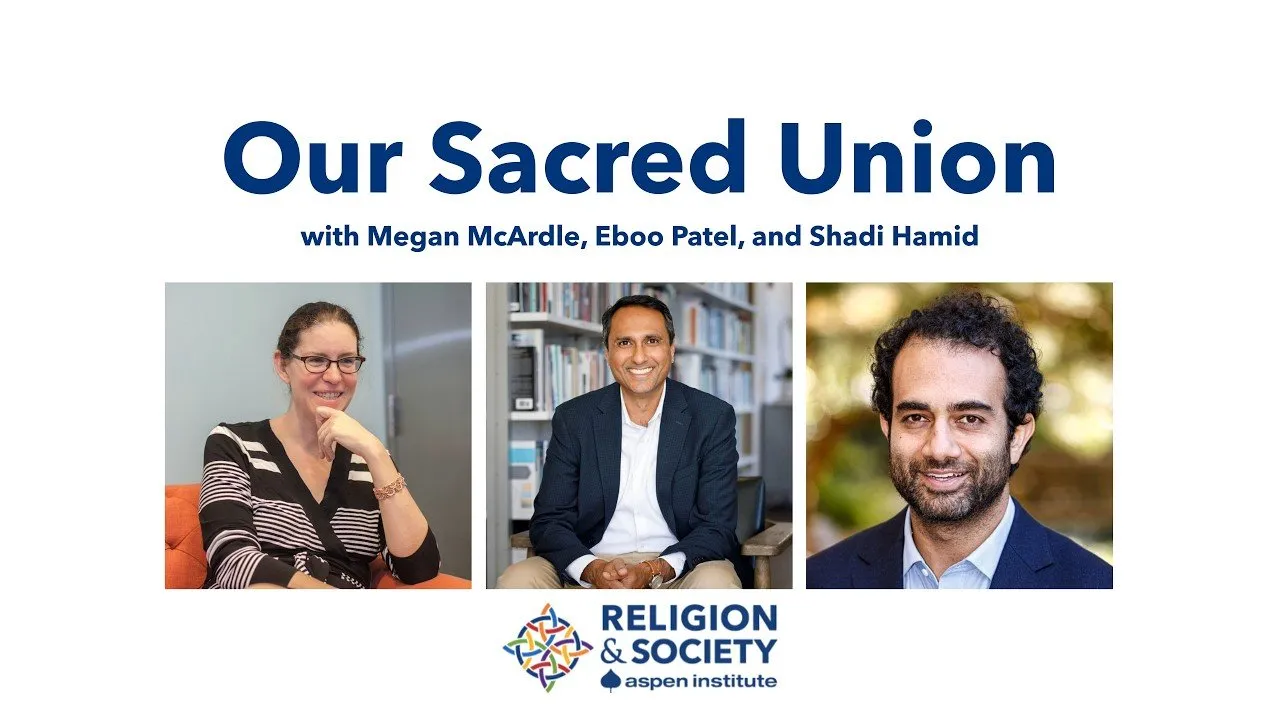
In a time of deepening political and social fractures, the question of how Americans live together across "deep difference" has never been more urgent. At a recent Aspen Institute event, Eboo Patel, Megan McArdle, and Shadi Hamid gathered to discuss "Our Sacred Union." The conversation moved beyond the surface-level noise of cable news to explore the "waterline" of American life: the religious and civic traditions that have historically allowed a diverse democracy to function. From the legacy of Roger Williams to the "secularization paradox" of the 21st century, the panelists challenged the notion that a less religious America is necessarily a more tolerant one.
Key Takeaways
- Pluralism is a practice, not just a theory: True pluralism requires the ability to cooperate with and respect the dignity of individuals whose fundamental beliefs you may find wrong or even offensive.
- The Secularization Paradox: Increased secularization in the U.S. has not led to a more "rational" or "peaceful" politics; instead, political identities have become "worldly idols" that mirror religious fervor without religious constraints.
- Religion as Civic Infrastructure: Beyond personal spirituality, organized religious institutions provide the "social glue" and physical infrastructure—such as hospitals and disaster relief—that sustain American civil society.
- The "Utah Model" of Compromise: Strong religious identity does not have to lead to theocracy; it can actually provide the framework for protecting minority rights and achieving social peace through mutual exemptions.
The Invisible Tradition of Religious Pluralism
Eboo Patel, founder of Interfaith America, argues that the American experiment is the world’s first self-conscious attempt at a religiously diverse democracy. However, he notes that this "intellectual architecture" is increasingly invisible to modern civic leaders. In many elite institutions, religious identity is often treated with a mix of indifference or contempt, even as other forms of diversity are celebrated.
The "Moral Imagination" of the Founders
Patel traces the roots of American pluralism back to figures like Roger Williams, who established Rhode Island not just as a haven for religious freedom, but as a site for "interfaith friendships." This tradition continued through the "Holy Experiment" of William Penn and eventually into the First Amendment. Patel argues that we must reconnect with this history to navigate modern tensions. "Our moral imagination is built in no small part on how people from different religious communities could express their identities and cooperate across their disagreements," Patel noted.
The Blind Spot in Modern DEI
In his consultations with universities, Patel observed a striking trend: while students and staff are well-versed in many forms of identity, they often lack a "positive story" about religious identity. He cited instances of anti-Mormon chants in college stadiums that failed to register as "diversity issues" in the mainstream press or academic circles. This oversight, Patel argues, makes our civic institutions dramatically poorer and less capable of handling the very disagreements pluralism was designed to manage.
You have to learn how to live with the person that in your mind you don't believe in.
The Secular Elite and the Misunderstanding of Faith
Washington Post columnist Megan McArdle addressed the growing disconnect between a secularized elite and the millions of Americans for whom faith remains a "primal commandment." She suggested that secular liberals often fail to take religion seriously as a fundamental motivation, viewing it instead as a choice or a hobby.
Religion vs. "Golfing"
McArdle observed that when religious groups seek exemptions from civil rights laws or mandates, secular observers often treat the request as if someone were asking for an exemption based on a personal pastime. "It just did not compute for secular people that this was something more fundamental than playing golf or being really into crafting," she explained. This lack of empathy stems from an inability to recognize that pluralism is about navigating "pre-commitments" that cannot be argued away.
The Fragility of "Spiritual but Not Religious"
While many younger Americans identify as "spiritual but not religious," McArdle argues that this individualistic approach lacks the durability of traditional faith. Organized religion requires individuals to show up when they don't want to and serve people they might not like. These "unwanted obligations" are precisely what build the deep community bonds that a purely personal spirituality cannot replicate. Without these structures, the social trust required for a functioning union begins to erode.
The Secularization Paradox and Political Idolatry
Shadi Hamid, a senior fellow at Georgetown University, offered a counterintuitive perspective: as America becomes less religious, its politics become more fanatical. He argues that the decline in church attendance over the last 25 years has directly contributed to intense ideological polarization.
The Rise of Worldly Idols
When people stop finding meaning and identity in religious institutions, they do not necessarily become more "rational." Instead, they often redirect that spiritual energy toward politics. Hamid described figures like Donald Trump or movements like "wokeness" as "worldly idols" that provide a sense of belonging and moral purpose but lack the tempering influence of traditional theology. "Why are we so obsessed with politics? It's because people have a spiritual energy that is not directed towards religion and God," Hamid argued.
The Necessity of "Delayed Judgment"
Hamid, a Muslim, suggested that traditional faiths offer a vital civic tool: the concept of delayed judgment. By believing that ultimate justice belongs to God in the hereafter, believers can afford to be more magnanimous and less vengeful in the here and now. In a purely secular framework, every political battle becomes an existential struggle for "ultimate judgment," leading to a cycle of retribution rather than pluralistic coexistence.
Democracy is the right to make the wrong choice, and we have to take that very seriously.
The Civic Cost of Religious Decline
The panel concluded by looking at the practical, "above-water" consequences of the decline in religious participation. While spirituality is a personal matter, the civic institutions built by religious communities—hospitals, schools, and disaster relief organizations—are public goods that the entire nation relies upon.
Who Shows Up in 2040?
Patel pointed out that after the federal government, organizations like the Salvation Army and Catholic Charities are the largest providers of social services in the U.S. Seven of the nine major refugee resettlement organizations are faith-based. As the "nuns" (those with no religious affiliation) grow as a demographic, Patel raised a haunting question: "Who's going to show up when there's an earthquake in your town in 2040? Spirituality doesn't build hospitals."
The "Utah Model" as a Path Forward
McArdle highlighted Utah as a surprising example of successful pluralism. Despite being a "quasi-theocracy" with a Mormon majority, the state has successfully negotiated compromises on LGBTQ+ rights that protect against discrimination while providing robust religious liberty exemptions. This success stems from taking religion—and the reality of deep difference—seriously, rather than trying to secularize the public square by force.
Conclusion: Building a New Canopy
The conversation at Aspen suggests that the future of the American union depends on our ability to build a "new canopy" for pluralism. Just as the term "Judeo-Christian" was an "invented" 20th-century canopy designed to include Catholics and Jews in the American story, we now require a framework for an "Interfaith America." This does not require us to agree on theology or even on fundamental moral definitions. Rather, it requires a commitment to the "sacred" nature of the other—the recognition that our neighbors have a right to their beliefs and that we must find ways to live, work, and serve alongside them regardless.