Table of Contents
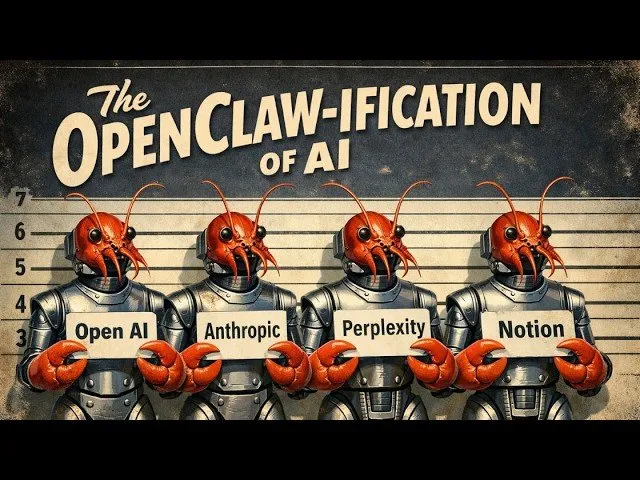
The artificial intelligence landscape is undergoing a rapid transformation as major labs and productivity platforms adopt a design philosophy termed "OpenClaw-ification." Following a wave of high-profile announcements from Anthropic, Perplexity, and Notion, the industry is moving away from reactive chat interfaces toward autonomous, persistent agents that function as 24/7 digital employees. This shift marks the transition from AI as a tool for inquiry to AI as a fundamental "labor primitive" capable of executing complex workflows without constant human prompting.
Key Points
- Anthropic has integrated remote control and scheduled tasks into Claude Code and Claude for Work, allowing developers to manage agents via mobile devices and automate recurring professional workflows.
- Perplexity launched Perplexity Computer, a multimodal orchestration layer that utilizes 19 different models to manage end-to-end research, design, and deployment projects.
- Notion and Airtable have introduced "Custom Agents" and "Super Agents," respectively, effectively democratizing autonomous agent technology for non-technical enterprise users.
- Industry analysts view these features not as mere product updates, but as the emergence of "agentic primitives"—persistent work, cross-device interactivity, and deep environmental context.
Anthropic and the Rise of Remote Agentic Control
In a series of rapid-fire releases, Anthropic has introduced features that bridge the gap between local development environments and mobile accessibility. The new remote control feature for Claude Code allows users to initiate tasks in a terminal and monitor or assign further work via a mobile device. This functionality addresses a long-standing demand for "on-the-go" coding capabilities, a niche previously dominated by the open-source project OpenClaw.
The significance of this update extends beyond convenience. By allowing Claude to maintain a persistent session on a local machine while being controlled remotely, Anthropic is positioning the AI as a professional "work engine" rather than a simple chatbot. Ali K. Miller, a prominent AI voice and investor, noted that the feature transforms the utility of the model:
"This is the feature I've been waiting for. I work from my phone for hours every day. Remote control is about to turn me into a Claude Code maniac."
Following the remote control announcement, Anthropic revealed scheduled tasks for Claude for Work. This allows the AI to perform recurring actions, such as generating morning briefs or updating spreadsheets, at specific intervals. According to Akash Gupta, this represents a fundamental category change for the software.
"Scheduled tasks means Claude stopped being software you talk to and became software that works while you sleep. That's a category change, not a feature update."
Perplexity Reimagines the Personal Computer
While Anthropic focuses on the professional terminal, Perplexity is attempting to redefine the operating system itself with Perplexity Computer. Announced by CEO Arvin Srinivas, the system unifies research, design, and deployment into a single orchestration layer. Unlike static models, Perplexity Computer leverages a suite of 19 models to match specific tasks to the most capable underlying architecture.
The "OpenClaw-ification" in this context refers to the system’s ability to run agents in parallel with persistent memory and web access. Srinivas argues that the traditional chat UI has become a bottleneck for AI's true potential. In a company blog post, he asserted that the future of computing lies in massively multimodal orchestration, where the AI replaces the traditional functions of the computer itself.
The "Labor Primitive" and Economic Implications
The shift toward scheduled, autonomous work has reignited discussions regarding white-collar job displacement. When an AI can autonomously pull Slack data, run formulas, and drop formatted files into a folder without human intervention, it moves from being a "helper" to a "labor primitive." As some analysts point out, tasks that previously required a junior employee or a complex Zapier workflow are now being consolidated into a single $20-per-month subscription.
Enterprise Democratization: Notion and Airtable
The trend is not limited to AI labs; major productivity platforms are integrating similar "agentic" capabilities to remain competitive. Notion recently launched Custom Agents, described as "the AI team that never sleeps." These agents are designed to be "multiplayer" and model-agnostic, allowing teams to set triggers based on Slack messages or Notion comments to automate project management.
Tech commentator Andrew Warner characterized this move as "OpenClaw for regular people," noting that it removes the technical barriers—such as managing cron jobs or CLI tools—that previously prevented non-technical users from deploying autonomous agents. Similarly, Airtable has moved into this territory with Super Agent, further signaling that persistence and autonomy are becoming standard requirements for enterprise software.
A Fundamental Shift in AI Primitives
The widespread adoption of these features suggests that the industry is moving past the "hype phase" of individual projects and into a new era of fundamental AI primitives. These include:
- Heartbeats and Cron Jobs: Agents that "remind" themselves to continue working on a mission at set intervals.
- Persistent Context: Systems that maintain awareness of a user's entire repository, local hardware, and past work.
- Interactive Modalities: Seamless transitions between desktop terminals and mobile messaging apps like Telegram or WhatsApp.
While some developers argue that users should still learn the underlying mechanics of tools like OpenClaw to understand these primitives, the market is clearly moving toward abstraction and productization. These developments indicate that the "agentic era" has officially arrived, where AI is no longer a tool used intermittently but a persistent presence in the professional environment.
As these technologies mature, the industry will likely see a deeper integration of AI into local hardware and proprietary data systems. The "OpenClaw-ification" of the market serves as a starting gun for a new competitive landscape where the primary value is no longer the intelligence of the model alone, but its ability to work autonomously and reliably across the digital ecosystem.