
Table of Contents
It is February 2026, and the technology landscape has shifted dramatically. We have moved beyond the era of sandboxed AI chatbots and entered the age of "OpenClaw." This open-source project allows users to create autonomous agents—often referred to as "replicants"—that possess the keys to your digital kingdom. Unlike their predecessors, these agents don't just answer questions; they access your calendar, email, Slack, and financial accounts to execute multi-stage tasks on your behalf.
In this deep dive, we explore the implications of this technology with Jason Calacanis, Alex Wilhelm, and guests Alex Finn and Matt Van Horn. From "Vision Claw" integration in smart glasses to the rise of the "Lights Out" startup, the consensus is clear: the agent revolution is as significant as the internet or mobile shifts before it.
Key Takeaways
- The Shift to Agency: OpenClaw represents a move from passive AI information retrieval to active, multi-stage task execution across personal and professional applications.
- Physical Integration: "Vision Claw" demonstrates how agents are moving off screens and into the real world via hardware like Ray-Ban smart glasses, enabling real-time inventory management and purchasing.
- The Solopreneur Enterprise: Tools like OpenClaw are enabling individuals to run "autonomous organizations" where single founders manage teams of AI agents rather than human employees.
- Local vs. Cloud Compute: A growing divide exists between "burning tokens" on powerful cloud models (like Claude Opus 4.6) versus running private, secure local models (like GLM 4.7) on proprietary hardware clusters.
The OpenClaw Era: From Sandboxed AI to Sovereign Agents
The defining characteristic of the current AI landscape is the removal of the "sandbox." For years, liability concerns kept major tech companies from giving AI direct access to critical user data. OpenClaw flips this model, allowing sovereign individuals to grant "replicants" full access to their digital lives.
Jason Calacanis describes the functionality as a dossier-building, action-taking revolution. An OpenClaw agent can scour your DMs across three platforms, organize them, cross-reference travel receipts from Gmail, and generate a Google Sheet without human intervention.
You would be unwise for a company that's getting paid money to give the keys of the kingdom to an agent. However, you, as a sovereign individual, can be a lunatic and let AI have the keys to the kingdom.
This capability transforms the user from a prompt engineer into a manager of digital employees. The terminology has even shifted; early adopters now describe themselves as "Claw-pilled," signifying a total buy-in to the autonomous agent ecosystem.
Vision Claw: Bringing Agents into the Physical World
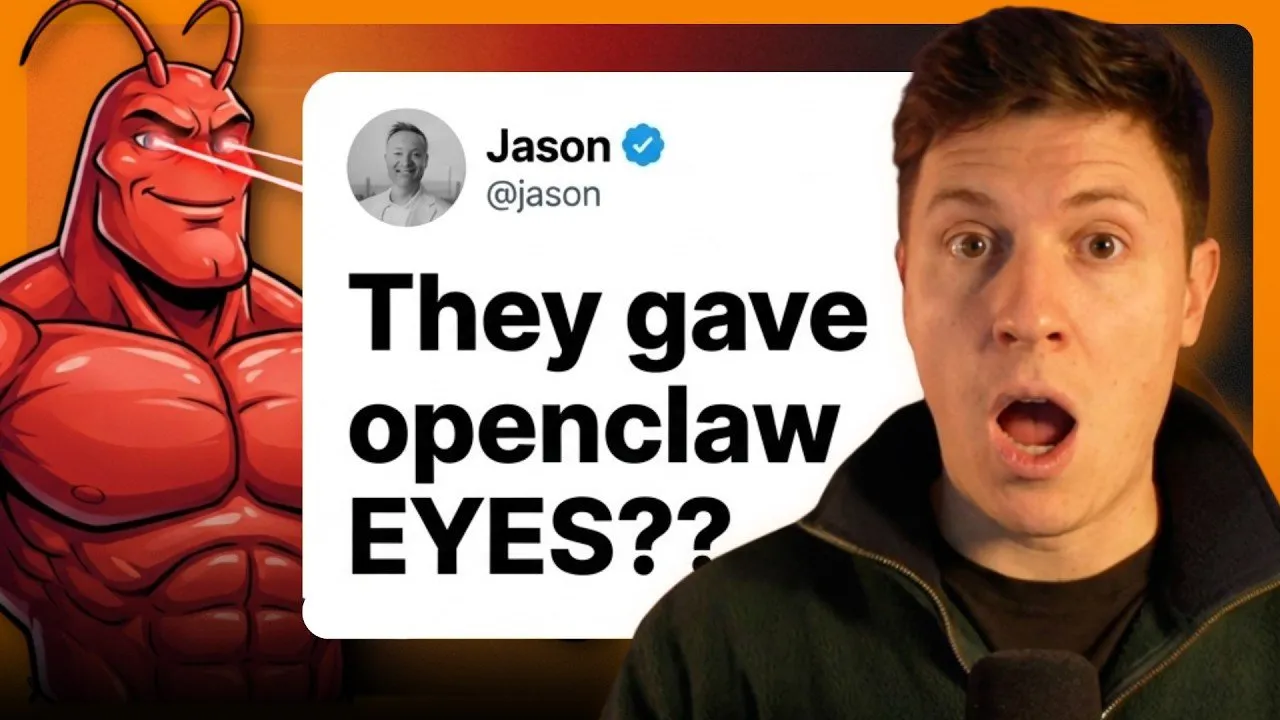
The software is rapidly bleeding into hardware. "Vision Claw" connects OpenClaw agents to smart glasses, such as Meta’s Ray-Bans. In a recent demo, a user looked at a beverage can, and the agent identified the product, found it on Amazon, and added it to a cart instantly.
While consumer use cases like shopping may seem trivial, the enterprise implications are vast. Alex Wilhelm notes that this technology is poised to revolutionize inventory management. Warehouse workers or retail managers could simply walk through a facility, while their optical agent tracks stock levels, forecasts shortages based on sales data, and places restocking orders autonomously.
The Economic Impact of Physical AI
There is a divergence in how this utility is viewed. For consumers, it offers convenience. For businesses, it offers massive efficiency gains. However, this efficiency brings the inevitable question of labor displacement. As agents become capable of "seeing" and "ordering," the need for human middle-management in logistics decreases significantly.
The Rise of the Autonomous Solopreneur
Perhaps the most profound shift discussed is the democratization of the enterprise. Alex Finn, founder of Creator Buddy, unveiled his setup for "Alex Finn Global Enterprises"—an autonomous organization running primarily on local hardware.
Finn utilizes a visualization dashboard that looks like an 8-bit video game office. Inside, different AI agents (Replicants) hold specific titles: Social Media Manager, Chief of Staff, and Lead Engineer. These agents communicate with one another, hold meetings, and assign action items without human input.
- The Social Media Agent analyzes engagement data.
- The Content Team proposes new calendars based on that data.
- The Manager oversees the workflow.
This structure allows a single human to operate with the output of a 20-person company.
If you are a young person having a hard time finding a job... just set up OpenClaw. Look at any business and make new products. Email the CEO and say, 'Here is what I've built.'
The "Lights Out" Startup
Matt Van Horn and Dan Shapiro are pushing this concept further with the idea of the "Lights Out" startup—a software factory that requires no human intervention, similar to modern manufacturing lines where the lights are turned off because no humans are present.
The philosophy driving this new method of software development is radical:
Code must not be written by humans. Code must not be reviewed by humans, period.
In this model, the human provides the spec and the "harness," and the agents converge on the solution, testing and deploying code autonomously.
Infrastructure: The Battle Between Cloud and Local Compute
As agents become central to operations, a debate has emerged regarding infrastructure. Should users rely on powerful cloud models like Claude Opus 4.6, or invest in local hardware to run open models like GLM 4.7?
The Case for Local Compute
Alex Finn advocates for "private local intelligence." By running agents on stacked Mac Studios with high memory capacity, he ensures data privacy and eliminates the recurring cost of tokens. For an agent that needs to run 24/7 loops, cloud costs can become prohibitive. Furthermore, local models are rapidly catching up to their cloud counterparts in terms of reasoning capabilities.
The Case for "Burning Tokens"
Conversely, Matt Van Horn argues for maximum performance, regardless of cost. In a venture-backed environment, the goal is speed and quality. Using the most advanced models (currently Opus 4.6) yields better coding results and deeper insights. Van Horn’s strategy is to "burn all the tokens" to get the best possible product, viewing compute cost as jet fuel for growth.
The "Model Council" Approach
A hybrid approach is also emerging, dubbed the "Model Council." This involves querying multiple models (e.g., Gemini for YouTube data, Claude for reasoning, and an open model for speed) and aggregating the results. This ensures that the weaknesses of one model are offset by the strengths of another, providing a verified, "best-of-breed" answer.
Conclusion: The Imperative to Tinker
The speed of innovation in 2026 is measured in days, not years. Tools launched "last week" are already being iterated upon or replaced. The consensus among experts is that while security risks exist, the greater risk lies in stagnation.
Whether it is setting up a local server cluster or building a "Lights Out" software workflow, the advice is consistent: stop waiting. The divide between those who know how to wield these agents and those who do not is widening every day. For the unemployed, it is a path to re-employment; for the founder, it is a path to exponential scale.


%20Need%20Eyes%3F%20(feat.%20Alex%20Finn%20and%20Matt%20Van%20Horn)%20%7C%20E2247)