Table of Contents
OpenAI and the White House have unveiled parallel initiatives designed to mitigate the physical and economic strain of the artificial intelligence boom, addressing critical concerns regarding energy consumption, water usage, and grid stability. As the industry faces increasing scrutiny over its resource footprint, global business leaders at the World Economic Forum in Davos are simultaneously debating the technology’s profound implications for the labor market and social stability.
Key Points
- OpenAI launches "Stargate Community": A new initiative committing to energy independence and "good neighbor" policies for data centers, ensuring operations do not spike local electricity prices or water usage.
- White House pushes for energy auctions: The administration is coordinating with PJM Interconnection to hold emergency power auctions, aiming to force tech companies to finance new power generation via 15-year contracts.
- Education overhaul: Both OpenAI and Google announced programs to integrate AI into global education systems and test preparation to bridge the widening skills gap.
- Davos leadership divided on disruption: CEOs from Microsoft, JPMorgan, and Nvidia offered contrasting views on AI’s economic impact, ranging from a "infrastructure boom" for skilled trades to potential civil unrest due to job displacement.
Infrastructure and Resource Management
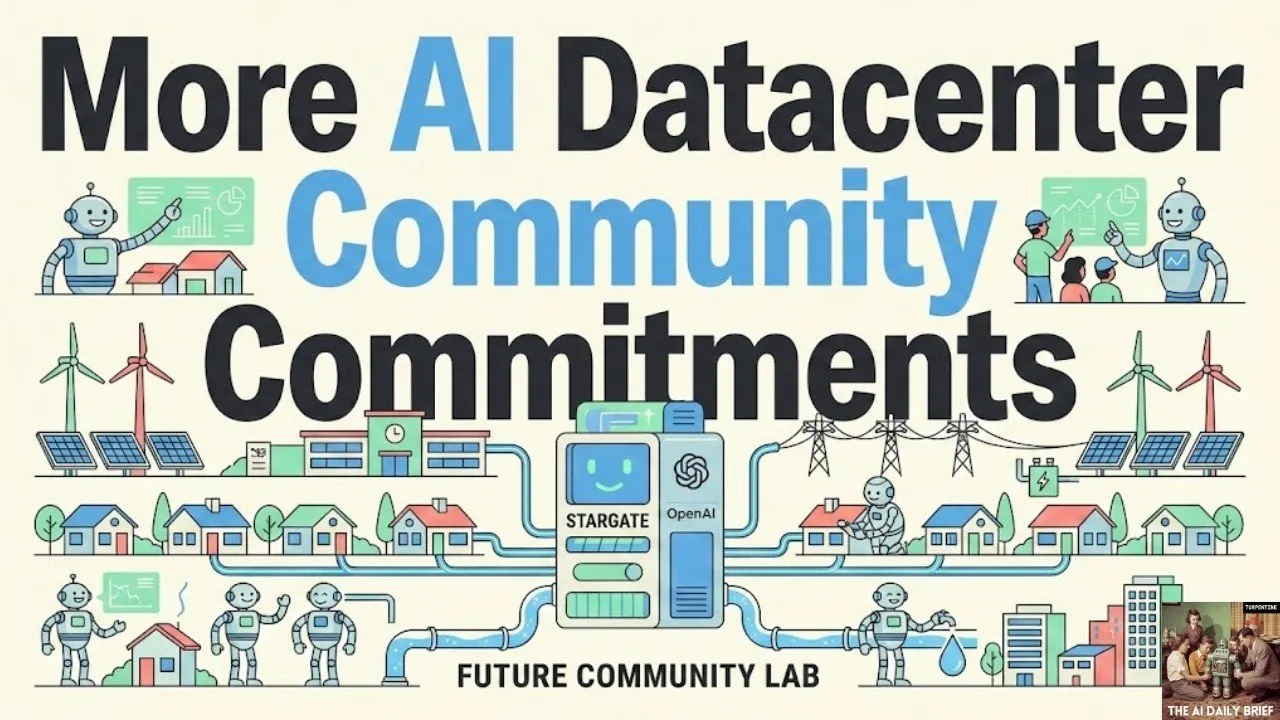
As the race to build massive AI data centers accelerates, the industry is pivoting to address the physical externalities of these facilities. OpenAI formally introduced "Stargate Community," a framework designed to ensure their infrastructure projects act as positive local partners rather than resource drains. A core tenet of the plan is financial and operational self-sufficiency regarding energy.
"Across all our Stargate community plans, we commit to paying our own way on energy so that our operations don't increase your electricity prices."
The company indicated that solutions would be tailored to specific locations, potentially involving the construction of independent power resources or funding local grid upgrades. Regarding water conservation—a contentious issue for data centers—OpenAI plans to utilize closed-loop or low-water cooling systems. Citing their facility in Abilene, Texas, the company referenced local officials stating that the data center’s annual water consumption would be approximately half of what the county consumes in a single day.
Simultaneously, the White House is intervening to protect consumers from spiraling energy costs in the Northeast. In collaboration with state governors, the administration is compelling PJM Interconnection, the nation's largest grid operator, to conduct an emergency wholesale power auction. PJM currently forecasts a 17% jump in peak demand by 2030.
The proposed auction structure aims to shift the financial burden of grid expansion from ratepayers to technology firms. By allowing tech companies to bid on 15-year contracts for new electricity generation—an increase from the standard 12-month terms—regulators hope to incentivize rapid construction while insulating existing customers from rate hikes. This move is politically significant for leaders like Pennsylvania Governor Josh Shapiro, who noted that PJM has been slow to integrate new generation despite rising demand.
Global Education and Workforce Development
Beyond physical infrastructure, major tech players are moving to address "human infrastructure" through education. OpenAI announced its "Education for Countries" program to combat the "capability overhang" and prepare workforces for a market where 40% of core skills may change by 2030.
The initiative involves partnerships with governments and universities in countries including Estonia, Italy, Jordan, and the UAE to embed AI tools and training directly into national curriculums. Additionally, OpenAI is establishing "OpenAI Academies" to provide credentialing for high-quality jobs in the skilled trades required to build and operate data centers, engaging with local labor unions to formalize these pathways.
Google is similarly expanding its educational footprint. Through a partnership with the Princeton Review, Google’s Gemini AI can now administer and grade full-length practice SAT exams. The tech giant also awarded $500,000 to Cal State Fullerton to improve AI literacy among educators, ensuring teachers can guide students in using the technology critically.
Davos Perspectives: Disruption vs. Opportunity
The societal adaptation to AI remained a central theme at the World Economic Forum in Davos, where industry titans debated the speed and nature of the coming economic shifts. Microsoft CEO Satya Nadella emphasized that the industry must maintain "social permission" to operate, warning that using scarce energy resources for AI is only justifiable if it delivers tangible improvements to human outcomes.
Nadella pushed back against the narrative of a jobless future, invoking the "Jevons paradox"—the economic theory that as technology increases the efficiency with which a resource is used, the total consumption of that resource increases rather than decreases.
"If you buy my entire argument that we've got a new commodity, it's tokens, and the job of every economy and every firm in the economy is to translate these tokens into economic growth, then if you have a cheaper commodity, it's better."
Conversely, JPMorgan CEO Jamie Dimon offered a starker assessment, warning that companies and governments cannot ignore the potential for rapid displacement. Using the trucking industry as an example, Dimon cautioned that an abrupt transition to autonomous systems could slash wages from $150,000 to $25,000 for millions of drivers, potentially triggering civil unrest if not managed through phased implementation and collaborative retraining.
Nvidia CEO Jensen Huang took a more bullish stance on the immediate future, arguing that the "largest infrastructure buildout in human history" is creating a massive boom for the physical trades. Huang suggested that labor shortages, rather than layoffs, would be the primary challenge, citing a surge in demand for plumbers, electricians, and steelworkers needed to construct the physical backbone of the AI economy.
Looking Ahead
The convergence of these announcements signals a maturing of the AI industry, moving from a phase of unchecked experimental growth to one requiring deep integration with public policy and physical infrastructure. The success of the White House’s emergency energy auctions will be a critical test case for whether the private sector can effectively subsidize national grid expansion. Meanwhile, as the 2024 U.S. election approaches, the balance between technological progress and energy costs will likely remain a pivotal issue for voters and policymakers alike.