Table of Contents
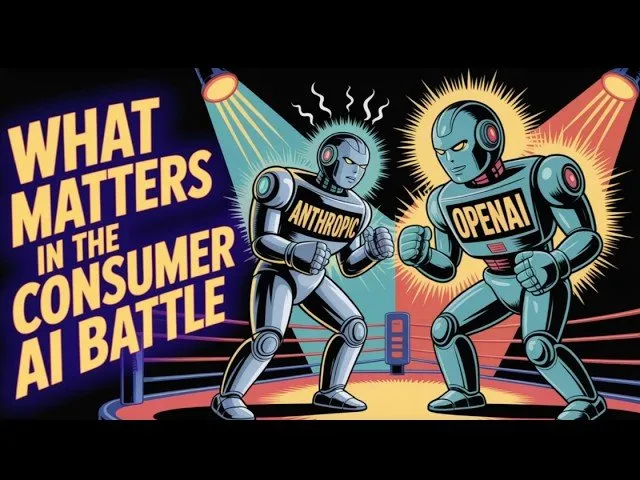
The competition between OpenAI and Anthropic has shifted from a niche technical race into a full-scale battle for consumer dominance. As Anthropic captures significant market share—reaching a reported $19 billion in annual recurring revenue (ARR)—the industry is forced to reconcile whether users prioritize raw performance, product "vibes," or ethical alignment in their choice of AI tools.
Key Points
- Anthropic has seen explosive growth, now commanding over 60% of business AI payments processed through Ramp, effectively matching OpenAI in revenue scale.
- OpenAI is combatting user dissatisfaction with the "insufferable" personality of its previous models by launching GPT-5.3 Instant, which promises a more direct, less moralizing, and "less cringe" user experience.
- The rise of agentic AI—where tools independently execute tasks—is expanding the market beyond power users to a broader, less technical demographic.
- Ethical friction, including OpenAI’s recent partnership with the Pentagon, has fueled a "Quit ChatGPT" movement, though the long-term impact on user retention remains to be seen.
The Shift in Consumer Priorities
For months, the industry debate centered on which model provided the most accurate, state-of-the-art performance. However, recent trends suggest that user experience, or "vibes," is becoming a critical competitive moat. OpenAI’s latest model update specifically addresses long-standing user complaints about "infantilizing" preambles and unsolicited advice. By stripping away moralizing guardrails, the company aims to move from a lecture-based interface to a utilitarian, direct assistant.
The model will no longer tell you to stop, take a breath, and make overbearing assumptions about the user's emotional state. The intention is to provide a straight answer rather than one bogged down in caveats.
This pivot recognizes that for many consumers, "good enough" performance is already achieved; therefore, the user interface and conversational tone become the primary differentiators. Whether these subjective qualities—or technical features like Anthropic’s new voice mode—will drive sustained loyalty remains a central question for the industry.
Market Dynamics and The "Agentic" Era
The transition from simple chatbots to agentic AI—systems capable of executing complex workflows—is proving to be a powerful catalyst for adoption. While critics initially dismissed complex tools as "work-only" features, current data suggests a significant appetite among non-technical users. Projects like Claude Code are attracting thousands of users who are not professional developers but are eager to automate their daily tasks.
Furthermore, the competitive landscape is complicated by the challenge of switching costs. While users appear willing to toggle between models, the "moat of memory"—the contextual history a user builds with a specific AI—makes migration difficult. This has led to speculation that regulators may eventually mandate data and memory portability, similar to how telecommunications regulators enforced number portability.
Ethics, Policy, and Future Adoption
The "Quit ChatGPT" movement, which claims over 2.5 million participants, highlights a growing intersection between AI adoption and political alignment. While 2.5 million represents less than 1% of the estimated 900 million users in the ecosystem, the rapid growth of Anthropic’s app downloads suggests that ethical considerations are no longer entirely negligible to the average consumer.
The battle moving forward will not be determined by a single feature or a superior benchmark score. Instead, success will likely favor the company that best manages the integration of these tools into the existing "home and work" ecosystems. As OpenAI prepares to release further updates, the market will soon discover if high-performance releases are enough to overcome the growing preference for platforms that align with user values and provide a seamless, non-intrusive experience.