Table of Contents
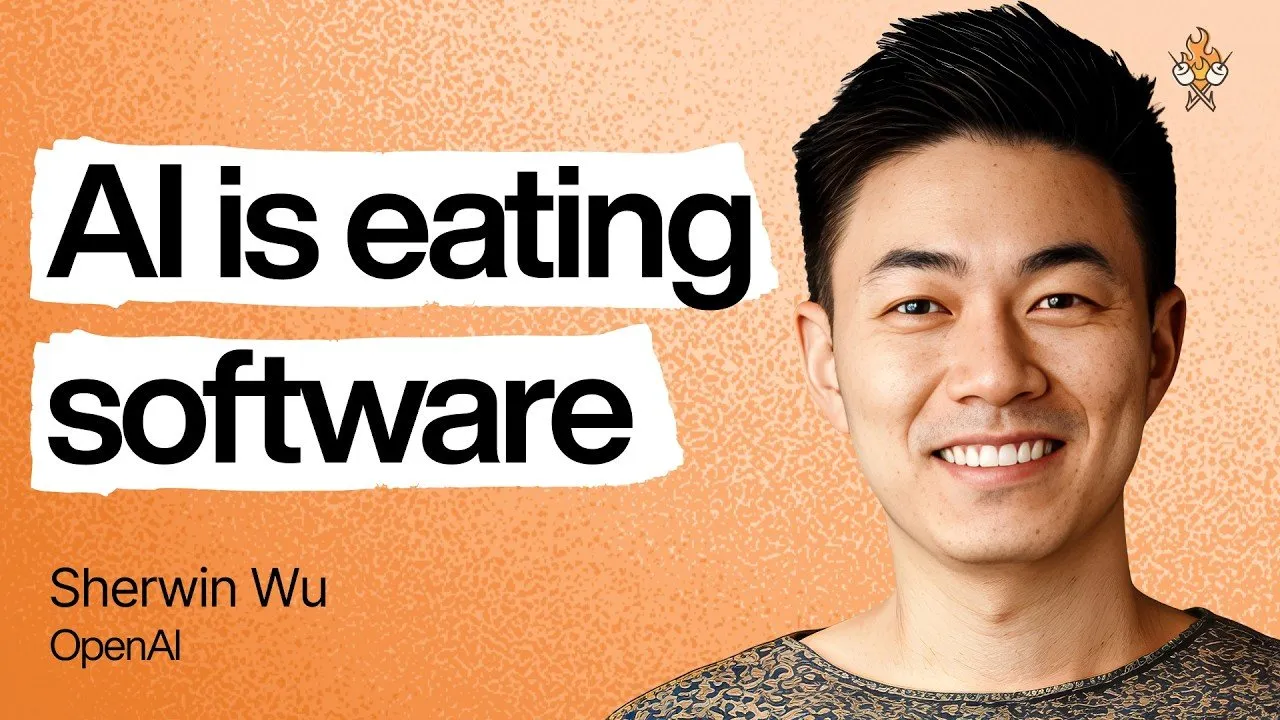
We are witnessing a fundamental shift in the definition of software engineering. At OpenAI, the internal metrics tell a startling story: 95% of engineers use Codex daily, and AI now reviews 100% of pull requests. The role is no longer about manually crafting every line of syntax; it is evolving into a high-level orchestration of intelligent agents.
Sherwin Wu, Head of Engineering for OpenAI's API, suggests that we are entering an era where engineers function less like construction workers and more like wizards. They cast "spells" in the form of prompts and manage fleets of autonomous agents to execute complex tasks. This transition brings massive leverage, but it also demands a new philosophy regarding management, product strategy, and the economic landscape of software startups.
Key Takeaways
- The "Sorcerer" Paradigm: Engineering is shifting from writing code to managing "fleets of agents," where the primary skill is crafting the right incantations (prompts) and supervising the output.
- The Surgeon Model of Management: In an AI-native organization, managers must treat top performers like surgeons, dedicating the majority of their time to removing blockers and "handing them the scalpel."
- The Scaffolding Trap: Startups should avoid building heavy infrastructure around current model limitations. As models improve, they will "eat your scaffolding for breakfast."
- A Golden Age for Niche SaaS: While the "one-person billion-dollar company" grabs headlines, the real explosion will likely be in thousands of smaller, highly profitable B2B startups building bespoke vertical software.
- Bottom-Up Adoption: Successful AI integration rarely comes from top-down mandates. It requires internal "tiger teams" of enthusiasts to discover and evangelize specific use cases.
From Writing Code to Casting Spells
The metaphor of the programmer as a wizard has existed since the 1980s, notably in the classic textbook Structure and Interpretation of Computer Programs (SICP). However, Sherwin Wu argues that for the first time, this metaphor is becoming literal. In the past, programming languages were the incantations. Today, natural language prompts serve as the spells that summon digital labor to execute tasks.
It literally feels like we're wizards casting all these spells. And these spells are kind of like going out and doing things for you... Engineers are becoming tech leads. They're managing fleets and fleets of agents.
This shift fundamentally changes the daily workflow of an engineer. At OpenAI, engineers who heavily utilize Codex open approximately 70% more pull requests (PRs) than those who do not. The friction of code generation has collapsed, allowing a single engineer to keep 10 to 20 threads moving simultaneously. However, this power comes with the "Sorcerer’s Apprentice" risk: without careful supervision, these agents—like Mickey Mouse’s enchanted brooms—can create chaos rather than value.
The "No Escape Hatch" Experiment
To understand the limits of this new paradigm, OpenAI is currently running an experiment where a specific team maintains a codebase written 100% by Codex. When the agent fails to implement a feature correctly, the engineers are not allowed to manually "fix" the code. Instead, they must improve the context, documentation, or "skills" files available to the agent.
This constraint has revealed a critical insight: when AI fails, it is usually a context problem, not a capability problem. The solution is often to encode tribal knowledge into the repository—via markdown files or comments—so the model can understand the intent. This suggests that the future of coding is less about logic construction and more about context curation.
The "Surgeon" Philosophy of Engineering Management
As individual contributors gain massive leverage through AI, the role of the engineering manager must also evolve. Wu draws on the "surgical team" concept from Fred Brooks's The Mythical Man-Month. In this model, the surgeon (the lead engineer) is the sole person doing the cutting, while others exist solely to support them.
While modern engineering remains collaborative, Wu applies this philosophy to management by focusing disproportionately on top performers. In an AI-augmented world, the gap between a good engineer and a great engineer widens significantly because high-agency individuals use these tools to supercharge their output.
Wu advises managers to spend upwards of 50% of their time with their top 10% of performers. The manager’s job is to look around corners, anticipate blockers, and ensure the "surgeon" has every tool they need before they even ask for it. Furthermore, AI tools are beginning to assist in this management layer. By connecting LLMs to organizational data (Slack, Notion, GitHub), managers can now generate deep-dive reports on team blockers and performance, effectively allowing them to manage larger teams with greater context.
The Economic Ripple Effects: A B2B SaaS Explosion
Much of the current venture capital discourse focuses on the impending arrival of the "one-person billion-dollar startup." While Wu agrees this is possible, he believes the second and third-order effects are more interesting. To enable that singular massive company, the market will require a vast ecosystem of bespoke software tools.
We may be entering a golden age of B2B SaaS, characterized not just by unicorns, but by thousands of smaller, highly profitable businesses. Because the cost of building software is collapsing, it is now economically via to build hyper-specific vertical tools that might only serve a small audience.
The implication for founders:
- Micro-SaaS Boom: There may be tens of thousands of startups generating $10 million in revenue with very small teams.
- Vertical Integration: Specialized AI tools will emerge for niche business processes that were previously too expensive to automate.
- Outsourcing over Hiring: The billion-dollar one-person company will likely achieve its scale not by doing everything alone, but by stitching together dozens of these bespoke SaaS products to handle support, ops, and logistics.
The Bitter Lesson for Product Scaffolding
For developers building on top of AI models today, there is a dangerous temptation to over-engineer. In the early days of GPT-3 and GPT-4, developers built elaborate "scaffolding"—complex vector stores, rigid agent frameworks, and intricate logic chains—to compensate for the models' limitations.
Wu warns that this is often a losing strategy. As models improve, they natively solve the problems that the scaffolding was designed to address, rendering that code obsolete.
The models will eat your scaffolding for breakfast... Make sure you're building for where the models are going and not where they are today.
We have already seen this play out with vector databases. In 2023, complex vector search architectures were considered essential for context retrieval. Today, models have larger context windows and better inherent retrieval capabilities, often making simple file-based search or "skills" files sufficient. The winning strategy is to bet on the model getting smarter, rather than building infrastructure that assumes it will stay stupid.
Business Process Automation: The Unsexy Opportunity
While Silicon Valley focuses on coding agents and creative tools, a massive, underappreciated opportunity lies in Business Process Automation (BPA). The vast majority of economic activity involves repeatable, standard operating procedures—processing insurance claims, managing logistics, or handling utility service requests.
These tasks are distinct from open-ended knowledge work. They require high determinism and adherence to strict protocols. Wu is bullish on applying AI to these unglamorous workflows. The potential to revolutionize how traditional industries operate is arguably larger than the impact on software engineering itself.
For companies looking to deploy AI, the anti-pattern is a top-down executive mandate. Successful deployment almost always comes from the bottom up. Wu suggests finding the "technical adjacent" employees—the Excel wizards or operations leads who are genuinely excited about the technology—and forming a "tiger team" to experiment. These evangelists can identify the specific business processes that are ripe for automation far better than a C-suite executive can.
Conclusion
The trajectory for the next 12 to 18 months points toward agents that can handle increasingly long horizons of work—moving from tasks that take minutes to those that take hours or days. Simultaneously, modalities like audio will likely become first-class citizens in enterprise workflows.
We are currently in a unique window of time where the rules of software and business are being rewritten. The technology is advancing rapidly, but the best practices for using it are still being discovered. For engineers and founders, the advice is simple: do not take this moment for granted. Engage with the tools, trust that the models will improve, and prepare to cast bigger spells.