Table of Contents
In the rapidly evolving landscape of software engineering, the bridge between human intent and machine execution is narrowing. Michael Bolin, a distinguished engineer who has navigated the technical cultures of Google, Meta, and now OpenAI, offers a unique perspective on how AI tools like Codex are fundamentally redefining the role of the developer. Through his journey from creating early web automation tools to leading technical teams on massive infrastructure projects, Bolin provides a roadmap for how engineers can remain relevant—and exceptionally productive—in the age of AI.
Key Takeaways
- The 80/20 AI Rule: Modern developers should embrace AI for the vast majority of coding tasks (80-90%), reserving human focus for architectural integrity, security-critical sandboxing, and complex refactoring.
- The Three-Step Career Framework: To maximize impact, identify what you love, align it with the core value drivers of your employer, and operate at the intersection of those two domains.
- Embrace Deep Technical Literacy: Despite the power of AI, understanding underlying layers—like operating systems and memory management—remains essential for solving non-trivial problems that high-level abstractions cannot address.
- The Shift to Cloud-Based Agents: While local coding agents offer speed, the long-term industry trajectory favors cloud-based environments that allow for large-scale automation, cross-team integration, and compute-heavy tasks.
The Evolution of Developer Productivity
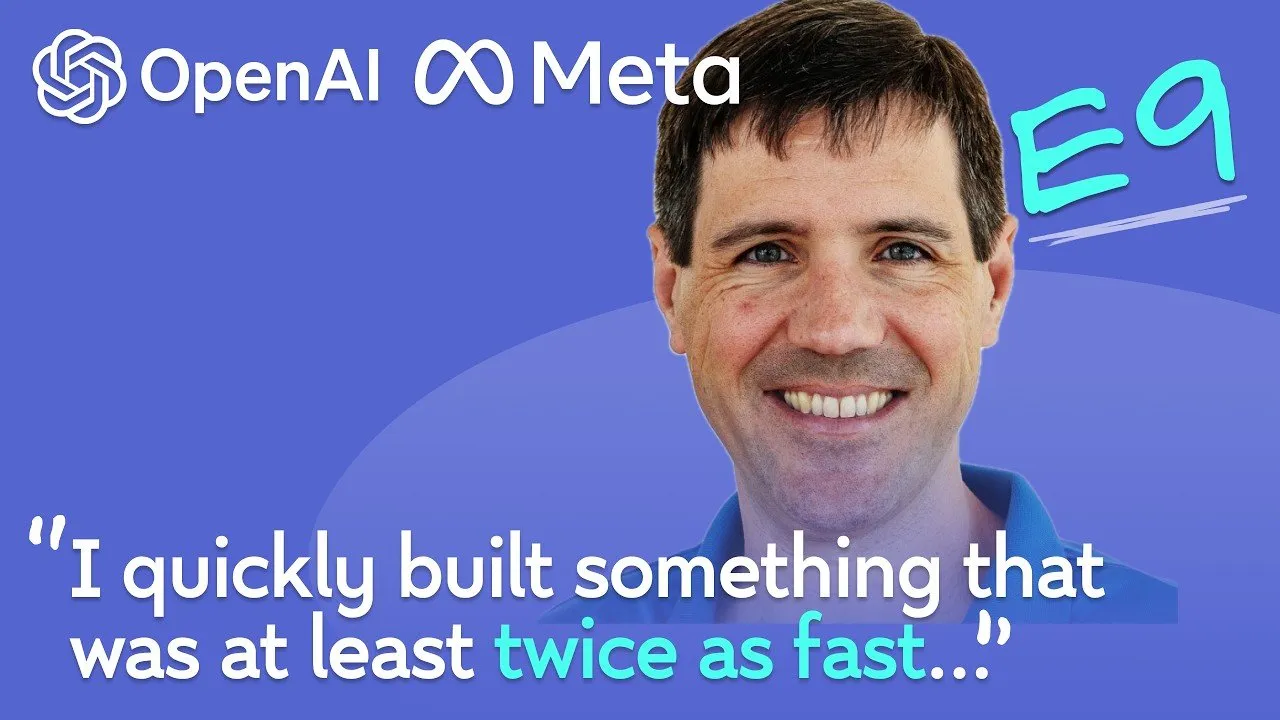
Bolin’s career reflects the shift from manual coding to leveraging advanced build systems and, eventually, AI-driven agents. His early work on build tooling at Meta—specifically the creation of Buck—was born from a fundamental dissatisfaction with slow iteration times. He recognized that if a process feels like it should be faster, it usually can be, provided one understands the underlying constraints.
From Manual Builds to Intelligent Agents
Bolin views the transition to AI coding as a liberation. "I almost feel a little bad writing code by hand," he notes, emphasizing that the bottleneck is no longer the physical act of typing, but the quality of the questions asked. By treating the AI as an agent that can handle the bulk of implementation, developers gain the bandwidth to act as "architects of intent" rather than mere typists.
The questions that you asked the agent is going to affect the quality of the thing that you get out.
Navigating High-Impact Engineering Roles
Achieving a principal-level (E8+) role requires a transition from being the primary "coder" to becoming an influencer who can move organizational mountains. Bolin admits that this shift is not without friction. Early in his tenure at Meta, his desire to fix technical debt—such as moving away from deprecated tools during the Microsoft-GitHub acquisition—was met with internal pushback. He learned that technical accuracy is only half the battle; the other half is organizational empathy.
The "Hero Quest" Trap
Bolin describes the "Hero Quest" as a common pitfall for high-level engineers: the belief that they can swoop into a complex project and solve a "Gordian Knot" problem in isolation. He warns that success at the highest level of industry is rarely about individual heroics. Instead, it is about identifying projects that act as force multipliers for the entire organization, often by collaborating with managers who can pair the right person with the right problem.
The Importance of First Principles
Even as AI automates boilerplate code, Bolin insists that deep technical education remains non-negotiable. He attributes his success on projects like the virtual file system Eden to his decision to study operating system internals cover-to-cover. He argues that many modern engineers risk becoming "layer-blind," operating so far above the hardware that they become unable to troubleshoot when those layers break down.
Adversarial Learning through CTFs
To cultivate this technical breadth, Bolin recommends Capture The Flag (CTF) competitions. These security-focused challenges force engineers to step outside their comfort zones, whether it is reverse-engineering assembly code or debugging obscure web configurations. "It helps with an adversarial mindset," he explains, noting that these games broaden an engineer's toolkit in ways that daily feature development cannot.
The Future of AI-Integrated Development
Bolin’s transition to OpenAI marks his focus on the next frontier: deep integration between the model and the development environment. At OpenAI, his work on Codex highlights a move toward cloud-based agentic workflows. Unlike local-only tools, these cloud environments can handle large-scale, automated tasks—such as managing entire CI/CD pipelines or resolving GitHub issues—without taxing the local machine's resources.
The Human Role in a Post-Code World
When asked what percentage of his work is model-generated, Bolin estimates 80% to 90%. However, the remaining 10% is where he adds the most value: ensuring security, maintaining test coverage, and guiding the model through complex architectural shifts. He encourages developers to move past the anxiety of being "replaced" and instead focus on becoming curators and reviewers of high-quality, AI-assisted output.
Ultimately, Bolin’s career trajectory underscores a vital truth: technology changes, but the core competencies of the elite engineer remain the same. The ability to identify systemic inefficiencies, the drive to learn the "how" behind the "what," and the capacity to align personal curiosity with organizational goals are timeless traits. As tools like Codex continue to lower the barrier to entry, these foundational skills will be the true differentiators that define the next generation of software leaders.