Table of Contents
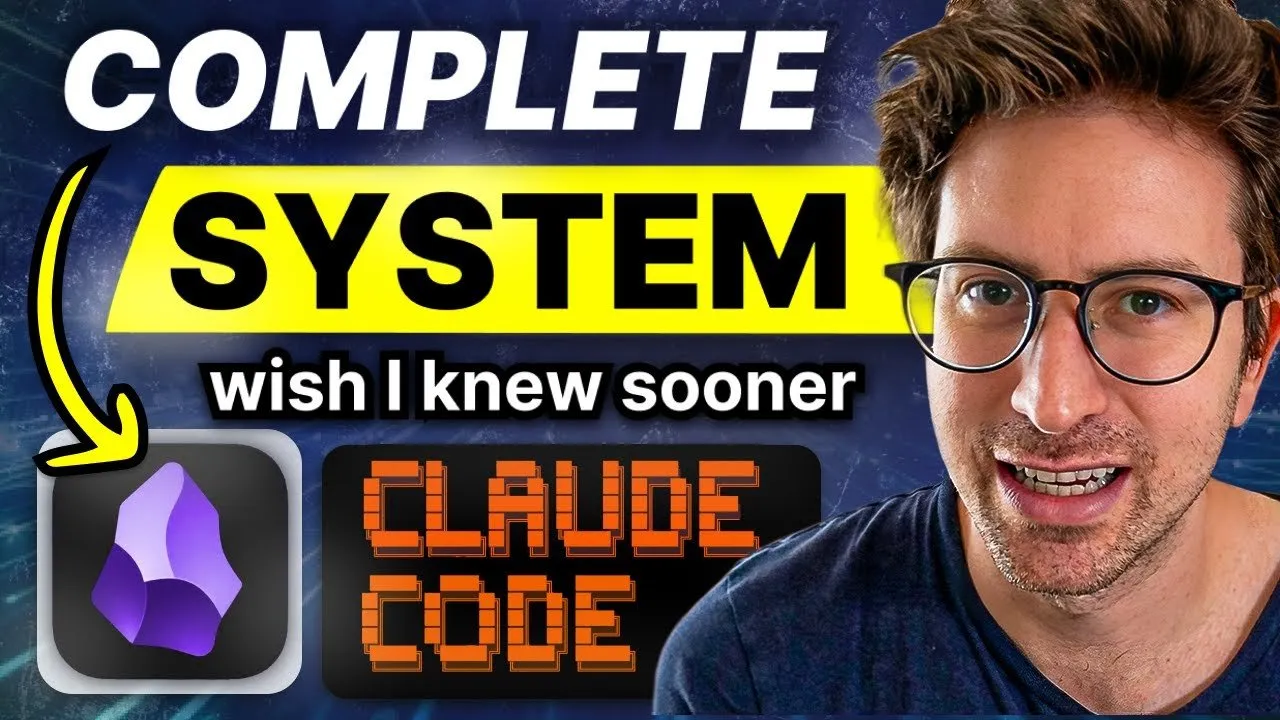
Most AI users treat Large Language Models (LLMs) like a disposable chat box, starting every session from scratch and struggling with "context drift." However, a more powerful paradigm is emerging: the integration of a structured "second brain" with agentic AI. By pairing Obsidian, a networked note-taking tool, with Claude Code, users are transforming their digital notes into a living, breathing personal operating system. This combination allows an AI to not only understand your current tasks but to recognize patterns in your thinking that you might have missed yourself.
Key Takeaways
- Context is the Leverage: The effectiveness of an AI agent is directly proportional to the quality and depth of the personal context you provide.
- Obsidian as a Relational Map: Unlike standard folders, Obsidian’s "Vault" allows AI to see interrelationships between ideas, people, and projects.
- Custom CLI Commands: Using Claude Code, you can build specialized "skills" to scan your vault, challenge your biases, and generate new startup ideas.
- Writing is Delegation: In an AI-driven world, the habit of daily reflection becomes the primary way you program your autonomous agents.
Solving the Context Gap with Claude Code
The primary friction in using AI today is the "cold start" problem. Every time you open a new chat window, you have to re-explain your goals, your preferences, and your project history. This is not only time-consuming but leads to inconsistent results. Claude Code, a command-line interface (CLI) agent, changes this by allowing you to feed local files directly into the LLM's workflow.
As Internet Vin explains during his demonstration, the ability to control a computer through natural language is only half the battle. The real power lies in persistence. By referencing a project description or a "context file" on your desktop, you can skip the introduction and get straight to work. This turns the AI from a stranger into a long-term collaborator who remembers your previous decisions.
"The whole game is feeding the beast good context."
By maintaining a "source of truth" in plain text files, you ensure that the agent always has access to the most up-to-date version of your dreams, goals, and constraints. This eliminates the need for the AI to "guess" what you want, leading to more accurate and personalized output.
The Obsidian Vault: A Map of Your Mind
Obsidian is often described as a second brain, but its true utility lies in its structure. It sits on top of a collection of Markdown (.md) files. While a standard folder is a hierarchy, an Obsidian Vault is a network. By using bidirectional linking, users create a "graph" of their knowledge.
When you connect Claude Code to the Obsidian CLI, the AI doesn't just read individual notes; it sees the relationships between them. It can identify that a note about "filmmaking" is linked to a note about "world building," which is further linked to a specific startup project. This structural awareness allows the AI to perform deep pattern recognition that would be impossible for a human to do manually across thousands of notes.
The Power of Interconnectivity
Interrelationships are what differentiate a digital archive from a thinking partner. When an agent can see how your ideas have evolved or how different domains of your life overlap, it can surface "latent ideas"—conclusions that your notes imply but which you haven't explicitly stated yet. This turns your note-taking habit into an automated insight engine.
Automated Intelligence: Custom CLI Skills
One of the most transformative aspects of Vin’s workflow is the creation of custom "skills" or commands within the terminal. Rather than just chatting with Claude, he uses specific shortcuts to trigger complex analytical tasks. These commands include:
- /context: Loads a comprehensive picture of his life, work, and current state from daily notes.
- /emerge: Surfaces unnamed patterns and unarticulated directions hidden across scattered notes.
- /ghost: Writes a response in his specific voice based on his entire history of writing.
- /challenge: Pressure-tests current beliefs by finding contradictions or counter-evidence in the user's own vault history.
These commands act as a "thinking partner," allowing the user to step back and look at their own thoughts from a higher level of abstraction. Instead of just asking the AI to "write an email," you can ask it to "find the contradictions in my current business strategy."
The "Trace" Command and Intellectual Evolution
A standout feature of the Obsidian and Claude integration is the ability to track the evolution of an idea. During the episode, Vin demonstrates the /trace command, which scans 13 months of notes to see how his relationship with a specific tool has changed.
The AI can identify distinct phases of development: from early skepticism and raw excitement to a pivotal realization about how to structure information. This historical perspective is vital for personal growth. It allows you to see how your skill levels are increasing and how your theories are compounding over time.
"The quality of information that the agent has entirely determines what it can do for you."
This capability turns a simple folder of text files into a perfect memory. Unlike human memory, which is often biased or fading, the Markdown files provide an objective record of what you thought at a specific moment in time. When the AI analyzes this record, it can provide a high-fidelity report on your intellectual progress.
From Reflection to Actionable Building
While many use Obsidian for reflection, the ultimate goal is action. By scanning a vault, Claude Code can suggest specific tools or commands that the user should build to improve their life. For example, the AI might notice that your daily notes are full of brilliant ideas that never get developed, and subsequently suggest (and build) a "Graduate" command to promote those ideas into standalone projects.
This creates a virtuous cycle:
- You write notes and reflect on your day.
- The AI identifies bottlenecks or opportunities in those notes.
- The AI builds the software or tools necessary to address those opportunities.
- You use those tools to become more productive, feeding more data back into the vault.
Writing as the New Programming
In this new paradigm, writing is the primary way you delegate tasks to agents. Developing a strong writing and reflection habit is no longer just about "journaling"; it is about creating the technical specifications for your personal AI. If you can describe a preference or a workflow in a note, you can automate it.
"Writing right now is a big way of how you delegate things to agents."
The Future of the Personal OS
As we move toward a world of autonomous agents like OpenClaw, the Obsidian Vault serves as the "source code" for your personal AI. Instead of managing the agent directly, you manage the vault. If the agent makes a mistake or fails to understand your goals, you don't just correct the agent; you update the information in your vault.
This shift raises significant questions about privacy and data ownership. While giving an AI access to your "second brain" is daunting, the potential rewards—a happier, healthier, and wealthier life driven by "ideas on tap"—are immense. We are witnessing a fundamental shift in the human relationship to computers, moving from tools we operate to partners we co-evolve with.
Whether you use Obsidian or another Markdown-based tool, the message is clear: the alpha in the AI age belongs to those who can organize their context. Start building your vault today, and give your AI the memory it needs to truly serve you.