Table of Contents
NVIDIA’s recent GTC 2026 conference felt less like a tech event and more like a pivotal moment in global industrial history. With 30,000 attendees and a vision spanning from planetary-scale data centers to space-based orbital infrastructure, Jensen Huang’s empire is rapidly becoming the backbone of the modern economy. Yet, NVIDIA is only one piece of a rapidly shifting landscape where Anthropic is challenging OpenAI’s dominance, Elon Musk is building a "TerraFab" to bypass semiconductor bottlenecks, and the traditional job market for computer science graduates is undergoing a painful, structural collapse. Welcome to the era of the organizational singularity.
Key Takeaways
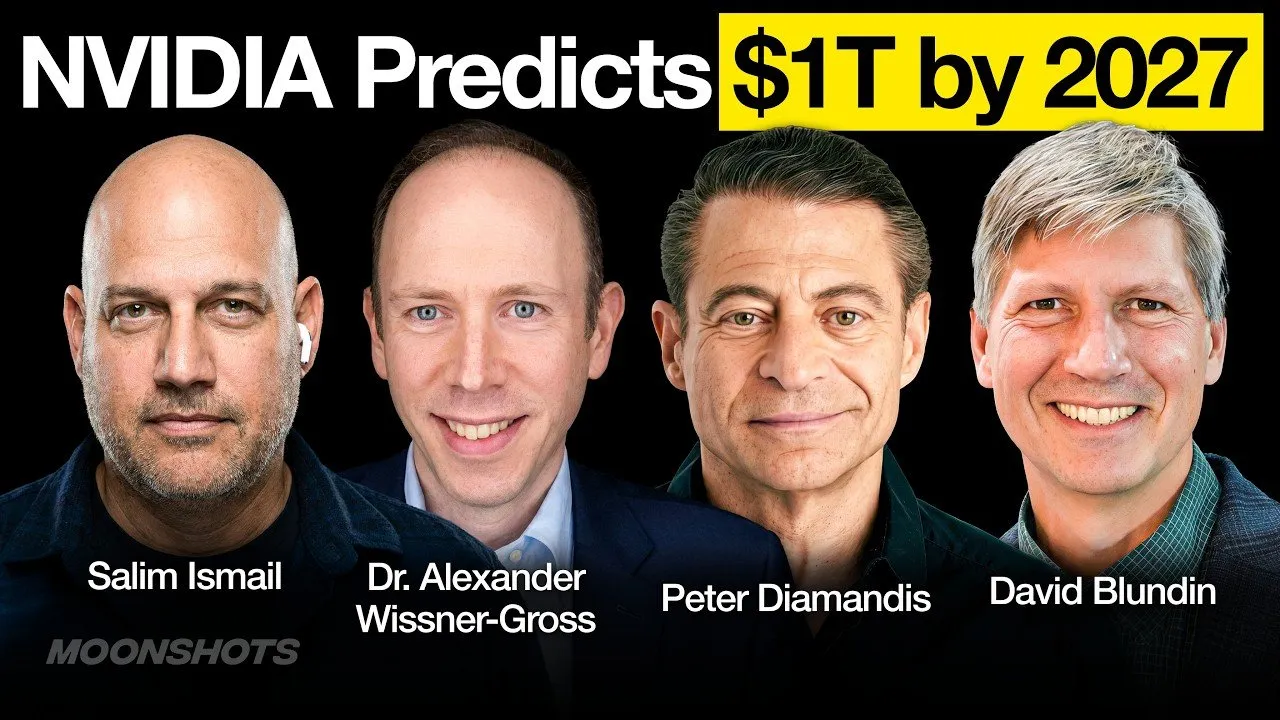
- NVIDIA’s Trillion-Dollar Trajectory: Jensen Huang is positioning NVIDIA as the essential infrastructure provider for everything from robotics to space-based computing, targeting $1 trillion in revenue by 2027.
- The Organizational Singularity: As agentic AI workflows like OpenClaw gain adoption, human-to-human corporate processes are rapidly becoming obsolete, forcing a shift toward AI-native operating systems.
- The Anthropic vs. OpenAI Shift: Enterprise adoption has swung heavily toward Anthropic, highlighting a growing preference for reliability and specialized inference capabilities over consumer-facing AI models.
- The CS Job Collapse: New data reveals a sharp decline in computer science placement rates and starting salaries, signaling that traditional degrees are losing value to meritocratic, project-based skills.
- The Rise of Universal High Income (UHI): Visionaries like Elon Musk suggest that as AI drives down the cost of goods and services toward the price of electricity, the economic focus will shift from job-based wages to UHI, ensuring a share of total economic output.
The Rise of AI-Native Infrastructure
The speed at which AI capabilities are evolving has left legacy systems struggling to keep pace. Jensen Huang’s vision for NVIDIA is not just to sell chips, but to build an ecosystem where "radical innovation at the edges" can thrive. This approach mirrors the early days of Microsoft and Google, but at a scale amplified by current exponential trends.
The OpenClaw Phenomenon
OpenClaw has emerged as a record-breaking open-source project, scaling faster than both Linux and Facebook. It represents the "unhobbling" of AI agents—systems that can work 24/7, messaging and reasoning on top of existing language models. For enterprises, this is a monster implication. As agents begin to perform recursive self-improvement on business workflows, human-to-human bottlenecks are being stripped away.
"Once you have that recursive self-improvement in business workflows, all human-to-human workflows essentially evaporate. You can't compete because once you put a workflow into this set of agents, they’re optimizing it by themselves."
The Frontier Lab Arms Race
While OpenAI defined the early phase of the AI revolution, Anthropic is effectively capturing the enterprise market. Current data shows a stark reversal in enterprise customer share, with Anthropic scaling from 40% to over 70% in just three months, while OpenAI’s share has dropped significantly. This shift suggests that enterprise buyers are prioritizing stability and reliability in their pursuit of actionable reasoning.
Specialization vs. Generalization
OpenAI’s bet that consumers would be as hungry for reasoning compute as enterprises turned out to be less accurate than anticipated. Conversely, Anthropic’s forced focus on enterprise needs—due to limited initial resources—has paradoxically positioned them as the preferred partner for businesses facing existential competitive risks.
The Hardware Bottleneck and Elon's TerraFab
The demand for compute is currently gated by TSMC’s manufacturing capacity. NVIDIA has locked up much of this supply, but the industry is hitting a ceiling that only new manufacturing paradigms can break. Elon Musk’s "TerraFab" initiative is the latest attempt to solve this by bringing chip production under direct control, targeting a scale that dwarfs current global output.
Geopolitical Implications of Self-Sufficiency
By scaling independent chip production in the United States, companies like Tesla are fundamentally de-risking their supply chains. If such ventures succeed, they represent more than just a win for a specific corporation—they are a critical hedge against global geopolitical instability. As the race to achieve faster-than-Moore’s-Law improvements continues, the companies that control their own hardware stacks will likely emerge as the most resilient entities of the next decade.
The Death of Traditional Credentials
Perhaps the most sobering realization this week is the collapse of the traditional computer science career path. Recent data from the Tech Layoff Tracker paints a bleak picture for new graduates, with placement rates plummeting and starting salaries failing to meet expectations. The "ladder" of high school to college to a corporate tech job is effectively being pulled up.
The Rise of the Entrepreneurial Mindset
The solution is no longer found in traditional university degrees, which are becoming increasingly disconnected from the pace of technological change. Instead, the focus has shifted entirely to meritocratic output—what a developer can build, share on GitHub, and deploy via a startup. If you are not building, you are increasingly at risk of being on the menu rather than at the table. The only path forward in an AI-dominated economy is to become a creator and an entrepreneur.
Conclusion
We are living through a supersonic tsunami of technological change that is rewriting the rules of industry, education, and governance. Whether it is the move toward nuclear energy to power massive data centers, or the emergence of physical AI (robotics) to solve industrial challenges, the mandate for the individual is clear: get future-ready. By moving away from scarcity-based mindsets and embracing a strategy of abundance—building, creating, and leveraging AI to perform the work of tomorrow—we can participate in the greatest economic expansion in human history. The tools are here; the question now is how we choose to use them to shape the future.