Table of Contents
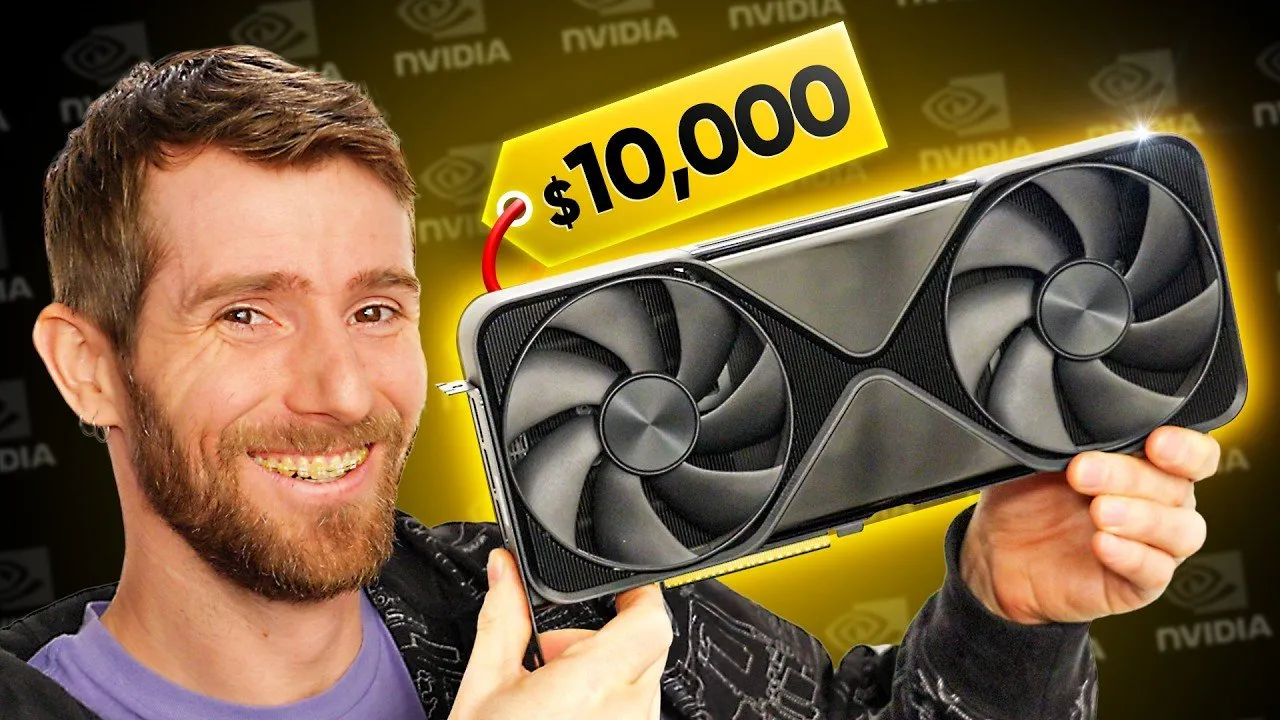
In a rare look at enterprise-grade hardware, independent testing has revealed the capabilities of Nvidia’s unreleased RTX Pro 6000 Blackwell, a $10,000 workstation GPU designed to supersede the consumer-focused RTX 5090. While Nvidia did not distribute review units to standard media outlets, a partnership with system integrator Falcon Northwest has provided a first look at the card’s specifications, which include a massive 96GB of GDDR7 VRAM and core counts that technically outclass the world's fastest gaming cards.
Key Points
- Unmatched Specifications: The RTX Pro 6000 features 10% more CUDA, Tensor, and Ray Tracing cores than the RTX 5090, along with triple the video memory (96GB vs. 32GB).
- Resolution Scaling: While the consumer RTX 5090 remains competitive at 1080p, the Pro 6000 demonstrates up to a 15% performance lead in 4K gaming workloads.
- Enterprise Pricing: Valued at approximately $10,000, the card targets professional rendering and heavy AI inference workloads rather than the general enthusiast market.
- Hardware Variations: The GPU is available in three configurations, including a 300W blower, a passive server unit, and a 600W "workstation beast" with active cooling.
Hardware Architecture and Specifications
The RTX Pro 6000 Blackwell represents the pinnacle of Nvidia’s current semiconductor engineering. Although it shares the same 512-bit memory bus as the consumer flagship RTX 5090, the professional variant maximizes the silicon's potential. The card boasts a 10% increase across all core metrics—CUDA cores for rasterization, Tensor cores for AI processing, and RT cores for ray tracing.
Notably, Nvidia has increased the rated boost clock by 8% compared to standard professional card tuning, which typically sacrifices speed for stability. The most significant differentiator, however, is the memory capacity. With 96GB of GDDR7 VRAM, the card eliminates the memory bottlenecks that plague complex 3D rendering and Large Language Model (LLM) inference on consumer hardware.
For media professionals, the hardware includes an additional 9th-generation NVENC encoder and two extra 6th-generation NVDEC decoders, streamlining high-resolution video workflows.
"It's the kind of ludicrous hardware that makes you want to say, 'Holy [expletive].' [It is] designed to take on anything from professional rendering to AI workloads."
Performance Analysis: Gaming and Professional Workloads
Benchmarking results present a complex picture of how raw power translates to real-world performance. In 1080p gaming scenarios, the RTX 5090 occasionally outperforms the $10,000 Pro card by margins of 7% to 11%. Analysts attribute this anomaly to driver optimization; the RTX 5090 utilizes "Game Ready" drivers, whereas the Pro 6000 relies on enterprise drivers which prioritize stability over aggressive clock boosting in low-load scenarios.
However, the dynamic shifts dramatically as resolution increases. At 1440p and 4K, the Pro 6000’s superior core count allows it to pull ahead.
- 4K Gaming: In titles like Cyberpunk 2077, the Pro 6000 converts a 1080p deficit into a 15% lead over the RTX 5090 at 4K.
- AI Inference: Computer vision tasks run approximately 14% faster on the Pro hardware.
- 8K Resolution: While the Pro card maintains a lead, CPU bottlenecks and diminishing returns result in similar frame rates to the 5090, suggesting current system architectures struggle to fully feed these GPUs at extreme resolutions.
Market Implications and Use Cases
The existence of the RTX Pro 6000 highlights the growing segmentation in Nvidia’s product stack. For the vast majority of creative professionals using Adobe Creative Cloud or Blender, the RTX 5090 provides nearly identical performance for a fraction of the cost. The 32GB of VRAM on the consumer card is sufficient for most standard 4K video editing and 3D scenes.
The Pro 6000 is strictly positioned for edge cases where memory capacity is non-negotiable. This includes production-grade rendering involving massive texture pools, uncompressed 8K video pipelines, and local AI model training that exceeds the 32GB buffer of the 5090.
"The RTX Pro 6000 can fit much larger models in VRAM than the 5090 could ever dream of running efficiently... If you work in professional applications that require certified drivers, or if you use software that prioritizes Nvidia for the latest optimizations, this is as good as it gets."
Looking Ahead
Despite the high entry price, the market for ultra-high-end GPUs is expanding. With scalped versions of the RTX 5090 already reaching $4,000, the gap between enthusiast and enterprise pricing is narrowing. As 8K displays become more prevalent and AI models grow in complexity, the demand for 96GB+ memory buffers is expected to trickle down from the server room to the high-end workstation.
For now, the RTX Pro 6000 stands as the fastest PCIe card available, serving as a glimpse into the future performance tiers of consumer hardware.