Table of Contents
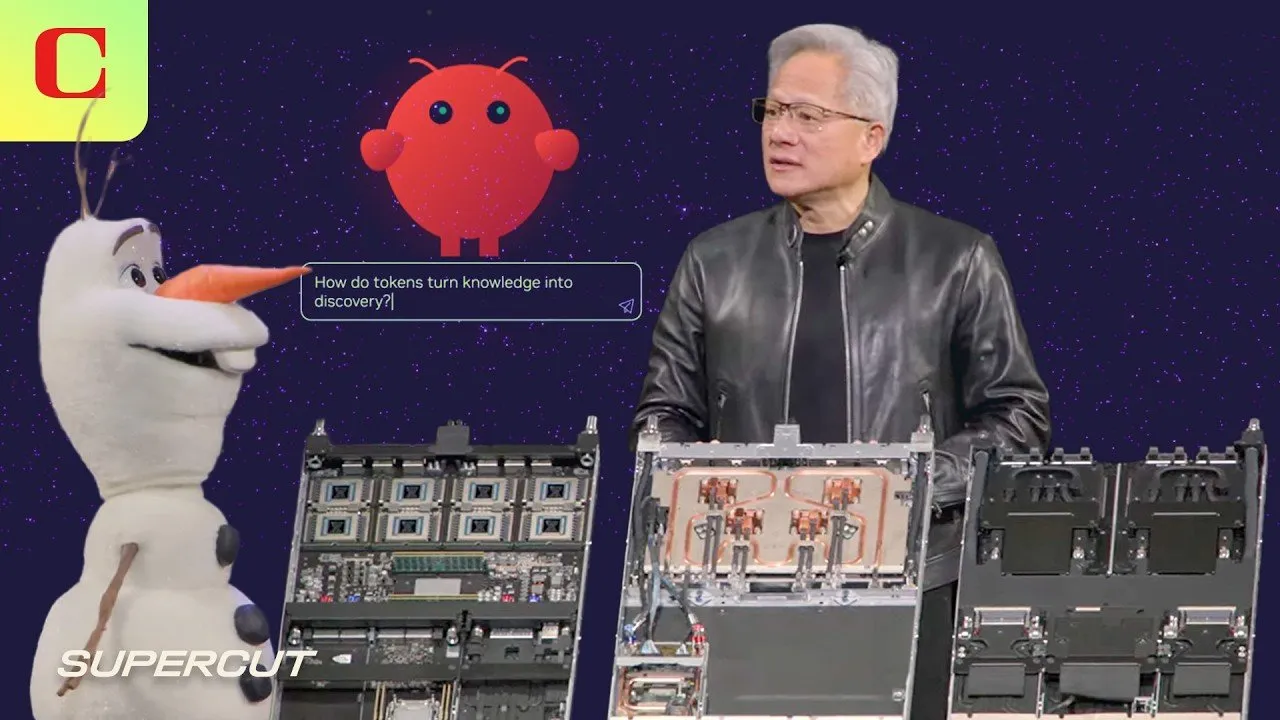
NVIDIA officially unveiled its next-generation technological roadmap at the GTC 2026 keynote, signaling a pivot toward "AI factories" and the integration of generative AI with structured data. The announcement featured advancements in neuro-rendering, new data center hardware, and the introduction of open-source agentic frameworks that aim to transform how enterprises build and deploy autonomous systems.
Key Points
- NVIDIA introduced DLSS5, a new neuro-rendering technology that fuses traditional 3D graphics with probabilistic generative AI.
- The company launched the Vera Rubin system, a fully liquid-cooled data center architecture designed to drastically reduce installation and manufacturing cycle times.
- Spectrum X with co-packaged optics (CPO) has entered full production, leveraging proprietary technology developed with TSMC.
- The firm announced support for Open Claw, an open-source project described as the "operating system for agentic computers," aimed at standardizing personal AI agents.
The Convergence of Structured Data and AI
At the core of the 2026 GTC presentation was the emphasis on the fusion of structured data—the foundation of enterprise business intelligence—with generative AI. NVIDIA leadership highlighted that while generative AI is probabilistic, structured data provides the necessary "ground truth" to ensure AI outputs remain trustworthy and controllable. By combining these, the company aims to move beyond simple chatbots toward systems that can reason, reflect, and perform complex tasks autonomously.
The concept of fusing structured information and generative AI will repeat itself in one industry after another. Structured data is the foundation of trustworthy AI.
To facilitate this shift, NVIDIA is positioning its ecosystem to support data frames across major platforms, including Snowflake, Data Bricks, and Google Cloud BigQuery, ensuring that high-performance compute can interact directly with the massive datasets that define modern enterprise computing.
Hardware Innovation and Data Center Efficiency
The keynote highlighted significant leaps in infrastructure, most notably with the Vera Rubin system. Moving away from traditional cabling and air cooling, the new architecture is entirely liquid-cooled, allowing for a 45° Celsius intake, which significantly lowers data center energy overhead. These systems are powered by a new, highly efficient CPU designed specifically for high-thread-count data processing and agentic workloads.
Complementing this is the sixth-generation NVLink, a proprietary scale-up switching system. According to the announcement, this technology remains a key differentiator, as it provides the high-bandwidth backbone required for modern AI clusters that standard Ethernet or InfiniBand may struggle to support at scale.
The Rise of Agentic Computing
NVIDIA’s support for Open Claw marks a transition from AI that simply "answers questions" to AI that "performs work." By allowing developers to create agents that can access file systems, manage scheduling, and spawn sub-agents, NVIDIA is treating these frameworks as the next evolution of the personal computer.
The demonstration featured an interaction between a human operator and an autonomous Omniverse character, utilizing the Newton physics solver. This integration of 3D virtual world modeling with autonomous reasoning underscores the company's broader ambition: creating robots and digital entities that can navigate and adapt to the physical world with high levels of intelligence.
Future Outlook
As NVIDIA shifts to a platform-centric model—focused on CUDA X, custom systems, and AI factories—the industry can expect a move toward standardized "agentic operating systems." With Spectrum X already in production, the company is prioritizing the rapid deployment of these technologies to keep pace with the demand for smarter, more efficient AI infrastructure. Developers and enterprise users should anticipate further integration of these agentic tools into standard DevOps workflows over the coming months.
![CAUTION: This Bitcoin TRAP Is Almost Set! [How I’m Playing It]](/content/images/size/w1304/format/webp/2026/03/bitcoin-price-trap-warning-market-analysis.jpg)