Table of Contents
The pace of innovation in Silicon Valley has shifted from rapid to blistering. In the latest discussion on This Week in Startups (now simply rebranded as "Twist"), the conversation dives deep into a hypothetical yet startlingly realistic 2026 landscape. From Nvidia’s massive strategic acquisitions to the cultural ripple effects of GLP-1 drugs on the hospitality industry, the ecosystem is undergoing a fundamental restructuring.
The following analysis breaks down the critical shifts discussed, ranging from $20 billion hardware consolidations to the democratization of legal work through AI, offering a roadmap for what founders and investors can expect in this accelerating market.
Key Takeaways
- Nvidia's $20 Billion Defense: The acquisition of Groq via a non-exclusive licensing deal signals Nvidia's move to secure inference dominance against Google's TPUs.
- The "Ozempic Effect" on Hospitality: High-end dining is facing an existential crisis as GLP-1 usage reduces food and alcohol consumption, altering restaurant economics.
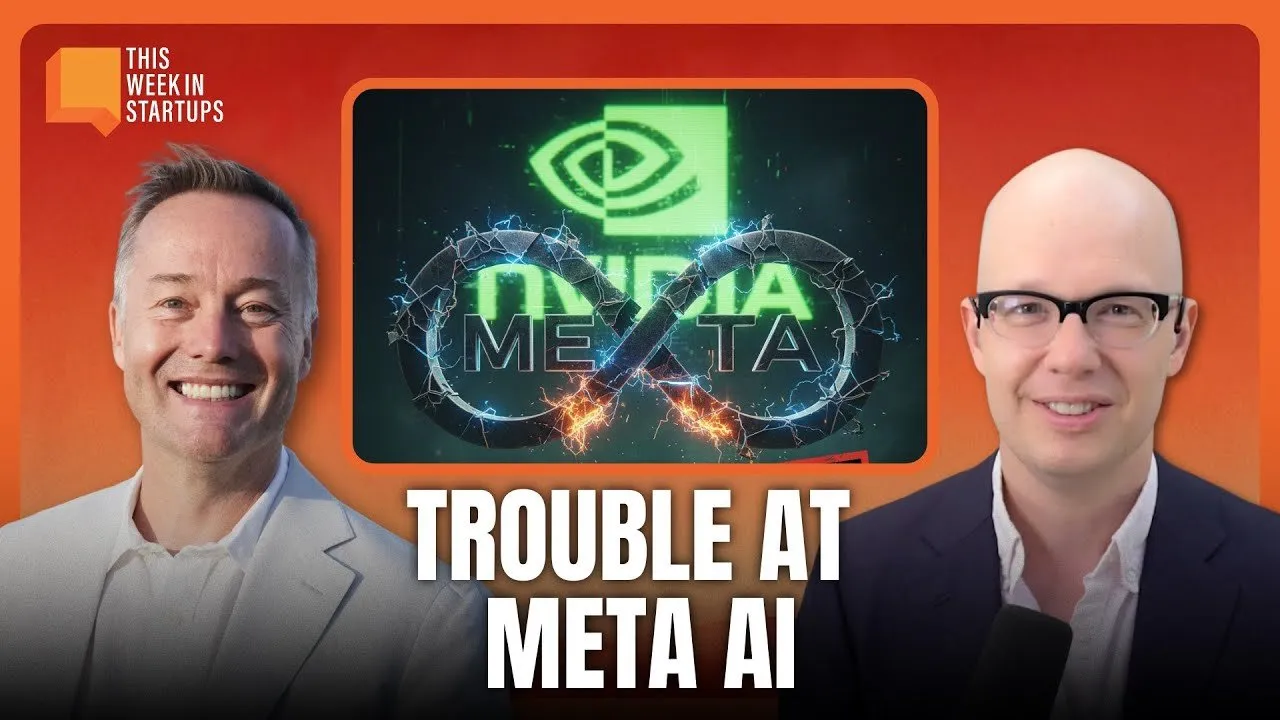
- Meta's Internal Power Struggle: Tension between AI research pioneers and new product-focused leadership has led to significant departures and a shift in strategy.
- Prediction Markets as Truth Engines: Platforms like Poly Market are becoming the go-to source for forecasting geopolitical events and the IPO pipeline.
- AI Replacements for Professional Services: Tools like Google NotebookLM are allowing founders to bypass expensive legal fees, marking a return to "rugged individualism" in startup culture.
The Chip Wars: Nvidia’s $20 Billion Groq Acquisition
The headline-grabbing news of 2026 is Nvidia’s acquisition of Groq for approximately $20 billion. This is not a standard merger; it is structured as a non-exclusive licensing agreement for Groq’s inference technology. This deal represents a "home run" for early investors, turning a seed fund investment into a potential 20x return.
Strategically, this move is about more than just adding technology; it is about defensive positioning. Nvidia has long dominated the training side of AI with its GPUs. However, as the industry shifts focus to inference—the actual operation of AI models when they answer queries—competitors like Google’s TPUs have gained ground. By integrating Groq’s architecture, founded by former Google TPU engineer Jonathan Ross, Nvidia is effectively de-risking its future.
The Regulatory Workaround
The structure of this deal is particularly notable. By opting for a licensing agreement rather than a full equity purchase, the companies effectively bypassed slower FTC regulatory approvals. While this allows for immediate liquidity and technology transfer, it comes with tax implications. Proceeds from such deals are often treated as ordinary income rather than long-term capital gains, a trade-off investors seem willing to accept for speed and certainty.
"We need these singles and doubles to keep the venture space vibrant. And this will be great for me as a GP to send a distribution to our LPs."
The Hospitality Crisis: GLP-1s and Cultural Shifts
Beyond the data centers, the "real economy" is seeing a massive disruption driven by biology. Top-tier restauranteurs in Los Angeles and beyond are reporting a collapse in the traditional fine dining business model. The culprit is a convergence of modern habits: the widespread use of GLP-1 agonists (like Ozempic and Mounjaro) and a shift away from alcohol toward cannabis and other substances.
The economics of a restaurant rely heavily on alcohol sales and high check averages. However, with patrons on appetite suppressants ordering significantly less food and abstaining from alcohol, the "middle tier" of dining—the $75 per person meal—is evaporating. The market is bifurcating into ultra-expensive, experience-driven venues ($300+ per person) and fast-casual chains like Sweetgreen.
The Peptide "Grey Market"
This shift is supported by a burgeoning "grey market" for peptides. Compounding pharmacies and international suppliers are creating a cottage industry for substances like Retatrutide. Similar to the early days of the cannabis industry, independent testing sites are emerging to verify the purity of these batches, creating a semi-legitimate infrastructure around non-FDA-approved biohacking. This sector is predicted to be one of the significant business opportunities of the coming years, despite the medical risks.
Meta’s AI Turbulence and Strategic M&A
The internal dynamics at Meta have become a focal point of industry gossip. The restructuring of the AI division has led to the departure of Yann LeCun, a Turing Award winner and one of the "godfathers of AI." Reports suggest friction arose after LeCun was asked to report to Alexander Wang, the founder of Scale AI, who was brought in to lead the super-intelligence team.
This clash highlights a broader tension in Silicon Valley: the philosophical divide between academic research and aggressive product scaling. Critics argue that sidelining a researcher of LeCun's caliber in favor of younger, product-focused leadership risks alienating top talent. Furthermore, admissions that benchmarks for models like "Llama 4" may have been curated or "fudged" to appear more competitive have cast a shadow over recent releases.
Geopolitical Asset Extraction
On the acquisition front, Meta’s purchase of the "Butterfly Effect" startup for $2.5 billion underscores a new playbook for global capital. The company, originally Chinese, moved operations to Singapore to become palatable for Western acquisition. This "extraction" strategy allows US giants to acquire top-tier engineering talent and IP from China while navigating the complex web of international sanctions and investment bans.
Forecasting 2026: The IPO Pipeline
Prediction markets, specifically Poly Market, have evolved from novelty gambling to essential sentiment indicators. Traders are now pricing in the probabilities of major liquidity events for the 2026-2027 window. The current sentiment suggests a robust pipeline for tech IPOs:
- Cerebras: 80% probability. Positioned as a strong hardware competitor, the market views an IPO as imminent.
- SpaceX: 74% probability (though likely understated). With massive government contracts and Starlink revenue, a public offering seems inevitable.
- Discord: 50% probability. The market views this as underpriced, with a listing likely overdue.
- Anthropic: 50% probability. Given their capital requirements to compete with OpenAI, public markets may be the necessary next step.
- OpenAI: 50% probability. Despite massive private funding rounds (including backing from SoftBank), the sheer burn rate required to achieve AGI may force a public listing by 2027.
The Return of Rugged Individualism
Perhaps the most empowering shift for early-stage founders is the collapse of professional service costs due to AI. Venture capitalist Fred Wilson recently highlighted how he used Google’s NotebookLM to perform legal due diligence that previously cost $50,000. By uploading deal documents and data rooms into the LLM, he was able to interrogate the data and close the deal with minimal outside counsel.
This represents a return to "rugged individualism." Just as cloud computing collapsed the cost of server infrastructure a decade ago, AI is collapsing the cost of legal, accounting, and administrative work. Founders can now reach significant revenue milestones without a lawyer or accountant, using AI agents to handle the back office. While risky, this trend is unstoppable, forcing high-priced law firms to adopt these very tools to remain competitive.
"It seems that he collapsed $50,000 worth of legal work into essentially a couple of queries and a free-to-use tool... For founders out there who don't want to pay insane amounts of legal expenses, this provides a pathway."
Conclusion
The landscape of 2026 is defined by efficiency and consolidation. Whether it is Nvidia buying its way to inference dominance, restaurants adapting to a localized biological recession, or founders replacing legal teams with language models, the theme is clear: adaptability is the only currency that matters. As the cost of intelligence drops to zero, the value of strategic execution and real-world "world building" capabilities will skyrocket.