Table of Contents
Nvidia CEO Jensen Huang unveiled a suite of next-generation artificial intelligence technologies at CES 2026, headlined by the "Vera Rubin" high-performance computing platform and a breakthrough "reasoning" autonomous vehicle system dubbed Alpamo. In a move accelerating the timeline for AI-driven transport, the company confirmed that its new self-driving technology will debut in the Mercedes-Benz CLA in the United States during the first quarter of this year.
Key Points
- Vera Rubin Platform: The new AI supercomputing architecture is now in full production, featuring a CPU-GPU pairing that delivers twice the performance per watt of current standards.
- Alpamo AV System: A "thinking" autonomous vehicle model that reasons through driving decisions, launching first with Mercedes-Benz.
- Dual-Stack Safety: Nvidia introduced a redundant safety architecture combining the generative Alpamo model with a classical, traceable guardrail system.
- Sustainable Cooling: The new architecture utilizes "hot water" cooling at 45°C, eliminating the need for energy-intensive data center chillers.
- Industrial Integration: A deeper partnership with Siemens will integrate agentic AI into manufacturing, treating factories as giant, robot-operated systems.
The Vera Rubin Architecture
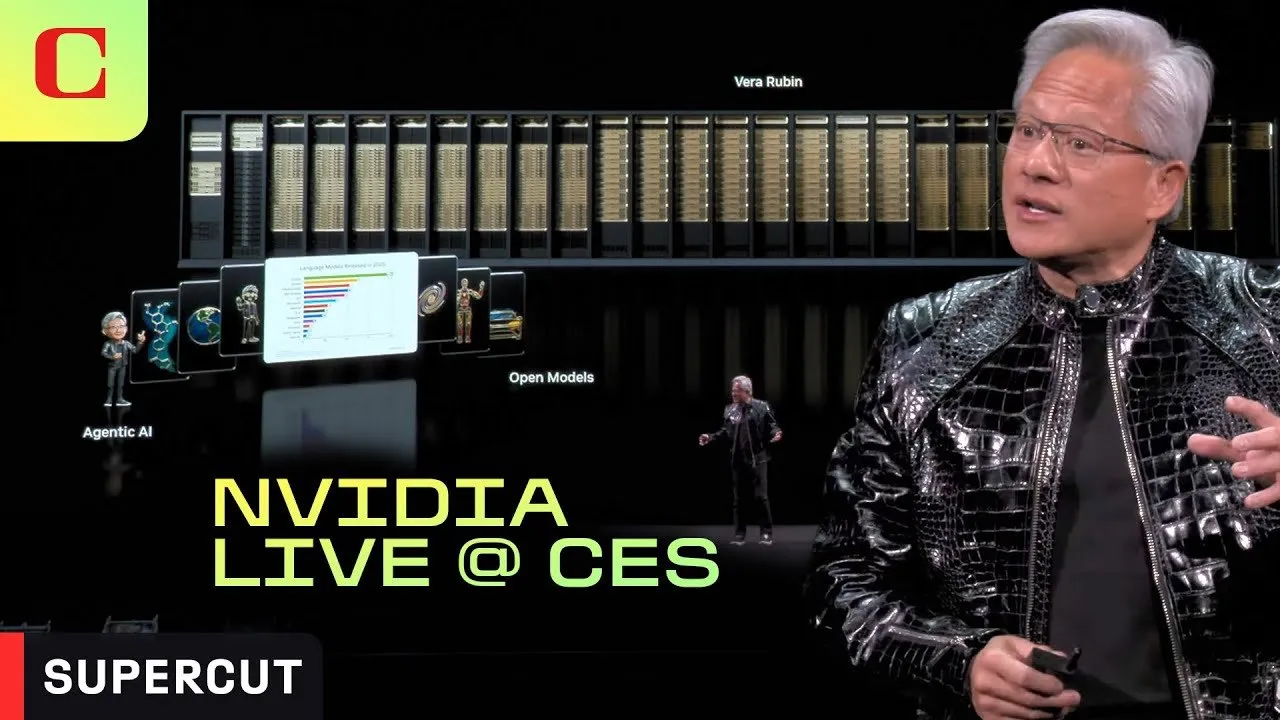
Addressing the skyrocketing computational demands of modern AI, Huang announced that the Vera Rubin platform—named after the renowned astronomer—is already in full production. The system represents a significant leap in data center density and efficiency. The architecture is built around the "Rubin Pod," a cluster comprising 1,152 GPUs across 16 racks.
The core innovation lies in the pairing of the Rubin GPU with the new Vera CPU. According to Nvidia, the Vera CPU offers double the performance per watt compared to the world's most advanced processors in power-constrained environments. Despite the Vera Rubin system consuming twice the power of its predecessor, the Grace Blackwell, Nvidia has achieved a thermal engineering breakthrough.
"The power of Vera Rubin is twice as high as Grace Blackwell. And yet, and this is the miracle... the water that goes into it is the same temperature, 45°C. With 45°C, no water chillers are necessary for data centers. We're basically cooling this supercomputer with hot water."
This thermal efficiency allows data centers to maintain standard airflow and water infrastructure while drastically increasing compute capacity.
Reasoning on the Road: Alpamo
In the automotive sector, Nvidia introduced Alpamo, described as the world’s first "thinking, reasoning autonomous vehicle AI." Unlike traditional self-driving systems that react to patterns, Alpamo is an end-to-end model trained on massive datasets comprising human driving demonstrations and synthetic data generated by Nvidia's Cosmos engine.
The system is designed to explain its actions, processing sensor input to determine a trajectory while simultaneously reasoning about why it chose that specific action. However, acknowledging the unpredictable nature of generative AI, Nvidia has implemented a unique "dual-stack" safety architecture. Alpamo operates alongside a classical, fully traceable AV software stack.
A "policy and safety evaluator" constantly monitors the vehicle's situation. If the AI model encounters a scenario with low confidence, the system instantly reverts to the classical, deterministic guardrail stack to ensure passenger safety. Huang noted that the Mercedes-Benz CLA, which utilizes this stack, has already been rated by NCAP as the world's safest car.
Industrial and Network Evolution
Beyond computing and cars, Nvidia announced the expansion of its partnership with Siemens. The collaboration aims to integrate "agentic AI"—autonomous software agents capable of planning and executing tasks—into industrial design and manufacturing. This initiative envisions manufacturing plants as gigantic robots, where AI agents assist in designing both the chips and the factories that produce them.
Supporting this ecosystem is the new Bluefield 4 processor, designed to handle virtualization, security, and networking, effectively offloading these tasks from the main compute nodes. Additionally, Nvidia revealed a co-innovation with TSMC called "Coupe," a silicon photonics process that integrates optical data transfer directly onto the chip, enabling 512 ports at 200 gigabits per second.
The Alpamo-powered Mercedes-Benz fleet is scheduled to hit U.S. roads in Q1, expanding to Europe in Q2, and reaching Asian markets in the second half of 2026.