Table of Contents
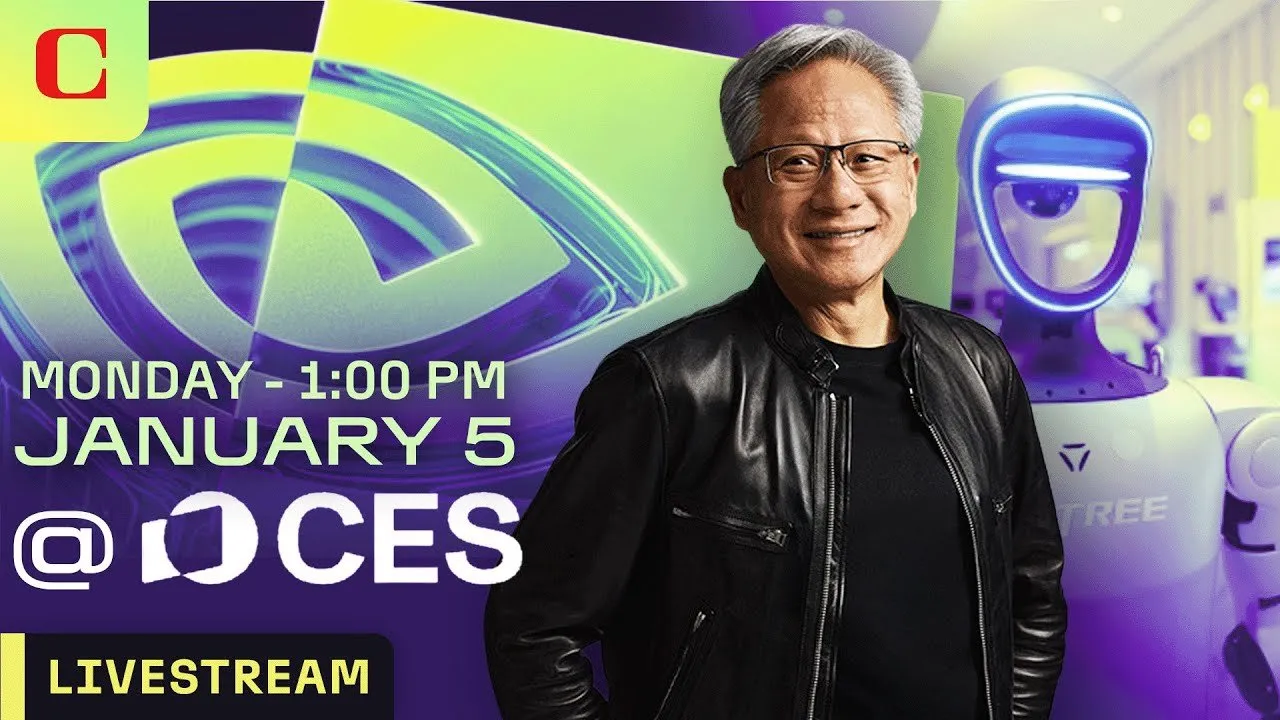
Nvidia CEO Jensen Huang kicked off CES 2026 in Las Vegas with a sweeping keynote that framed the current technological landscape as a "double platform shift," unveiling the full production of the Vera Rubin compute platform and outlining a future dominated by agentic and physical artificial intelligence. Addressing a packed venue, Huang detailed a comprehensive reinventing of the computing stack—from chips and networking to infrastructure and models—designed to support AI systems that can reason, plan, and interact with the physical world.
Key Takeaways
- Vera Rubin Platform in Production: Nvidia announced its next-generation architecture, the Vera Rubin platform, is now in full production, featuring a six-chip system designed for extreme co-design and 100% liquid cooling.
- The Era of Physical AI: Huang introduced Cosmos, a world foundation model that understands physics, and AlphaMEO, a reasoning autonomous vehicle model launching in Mercedes-Benz cars in Q1.
- Agentic AI Shift: The company is pivoting focus toward "Agentic AI"—systems capable of reasoning, research, and tool use—supported by new "KV Cache" storage solutions to handle massive long-term memory requirements.
- Industrial Partnerships: A major expansion of the partnership with Siemens was announced to integrate AI into industrial design and manufacturing, alongside new collaborations in the chip design sector with Synopsys and Cadence.
- Efficiency Breakthroughs: The new Rubin architecture utilizes hot water cooling (45°C inlet), eliminating the need for data center chillers and potentially saving 6% of global data center power consumption.
The Vera Rubin Platform: Extreme Co-Design
The centerpiece of the keynote was the official launch of the Vera Rubin platform. Huang revealed that the system is already in full production, defying typical industry lag times between announcement and manufacturing. The platform represents a shift toward "extreme co-design," where six distinct chips were developed simultaneously to overcome the slowing of Moore's Law.
The architecture includes the Vera CPU and the Rubin GPU. According to Huang, the Vera CPU delivers double the performance per watt of the previous generation, featuring 88 cores and 176 threads. The Rubin GPU boasts five times the floating-point performance of the Blackwell generation while only increasing transistor count by 1.6 times, a feat achieved through a new "MVFP4" tensor core architecture that dynamically adapts precision.
Huang emphasized the physical engineering of the system as much as the silicon. The compute trays are cable-free and 100% liquid-cooled. Notably, the system is designed to operate with 45°C water inlet capability.
"With 45°C water, no water chillers are necessary for data centers. We’re basically cooling this supercomputer with hot water. It is so incredibly efficient... that enables us to save about 6% of the world's data center power."
Defining Physical AI and Cosmos
Moving beyond text generation, Nvidia is aggressively targeting "Physical AI"—intelligence that understands the laws of nature and can interact with the real world. To power this, Nvidia introduced Cosmos, a world foundation model. Unlike language models trained on text, Cosmos is trained on internet-scale video, driving data, and 3D simulations to understand physics, causality, and object permanence.
Cosmos serves as a bridge between digital simulation and physical application, capable of generating synthetic training data for robots and autonomous vehicles. This solves the "long tail" problem in robotics, where real-world data for rare edge cases is scarce.
Autonomous Vehicles and AlphaMEO
Applying this technology to the automotive sector, Huang announced AlphaMEO, described as the world's first "thinking, reasoning autonomous vehicle AI." The system is trained end-to-end, from camera input to actuation, but distinguishes itself by reasoning about its actions before executing them.
Safety remains a priority through a dual-stack approach. While AlphaMEO handles driving duties, a separate, fully traceable safety stack runs in parallel to guardrail the AI's decisions. This technology will debut rapidly:
- Q1 2026: Launching in Mercedes-Benz vehicles in the United States.
- Q2 2026: Expansion to Europe.
- Later 2026: Rollout in Asia.
The Agentic AI Infrastructure
Huang argued that the industry is moving from static AI models to "Agentic" systems—AIs that can plan, use tools, and retain context over long periods. This shift requires a fundamental change in how data centers handle memory.
Current AI models struggle with "context memory" (KV cache) during long interactions. To solve this, Nvidia introduced a storage solution utilizing the BlueField-4 DPU. This creates a dedicated "context memory store" within the rack, providing an additional 16 terabytes of memory per GPU accessible via high-speed networking. This allows AI agents to maintain persistent memory of users and research without bottlenecking the primary compute resources.
"We would like to have this AI stay with us our entire life. And remember every single conversation we've ever had with it... The idea that we would create a new platform, a new processor to run the entire Dynamo KV cache context memory management system... is completely revolutionary."
Industrial and Strategic Implications
The keynote underscored Nvidia's entrenchment in the industrial sector. Expanding on a long-standing relationship, Nvidia and Siemens are integrating physical AI and Omniverse technologies into Siemens' entire portfolio of EDA (Electronic Design Automation) and industrial software. This collaboration aims to revolutionize manufacturing by allowing factories to be designed, simulated, and optimized entirely in digital twins before physical construction begins.
Huang also highlighted the critical role of open innovation, citing the rapid rise of open models like DeepSeek R1 as a catalyst for the industry. Nvidia continues to support this ecosystem by open-sourcing its own models and datasets, particularly in the autonomous vehicle space, to establish trust and standardization.
With the Vera Rubin platform in production and major commercial deployments of Physical AI scheduled for the coming months, Nvidia is signaling that the infrastructure for the next decade of automation is not just theoretical—it is being installed today.

![URGENT: This Next Market Rotation Will Go Parabolic! [& It’ll Be Quick]](/content/images/size/w1304/format/webp/2026/03/market-rotation-parabolic-shift-forecast.jpg)