
Table of Contents
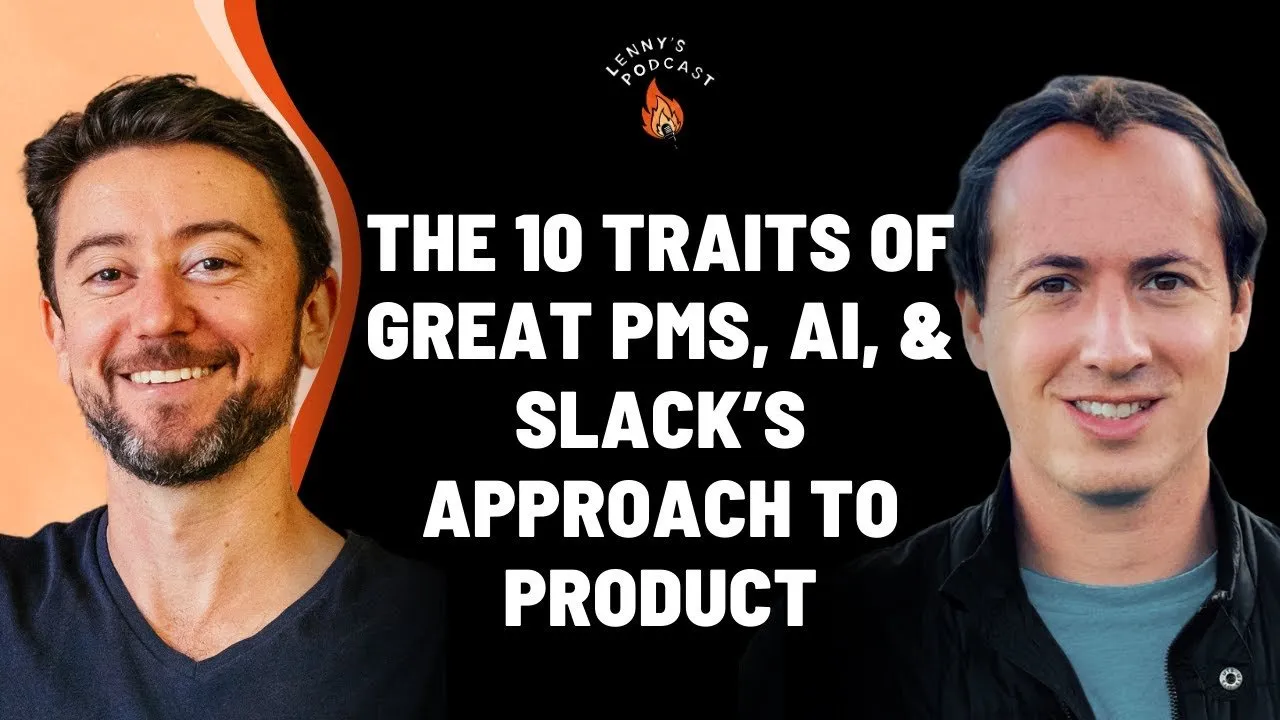
Noah Weiss, the Chief Product Officer at Slack, has spent nearly 15 years shaping how we interact with technology, from the early days of check-ins at Foursquare to the structured data of Google’s Knowledge Graph. Now steering the product vision at Slack, Weiss operates at the intersection of enterprise utility and consumer-grade delight.
In a wide-ranging conversation with Lenny Rachitsky, Weiss deconstructs the rigorous rituals that keep Slack’s product teams user-centric, the company’s pragmatic approach to Generative AI, and the specific metrics that saved their self-service business from a 2019 plateau. Whether you are an early-career product manager or leading a large organization, Weiss provides a blueprint for building software that people don't just use, but advocate for.
Key Takeaways
- The "Complaint Storm" Ritual: To break "creator's delusion," teams should critically review competitor products first to warm up their critique muscles before tearing down their own user flows.
- The U-Shaped Founder Model: Product leaders should involve founders heavily at the start (strategy/principles) and the very end (polish/review), leaving the middle open for team execution.
- The "Successful Team" Metric: When Slack’s growth stalled, they shifted their North Star from revenue to "Successful Teams"—defined as five people using the tool weekly. This leading indicator unlocked future upgrades.
- AI Trust Principles: In enterprise software, the confidence of the UI must match the accuracy of the data. Overconfidence in AI responses undermines user trust.
- PM Career Trajectory: Early career PMs should optimize for impeccable execution and data fluency, while senior leaders must master writing and decision velocity.
Managing Up: The Art of Working with Visionary Founders
Working with product-minded founders like Slack’s Stewart Butterfield or Foursquare’s Dennis Crowley requires a specific operational cadence. Weiss suggests that friction often arises when product leaders attempt to debate intuition rather than aligning on first principles.
The U-Shaped Involvement Curve
Micromanagement often stems from a lack of trust in the outcome. To mitigate this, Weiss advocates for a "U-shaped" engagement model regarding founder involvement over time:
- The Start (High Involvement): Engage the founder heavily during the definition phase. Agree on the strategic value, the anti-goals, and the core principles. This buys the team autonomy for the execution phase.
- The Middle (Low Involvement): Once principles are aligned, the team requires space to explore, prototype, and build without constant oversight.
- The End (High Involvement): Bring the founder back for the final polish. This is the "tasting the soup" phase, where their product intuition is most valuable for catching details that elevate the software from good to great.
Using the software is so different than looking at what the software will do visually... getting the entire development team, engineers, design, product, user research, and Stewart together in a room and doing a bug bash together... doing a real collective way so it doesn't just feel like the team says we want to ship and the founder says no.
Codifying Intuition into Principles
To scale a founder’s taste, you must translate it into written principles. At Slack, "Be a Great Host" isn't just a vague value; it translates to specific product behaviors, like saving users steps or anticipating needs—much like putting fresh towels on a bed before a guest arrives.
Rituals for Quality: Complaint Storms and Love Sprints
As product teams scale, they often lose touch with the "beginner's mind." Weiss employs two distinct rituals to combat incrementalism and maintain high standards.
The Complaint Storm
Teams often struggle to critique their own work honestly because they know the constraints and effort behind every feature. To fix this, Slack utilizes "Complaint Storms."
The process begins by reviewing a non-Slack product. The team walks through a competitor’s or adjacent product’s signup flow, listing every friction point, confusing copy choice, and bug. This exercises the team's critical eye without the emotional baggage of reviewing their own work. Once the team is in a critical flow state, they immediately pivot to reviewing their own product with the same ruthlessness.
Customer Love Sprints
Roadmaps are easily filled with large strategic bets, leaving little room for small quality-of-life improvements. Slack institutionalizes delight through "Customer Love Sprints." Roughly once a quarter, teams pause major feature work to execute a two-week sprint focused entirely on burning down a list of small, high-impact annoyances or requests that customers have flagged.
Navigating the AI Hype Cycle
Weiss, who worked on Google’s Knowledge Graph nearly 15 years ago, views the current AI wave with pragmatic optimism. Slack’s approach avoids "shiny object syndrome" by adhering to a core tenet: The promise of the UI must match the quality of the underlying data.
In the context of Large Language Models (LLMs), this is critical. Current models often present hallucinations with supreme confidence. For an enterprise tool where accuracy is paramount, this gap can be fatal to user trust. Slack focuses on features where they can close this gap, such as summarization and search, rather than open-ended generation where accuracy varies.
The Hybrid AI Org Structure
To move fast without creating silos, Slack uses a hybrid organizational structure for AI:
- Central Infrastructure: A core ML and Search team builds the "plumbing" that anyone can use.
- Embedded Prototyping: Individual product teams spin up prototypes using that infrastructure to solve specific customer problems.
This prevents AI from becoming a disconnected "lab experiment" and ensures it is applied directly to user needs.
Revitalizing Self-Service Growth
In 2019, Slack faced a silent crisis. While their enterprise sales were strong, the self-service business—the engine of their product-led growth—had plateaued. The tactics that worked for early adopters (technologically savvy teams in coastal hubs) were failing with the "late majority" (non-tech teams in legacy industries).
Trading Revenue for Learning
Weiss and the leadership team made a controversial decision: they threw away the existing roadmap. For six months, they accepted that they might drive zero immediate business impact. Instead, they optimized entirely for learning velocity.
They discovered that new users didn't lack features; they lacked comprehension and desirability. They didn't understand why they should switch from email to channels. The team overhauled the onboarding experience, introducing "sandbox" environments and better guidance, which eventually doubled the rate of new paid customer growth.
The "Successful Team" Metric
A critical component of this turnaround was redefining success. Metrics like "Account Created" were vanity; "Paid Customer" was a lagging indicator. Data science revealed a precise leading indicator for retention:
If you could get five people using Slack the majority of their work week to just communicate at all, that would be a successful team. They are going to be 400% more likely to upgrade over the next six months.
By rallying the entire self-service organization around creating "Successful Teams" (5 users, weekly active), they focused on activation rather than just acquisition.
The 10 Traits of Great Product Managers
Weiss famously penned a manifesto on the traits of elite PMs. In this conversation, he refined the list, distinguishing between skills needed for early-career execution and senior-level strategy.
For Early-Career PMs
- Impeccable Execution: You must be the "shock absorber" for the team. If you say you will do something, it gets done. This builds the capital required to take risks later.
- Data Fluency: You don't need to be a statistician, but you must be able to self-serve insights. Knowing your user data better than anyone else in the room gives you authority.
- Local Impact: Focus on moving the needle on your specific feature set. Demonstrated impact solves almost all career progression issues.
For Senior Leaders
- Live in the Future, Work Backwards: It is easy to get lost in the incrementalism of the next two weeks. Senior leaders must carve out time to envision the product two years out and reverse-engineer the path to get there.
- Writing Well: Writing is the only way to scale influence. As organizations grow, you cannot be in every meeting. Clear, concise writing allows your strategy to travel without you.
- Facilitating Decision Velocity: The job shifts from making decisions to ensuring the team makes high-quality decisions quickly. A senior PM prevents analysis paralysis.
Conclusion: Getting to the Next Hill
A recurring theme in Weiss’s philosophy is the metaphor of "Getting to the Next Hill." In product development, teams often become obsessed with the immediate climb—the current quarter, the current launch, the current bug list. However, you cannot see the mountain range behind the hill until you reach the top of the one you are currently on.
Great product organizations balance the crawl up the current hill with the bigger, bolder bets required to reach the beautiful range beyond it. Whether through integrating AI, rethinking growth loops, or empowering teams to take risks, the goal remains the same: make the user's working life simpler, more pleasant, and more productive.


)