
Table of Contents
When Nikhyl Singhal was growing up in the Midwest, entertainment often meant visiting the greyhound tracks. He observed a peculiar dynamic: mechanical rabbits would zip around the rail, motivating the dogs to run in circles. But on the rare occasion the machine broke and a dog actually caught the rabbit, the animal would often never run again. The dog had achieved its goal, and with the chase over, it lost its purpose.
This "greyhound paradox" is a fitting metaphor for the modern tech career. High performers spend decades chasing specific titles, valuations, or exits. Yet, without a plan for what happens after catching the rabbit, many successful leaders find themselves professionally lost and personally unfulfilled.
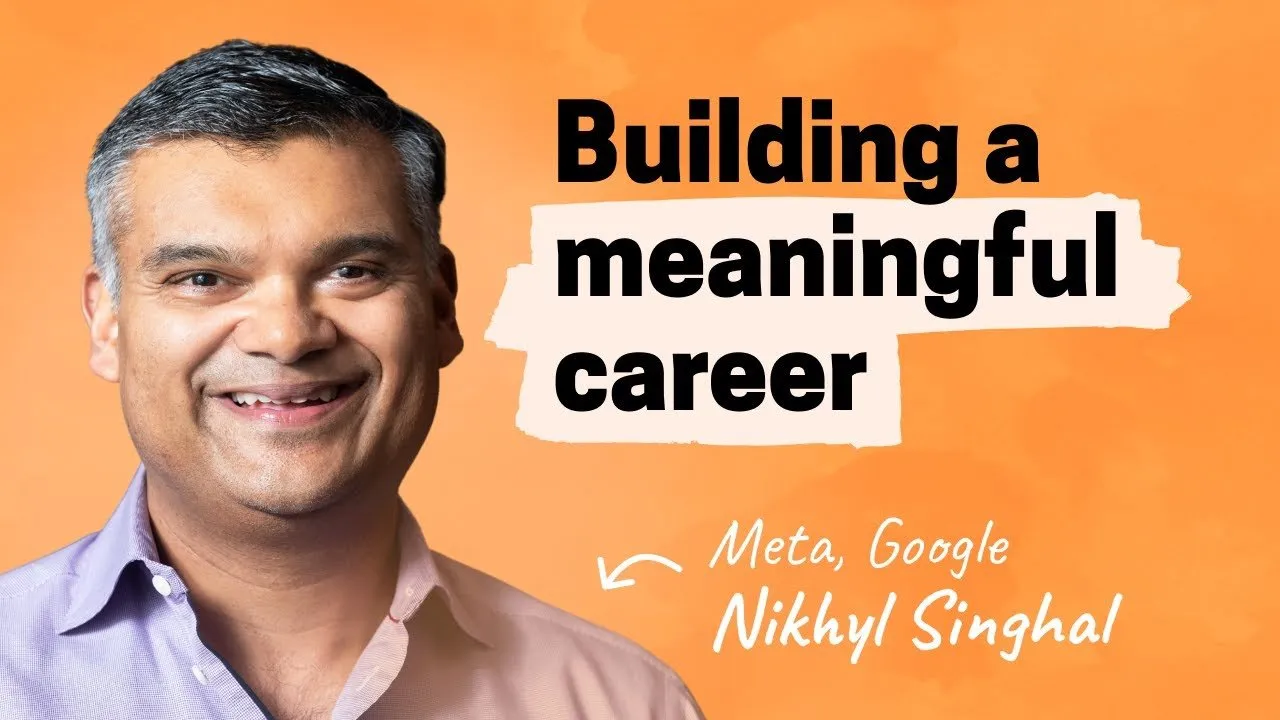
Nikhyl Singhal has seen this trajectory play out hundreds of times. As a VP of Product at Meta, former CPO at Credit Karma, and a veteran of Google, Singhal has mentored countless product managers through every stage of their professional lives. His insights go beyond standard career ladders, focusing instead on viewing a career as a multi-decade product roadmap.
Key Takeaways
- Think two jobs ahead: Don't just optimize for your next promotion; treat your career like a product roadmap by visualizing the "job after next" to determine what skills you need to build today.
- Avoid "Ex-Growth" companies: Be wary of organizations that have high valuations and cash reserves but have lost product-market fit. These environments can stall skill development and depreciate the value of your equity.
- The "Shadow of Superpowers": As you reach executive levels, the very traits that made you successful (e.g., being highly opinionated or a fast mover) can become liabilities that hinder your effectiveness.
- Embrace the Sidecar Model: New managers often struggle because they try to control the vehicle or let go too soon. The best approach is the "sidecar"—riding along to offer guidance without taking the steering wheel.
- Plan for Act III: A modern career may last 60 years. While Act I is about learning and Act II is about building, you must actively plan for Act III, which should center on giving back and sustainable purpose.
The Early Career: Avoiding Short-Term Traps
In the early stages of a product career, the temptation is to optimize for the immediate future—a better title, a slight pay bump, or escaping a difficult manager. Singhal argues that this short-termism is a strategic error. Instead, professionals should view their career through the lens of a product manager: define the long-term vision and work backward.
The "Job After Next" Framework
Lateral moves are rarely career accelerators. To ensure forward momentum, Singhal advises looking past your current boss’s job to the role beyond that. If your ultimate goal is to found a company, your intermediate steps should be in service of that objective, not just climbing a corporate ladder.
This perspective changes how you evaluate current struggles. A difficult environment or a chaotic startup might actually be the perfect training ground for the ambiguity you will face in your "job after next."
The MAGMA vs. Diversity Debate
There is a pervasive belief that having "MAGMA" (Meta, Apple, Google, Microsoft, Amazon) logos on a resume is the golden ticket. While these environments offer lessons in scale that are critical for executive roles later, they are not the only path to competency.
Singhal emphasizes the value of a diverse portfolio of experiences. A robust product builder should ideally experience three distinct phases:
- Pre-Product Market Fit: Searching for traction.
- The Scale-Up: Shepherding a product as "smoke turns to fire."
- At Scale: Optimizing and growing a massive, established product.
Collecting logos can feel shallow to a builder. The most capable product leaders are those who have navigated different types of ambiguity—market ambiguity, organizational ambiguity, and domain complexity.
The Mid-Career Crisis: Promotions and "Ex-Growth"
As professionals move into their mid-career phase, two major hurdles often arise: the stagnation of promotions and the trap of joining the wrong type of company.
The Danger of "Ex-Growth" Companies
During the zero-interest rate era, capital allowed companies to blitz-scale. Now that the market has corrected, a new category of company has emerged: the "Ex-Growth" company. These organizations raised massive amounts of capital at peak valuations but have since lost their growth velocity. They aren't laying people off because they have cash runways for years, but they are also not growing.
"If the answer is hundreds [of millions] or more and you're still trying to find that sucking sound, you're an ex-growth company."
Singhal warns that staying in these environments is dangerous for career equity. If a company is pivoting to find product-market fit but is burdened by a unicorn valuation and a headcount of 300+, the financial upside for employees is virtually nonexistent. More importantly, the learning velocity slows down. If you find yourself in an ex-growth company, the advice is stark: recognize it and leave.
Why You Aren't Getting Promoted
When promotions stall, it is rarely a mystery to the promotion committee, even if it confuses the candidate. Singhal identifies four primary reasons for stalled advancement:
- Lack of Advocacy: You may have the magic, but your manager doesn't see it. Without a champion in the room, promotion is impossible.
- The Role Doesn't Exist: In a contracting market, the "next level" job might simply not be available. You cannot be promoted into a vacuum.
- Impatience: High performers often expect promotions annually. As you become more senior, the cycle naturally lengthens because the skills required (influence, soft skills) take longer to demonstrate.
- Unaddressed Development Areas: This is the most common and painful reason. The candidate has a flaw they refuse to accept or address, often because it is tied to their identity.
Mastering Management: The Sidecar Approach
The transition from Individual Contributor (IC) to Manager is often mishandled in the tech industry. Great coders or product builders are thrust into management with zero training, leading to a cycle of poor leadership. For new managers, the hardest adjustment is learning how to share control.
Singhal creates a distinction between two common—but flawed—management styles:
- The Bicycle Parent: Holding onto the report and then letting go completely, hoping they don't crash.
- Divide and Conquer: Splitting the work and ignoring what the report is doing until the end.
Instead, he advocates for the Sidecar Model. The report is driving the motorcycle, but the manager is sitting in the sidecar attached to the vehicle. You are on the same journey and can communicate constantly, but you are not steering. This requires a difficult balance: you must earn the right to be invited into the process. Authority is granted by the organization, but permission to lead is granted by the employee.
The Rise of the Senior IC
A positive shift in the industry is the formalization of the Senior IC track. For years, the only way to advance was to manage people, forcing incredible builders to become mediocre managers. With the recent focus on efficiency and "delayering" at companies like Meta, the IC track is gaining prestige and viability. This allows builders to focus on craft, domain expertise, and complex problem-solving without the administrative burden of people management.
The Executive Trap: Shadows of Superpowers
Perhaps the most profound insight for senior leaders is the concept of the "Shadow of Superpowers." The premise is simple but devastating: the very traits that got you to the executive table are often the ones preventing you from succeeding there.
For example, a founder’s superpower might be extreme conviction and the ability to make decisions with little data. This is essential for zero-to-one survival. However, in a scaled executive role, that same trait manifests as an unwillingness to collaborate or listen to context. The superpower casts a shadow.
"Everyone focuses on your superpowers but no one ever thinks about what shadows they create."
Fixing this requires a painful identity shift. When a leader receives feedback that contradicts their self-image (e.g., a "great collaborator" being told they are difficult), they typically discard it. Singhal suggests that the "discard pile" of feedback is actually where the truth lies. To grow at the executive level, you often have to rewire the behaviors that defined your early success.
Act III: Finding Your North Star
Careers are lengthening. If a career spans 60 years, retiring at 65 is no longer the default, especially for knowledge workers. Singhal breaks the career trajectory into three acts:
- Act I: Learning the trade and acquiring skills.
- Act II: Building, earning, and establishing reputation.
- Act III: Giving back and finding meaning.
The mental health crisis often hits successful leaders when they complete Act II. They "catch the rabbit," achieve financial stability, and realize they have no plan for what comes next. They may spiral, create unnecessary conflict, or chase more money simply because they don't know how to stop.
The solution is to cultivate a "North Star" for Act III well before you reach it. This phase should be defined by mentorship, teaching, community building, or philanthropy. By shifting the focus from "getting" to "giving," leaders can insulate themselves from the existential crisis of success and ensure their career remains meaningful for the long haul.
Conclusion
Building a meaningful career is not a sprint to a specific title; it is a marathon that requires constant reinvention. From the impatience of the early years to the identity crises of the executive suite, the challenges evolve, and so must the strategies. By thinking largely about the "job after next," recognizing the shadows of your own strengths, and planning for a purpose-driven third act, you can avoid the fate of the greyhound—running endlessly in circles—and instead chart a path of sustainable impact.




)