Table of Contents
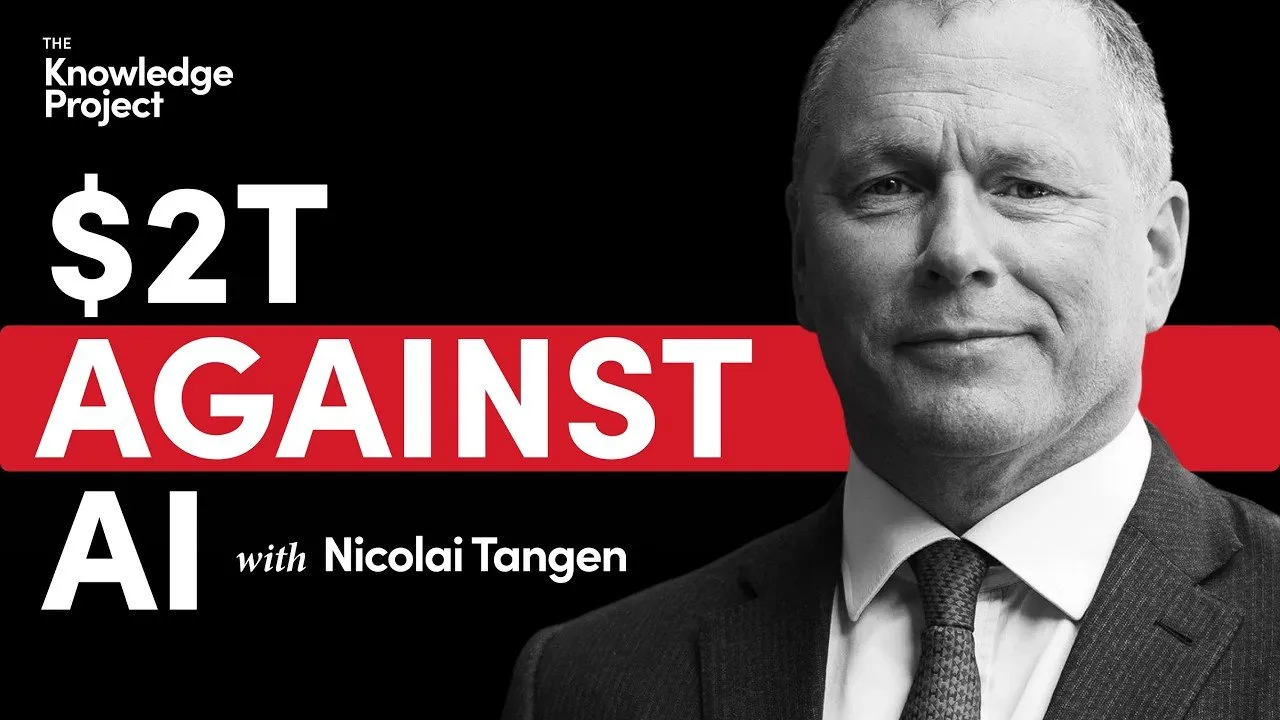
Nicolai Tangen manages approximately $1.6 trillion as the CEO of Norges Bank Investment Management, effectively overseeing the savings of the Norwegian people. Standing at the helm of the world's largest sovereign wealth fund provides a unique vantage point on the global economy, the rapid ascent of artificial intelligence, and the psychological fortitude required to manage risk on a massive scale. Yet, Tangen’s approach is far from the stereotypical, bureaucratic style often associated with institutional finance.
From using physical hockey pucks to encourage disagreement in meetings to lamenting the "ambition gap" between Europe and the United States, Tangen operates with a philosophy rooted in speed, agility, and contrarian thinking. In a landscape where traditional forecasting models are failing, his insights offer a blueprint for navigating uncertainty through psychological resilience rather than mere predictive data.
Key Takeaways
- The futility of prediction: In a volatile geopolitical climate, long-term forecasting is increasingly useless; success now depends on speed and agility.
- Aggressive AI adoption: Tangen advocates for "injecting AI everywhere" to drive efficiency, citing a 20% productivity gain within his own firm.
- The contrarian paradox: True investing success requires the rare combination of being stubborn enough to hold a view but flexible enough to change it when the facts shift.
- Risk psychology: Most investors mistakenly reduce risk after a loss; professionals must maintain their risk process regardless of recent outcomes, similar to elite sailors.
- Operationalizing disagreement: To combat groupthink, leaders must create physical mechanisms—like the "straight puck"—to depersonalize and encourage dissent.
The Imperative of AI Integration
While many institutional investors view the current tech rally with skepticism, Tangen views the artificial intelligence boom not merely as a market trend, but as a fundamental shift in productivity. The sovereign wealth fund is actively leveraging AI to handle capital inflows and optimize decision-making. Tangen notes that by utilizing these tools, his firm has increased productivity by roughly 20%, maintaining a flat headcount while producing higher-quality output.
When discussing whether the sector is in a bubble, Tangen points to "frothy" indicators—such as the correlation between Nvidia’s CEO dining in Korea and the subsequent stock surge of the restaurant chain—but ultimately lands on the side of utility. The tangible efficiency gains outweigh the speculative noise.
"If I were prime minister for a day, I would inject AI everywhere... It’s a once-in-a-lifetime opportunity for people, companies, and countries to pull apart."
He draws a parallel to the Swedish "Home PC" initiative in the 1980s, suggesting that nations utilizing this moment to democratize access to intelligence will see compounding benefits, while those that hesitate risk irrelevance.
Agility Over Prediction in Modern Markets
One of the most striking admissions from a man managing trillions is the declining value of economic forecasting. Tangen recounts a gathering with top intellects where they attempted to predict the events of the coming year. Upon reviewing the tape a year later, they realized they had been "80% wrong," failing to foresee major elections, tariffs, and geopolitical shifts.
Consequently, the fund has shifted its focus from prediction to agility. In a world where the future is unknowable, the ability to react faster than others becomes the primary competitive advantage. Tangen defines speed not just as physical movement, but as a mindset of efficiency.
"Trying to predict in this world is just more and more useless. So what you need to do, you just need to work on speed and agility."
He illustrates this with a simple heuristic: if you reply to an email within a minute, a two-word response is acceptable. If you reply a week later, social convention demands a full page of text. Speed simplifies communication and reduces drag on the organization.
The Psychology of High-Stakes Investing
Tangen’s background in social psychology deeply informs his investment philosophy. He argues that the defining characteristic of a great investor is the ability to hold two opposing traits simultaneously: stubbornness and flexibility.
The Art of Contrarianism
To generate alpha, one must bet against the consensus. However, in an era dominated by social media validation, the desire to be "liked" often overrides the courage to be different. Tangen tests for this trait in universities, asking students to raise their hands if they feel they are "weird" or think differently. Typically, less than 10% do.
The 90% who conform, he notes, will never make outsized returns. The challenge lies in maintaining a contrarian view when the market moves against you (stubbornness) while possessing the humility to admit when the thesis is broken (flexibility). This duality is exceptionally rare.
Risk Appetite and the Sailing Analogy
Perhaps the most critical psychological insight Tangen offers concerns how humans handle loss. Amateurs typically reduce their risk appetite after a loss due to fear. Professionals, however, understand that if the process is sound, they must get back on the horse immediately.
Drawing from his experience in competitive sailing, Tangen explains that if a wind shift puts you in last place, you cannot win the next race by sailing conservatively. You must take the same calculated risks you took when you were winning. This separation of outcome from process is what separates elite fund managers from the rest.
Building a Culture of Radical Candor
Changing the culture of a massive organization is a slow process—Tangen estimates it takes ten years—but it requires tangible interventions. His goal for the fund is to reduce fear and increase "psychological safety," allowing for honest feedback.
The "Straight Puck" Method
To solve the problem of polite silence in meetings, Tangen introduced the concept of the "straight puck." In ice hockey, a puck is a hard, physical object. In the boardroom, it serves as a metaphor to depersonalize disagreement. By "putting the puck on the table," an employee can signal that they are attacking the idea, not the person.
This gamification of dissent transforms disagreement from a social faux pas into a rewarded behavior. Tangen explicitly praises and rewards those who challenge him, reinforcing that the hierarchy of ideas matters more than the hierarchy of titles.
The Ambition Gap: Europe vs. America
Tangen also highlights a stark cultural divergence between the US and Europe regarding ambition. In the US, stating that one wants to "conquer the world" is viewed as a standard, even modest, aspiration. In Norway, influenced by the cultural code of Janteloven (which discourages individual superiority), such ambition is often frowned upon.
"If you have really really high ambitions, you achieve great things even if you fail. If you have low ambitions, you achieve nothing even if you succeed."
He argues that high ambition is a prerequisite for high performance. While he acknowledges the societal benefits of the European model, he suggests that for innovation and economic growth, a shift toward the American acceptance of risk and ambition is necessary.
Conclusion
Nicolai Tangen’s leadership of the Norwegian sovereign wealth fund serves as a case study in modern asset management. It is less about the mathematical perfection of the portfolio and more about the psychological resilience of the people managing it. By embracing the uncertainty of the future through speed rather than prediction, and by fostering a culture where disagreement is a tool rather than a threat, Tangen is betting that the best way to preserve wealth for future generations is to remain perpetually agile in the present.