Table of Contents
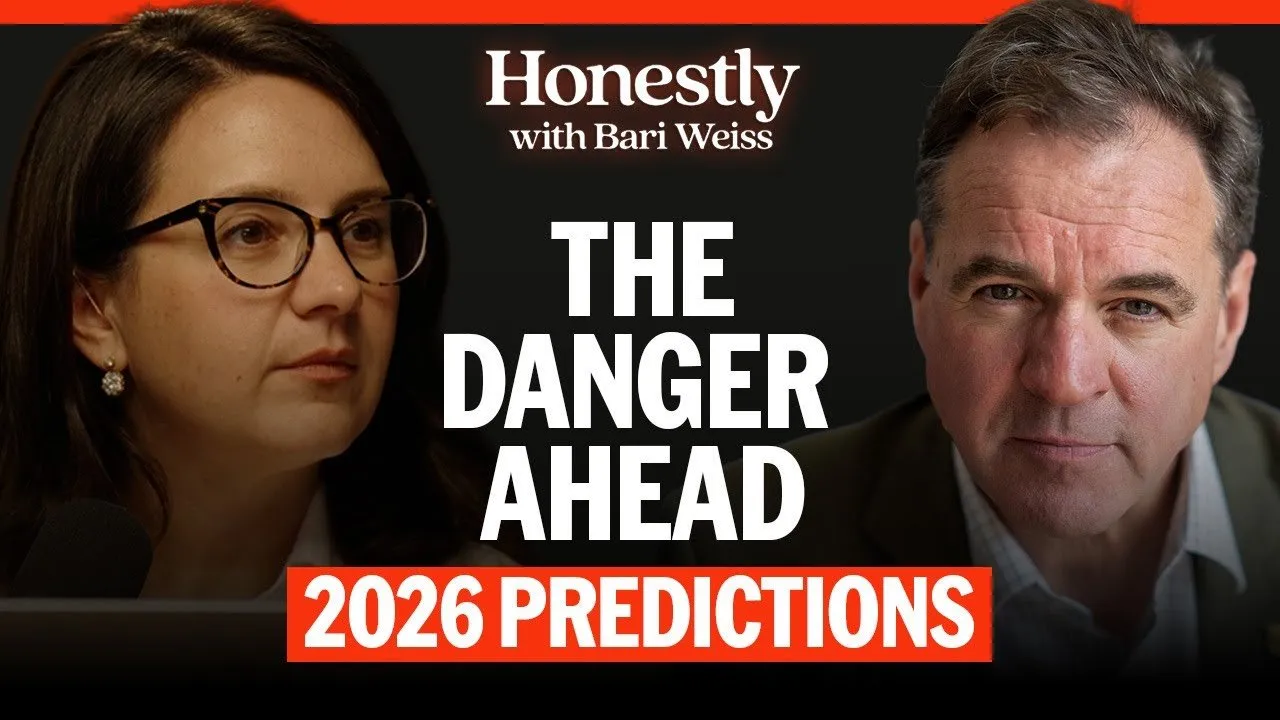
If the geopolitical landscape of the last few years has felt chaotic, historian Niall Ferguson warns that we should not expect the dust to settle anytime soon. While many hoped that a change in American leadership might usher in an era of tranquility, Ferguson argues that we are firmly entrenched in "Cold War II." This is not merely a series of disconnected conflicts, but a structural contest between two superpowers—the United States and China—playing out across technology, ideology, and geography. From the battlefields of Ukraine to the diplomatic high-wire acts regarding Taiwan, the forecast for 2026 suggests that while total global war may be averted, peace remains an elusive prospect.
Key Takeaways
- The Cold War II Reality: The world is locked in a structural rivalry between the U.S. and China, similar to the Soviet tensions of the 20th century, creating inevitable "hot" proxy wars.
- Ukraine's War of Attrition: Despite hopes for a deal, the most likely scenario for 2026 is a continuation of the conflict, as Vladimir Putin has little incentive to settle.
- Middle East Complexity: While Israel has achieved tactical successes, Iran is rebuilding its nuclear capabilities, likely forcing continued military action from Jerusalem.
- Diplomacy Over Invasion in Taiwan: Contrary to alarmist predictions, China is unlikely to invade Taiwan in 2026, preferring high-stakes summitry and economic coercion over amphibious assault.
- The Return of the Pogrom: A rising tide of global antisemitism poses a severe threat to Western democracies, requiring immediate and forceful condemnation.
The Entrenchment of Cold War II
To understand the specific conflicts erupting around the globe, one must first accept the overarching framework: the world is in a Second Cold War. This dynamic has been building since at least 2018, arguably earlier, yet many in the West failed to notice because of a lingering belief in the "end of history" narrative.
In this new era, the People's Republic of China has assumed the role previously held by the Soviet Union. The consequences are predictable. When two superpowers compete for dominance in technology, military hardware, and ideology, "hot spots" inevitably flare up along the fault lines. Whether it is the ongoing war in Eastern Europe, the multi-front conflict in the Middle East, or the tension surrounding Taiwan, these are not isolated incidents but symptoms of a bipolar global struggle.
"I think President Trump sincerely wants to try and end conflicts, but it's much easier to start a war... than it is to end one. And that's one of the lessons of 2025."
The Middle East: Beyond the Gaza Ceasefire
While media attention often narrows in on Gaza, the reality of the conflict is far broader. Israel has effectively been fighting a war on seven fronts, contending not just with Hamas, but with Hezbollah in Lebanon, the Houthis, and proxies in Syria. The strategic landscape going into 2026 is defined by the successes and unfinished business of the previous year.
Recent U.S. diplomatic efforts and Israeli military operations have severely degraded Iran's proxies and damaged its nuclear infrastructure. However, the regime in Tehran remains a persistent threat. Iran is actively rebuilding its damaged nuclear capabilities and attempting to revive its economy despite severe water shortages and sanctions.
For Israeli leadership, this presents a dilemma. Allowing Iran to rebuild squanders the tactical advantages gained in 2025. Consequently, 2026 will likely see continued Israeli strikes to prevent Iranian resurgence, even as political ambivalence grows in the United States—not just from the left, but increasingly from the isolationist right.
The Myth of Regime Change
Despite visible civil disobedience, such as Iranian women refusing to wear the hijab, observers should be cautious about predicting the collapse of the Ayatollahs. The regime has proven remarkably resilient against popular protest. While the death of the Supreme Leader could trigger a transition crisis, expecting a peaceful shift to a friendly government is optimistic. Without a credible succession plan, the most likely outcome of a power vacuum is a military-style dictatorship led by the Revolutionary Guard (IRGC), rather than a liberal democracy.
Ukraine: The Grind of Attrition
Entering the fourth year of the full-scale invasion, the war in Ukraine remains a bloody attrition fight. Early optimism about a swift Ukrainian victory often ignored the historical and economic imbalances between the two belligerents. Russia's willingness to absorb hundreds of thousands of casualties, combined with its economic resilience, makes a decisive defeat of Moscow unlikely.
The forecast for 2026 is grim. While there is a non-zero probability (roughly 30%) of a ceasefire, the base case is that the war continues. Vladimir Putin’s goal remains the breaking of Ukraine as a sovereign, independent state. He has no incentive to accept a compromise that leaves a viable, armed Ukraine on his border, especially when he can simply wait out Western fatigue.
"Putin can just play to win. He can just grind out this victory even if the casualties on the Russian side go to a million because he's Putin... He doesn't have the accountability to his own people."
The Trump administration's "Realpolitik" approach—viewing the conflict through the lens of great power competition—aims to separate Russia from China. However, this strategy risks undercutting Ukraine without securing a genuine peace, as Putin realizes he can likely achieve his maximalist aims by persisting.
China and Taiwan: Summitry, Not Invasion
A prevailing fear in geopolitical circles is that 2026 or 2027 will mark the year China invades Taiwan. Ferguson disputes this timeline. The Chinese military is not yet ready for the colossal logistical challenge of an amphibious invasion, nor is it likely to attempt a full blockade in the immediate future.
Instead, 2026 will be a year of intense diplomacy and "summitry." Expect multiple high-level meetings between U.S. and Chinese leadership. The table is set for complex negotiations involving tariffs, fentanyl controls, and export restrictions.
The leverage is bidirectional:
- China's Leverage: A monopoly on the mining and refining of rare earth elements, essential for modern electronics and green energy.
- U.S. Leverage: Control over the most sophisticated semiconductors, specifically those designed by Nvidia and manufactured by TSMC in Taiwan.
Beijing’s goal will be to pressure the U.S. to withdraw support for Taiwanese independence, aiming for a slow, suffocating integration similar to the fate of Hong Kong, rather than a dramatic military conquest.
The Rise of Global Antisemitism
Perhaps the most disturbing trend forecasted for 2026 is not strictly geopolitical, but social and ideological: the violent resurgence of antisemitism. The pattern established in recent years suggests that Islamist groups and their sympathizers increasingly view Jewish communities worldwide as "soft targets."
This is not a new phenomenon but the return of an old one: the pogrom. Violent outbreaks against Jewish populations were a regular feature of 19th-century Europe, and they are returning to the 21st-century West. This rise in violence is compounded by a fracturing on the American political right, where figures flirting with "old and odious" antisemitic tropes are challenging the traditional pro-Israel consensus of the MAGA movement.
"If you do not check antisemitism, if you do not condemn it... then like some ghastly cancer, it will spread until it poses a truly mortal threat. That is the way to think about the Holocaust."
The lesson of history is that antisemitism is a shapeshifting ideology—whether branded as 19th-century racial theory or 21st-century "anti-Zionism," the outcome is the annihilation of Jewish life. Combating this requires a return to the moral clarity of the past, where governments and financial institutions actively penalized regimes and movements that facilitated such hatred.
Conclusion
The outlook for 2026 is not one of easy resolutions. The structures of Cold War II ensure that tension will remain high, and the "peace through strength" doctrine will be tested by adversaries who are patient and resilient. From the frontlines of the Donbas to the diplomatic meeting rooms in Beijing, the U.S. faces a complex web of challenges.
However, the most urgent battle may be the internal one against the spread of toxic ideologies. As the world navigates these macro-conflicts, the moral imperative for Western democracies is to recognize that the safety of minority communities is the bellwether for the health of liberty itself.