Table of Contents
After a 36-year career culminating in leadership roles at both Netflix and Meta, David Rumpka recently retired with a wealth of unfiltered insights. From the early days of streaming at Netflix to managing video infrastructure during the pandemic at Meta, Rumpka has seen the evolution of Silicon Valley from the inside. But his most valuable lessons aren't just about code—they are about the human cost of engineering, the fallacy of "brilliant jerks," and why hiring processes often miss the mark.
In a candid reflection on his career, Rumpka breaks down the stark cultural differences between tech giants, shares a life-altering health scare that redefined his work ethic, and explains why he hired a wastewater treatment expert to write software. Here is a deep dive into the engineering philosophy of a veteran director.
Key Takeaways
- The "Brilliant Jerk" is a liability: High technical output does not justify toxic behavior; modern engineering requires collaboration over isolation.
- Work-life balance is a systemic requirement: If a company cannot survive your vacation, the company is broken, not you.
- Engineering intuition trumps LeetCode: Rumpka argues that foundational systems thinking is innate, while coding syntax can be taught.
- Scale dictates culture: Policies that work for a nimble "Zero to One" startup (like Netflix's early no-level system) often break down at massive scale (like Meta).
- Financial literacy equals career freedom: Starting financial planning on day one provides the leverage to take risks or lower-paying, passion-driven roles later in life.
The Fallacy of the Brilliant Jerk
Early in his career, before the streaming wars began, Rumpka worked at companies that tolerated—and even lionized—difficult personalities. He describes a common archetype in the 90s tech scene: the "Prima Donna" engineer. These were individuals who hoarded knowledge, refused to collaborate, and maintained messy, unapproachable workspaces, yet were deemed "too critical to lose."
Rumpka realized the flaw in this logic early on. When these "irreplaceable" jerks inevitably quit, the companies didn't collapse. Instead, the teams flourished because collaboration became possible again. This experience made joining Netflix a revelation. Netflix’s famous culture deck explicitly stated they did not hire "brilliant jerks."
"If you're a person who's always going off the rails, who's yelling and screaming, who's difficult to work with... they're going to let you go. And they don't care how smart you are or what level of contribution."
Rumpka notes that while the culture memo was aspirational—meaning the company wasn't perfect—it set a standard that revolutionized how he viewed team dynamics. Technical brilliance could no longer serve as a shield for poor behavior.
A Health Crisis and the 24/7 Myth
Perhaps the most poignant moment of Rumpka’s career occurred years before he joined Netflix, while working at a startup called InterVideo. The culture demanded 24/7 availability, with Rumpka routinely working until 2:00 or 3:00 AM. In 2004, his body shut down. He drove himself to the ER and was immediately diagnosed with stage three colon cancer.
Lying in a hospital bed with a 25% five-year survival prognosis, Rumpka realized the absurdity of trading his life for a job. He recovered, but the experience fundamentally altered his leadership style. He vowed never to be a leader who equated hours worked with value.
The Netflix Approach to Burnout
When Rumpka eventually interviewed at Netflix, he was braced for another high-pressure environment. Instead, Chief People Officer Patty McCord floored him with a different philosophy.
"We don't value 24/7 work here... if you want to impress us, blow us away with what you can do in an 8-hour day."
This wasn't just lip service. Rumpka recounts a time he had to force a key engineer to take a vacation during a critical stability crisis. The engineer argued that the systems would crash if he stepped away. Rumpka’s response was definitive:
"If this company cannot survive without you here on the clock, we got a problem... I don't care what happens. If things break, they break. Take your vacation."
The result? The team stepped up, realized they could stabilize the system without the manager's constant intervention, and they actually solved the problem faster because they were refreshed. Rumpka’s takeaway is clear: Work-life balance isn't just a perk; it is a component of a resilient engineering architecture.
Hiring: LeetCode vs. Engineering Intuition
One of Rumpka’s most controversial stances involves the modern technical interview. Having hired extensively at Netflix and Meta, he remains skeptical of LeetCode-style testing. He argues that these tests measure how fast someone can solve a rehearsed problem, not whether they have the "engineering gene."
To Rumpka, engineering isn't just writing software; it is the ability to understand complex systems, manage ambiguity, and make decisions with incomplete data.
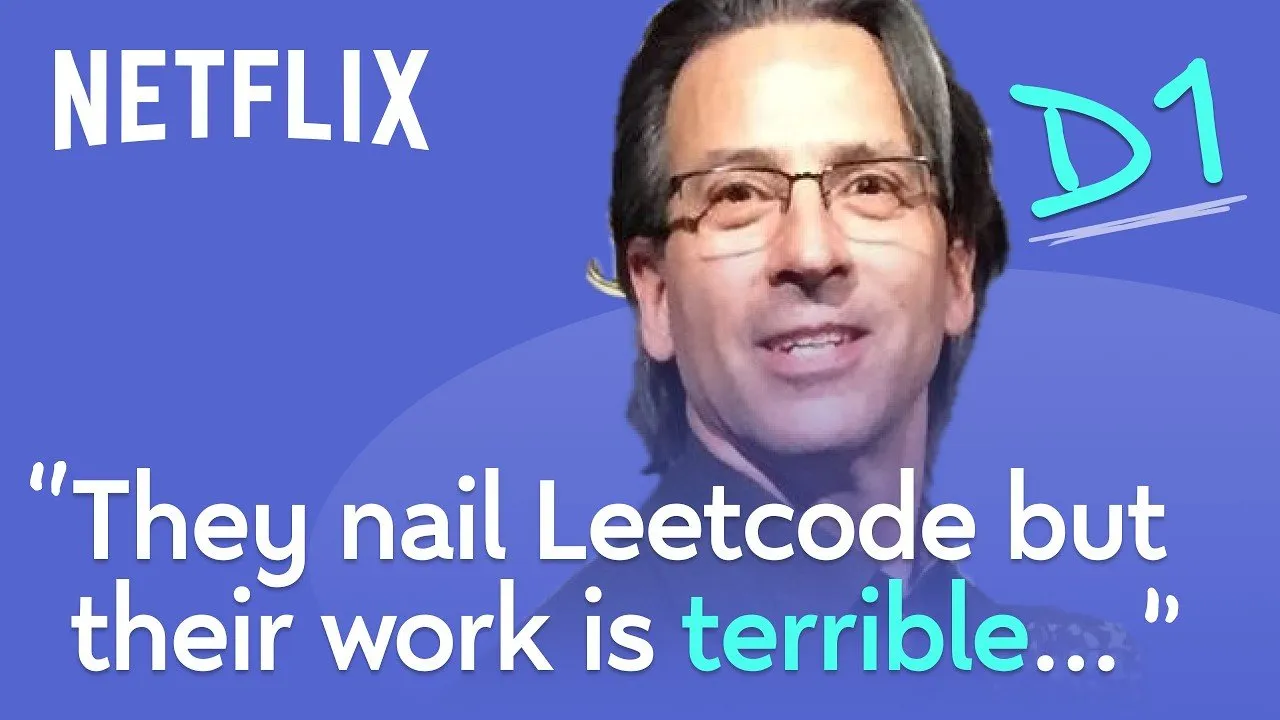
"I personally don't love LeetCode... They nail these interviews and they get in and their engineering work is terrible."
The Wastewater Treatment Engineer
To illustrate his point, Rumpka shares a story about a hire he made while taking graduate classes at San Jose State. He met a civil engineer who worked in wastewater treatment but wanted to transition to software. She had zero professional coding experience, but Rumpka noticed her profound understanding of statistics and complex systems.
Against standard hiring practices, he brought her in for an interview. He asked her to teach the team something she knew: wastewater treatment. For two hours, she captivated a room of software engineers by mapping out the facility's operations. Rumpka realized what she was describing was essentially a complex, distributed state machine.
He hired her despite the team's skepticism. The result? She became a top performer. Rumpka’s philosophy is that you can teach a brilliant mind how to code in a few months, but you cannot teach a coder how to think like an engineer.
Scaling Culture: Netflix vs. Meta
Rumpka offers a unique comparison between two FAANG giants, noting that "scale breaks everything."
At Netflix (during his tenure), the culture was optimized for a smaller, senior-heavy team. There were no formal levels—everyone was a "Senior Software Engineer." This fostered a team-first environment where individual credit mattered less than the product's success. However, as the company grew and junior engineers joined, this lack of structure became chaotic. Without levels, there was no objective way to justify compensation differences or map career growth.
Meta, by contrast, was built for massive scale. Rumpka admits he initially struggled with Meta's obsession with individual credit and performance calibration. However, he came to appreciate it as a necessary mechanism for a company of that size.
- Netflix: Great for "Zero to One" innovation, reliance on high-trust teams, struggled with career pathing for juniors.
- Meta: rigorous, objective systems for performance reviews. Rumpka noted that when you leave Meta, you take a documented history of every win and piece of feedback with you—a permanent record of achievement that "team-only" cultures often fail to provide.
The Challenge of Senior Leadership
Transitioning from Netflix to Meta taught Rumpka a humbling lesson in leadership. At Netflix, he grew his team organically from one person to fifty. Trust was built over years. At Meta, he was parachuted in as a Director responsible for 60 people who didn't know him.
His initial instinct was to identify problems and suggest fixes immediately. The feedback from his team was swift: "You've been here two weeks. You're already telling us what we need to do."
He realized that in high-functioning environments, a new leader's first job isn't to fix things—it is to build trust. He pivoted to a "listening tour," spending months in one-on-ones, understanding the technical debt, and learning the people before making strategic decisions. His advice to senior leaders entering new roles is to resist the urge to prove your value immediately. Slow down, absorb, and earn the right to lead.
Conclusion: The Long Game
Looking back on 36 years, Rumpka’s regrets are few but specific. He advises young engineers not to waste time at failing or stagnant companies. "If your job is not difficult, you're not growing," he warns. In software, obsolescence is always five years away; the only defense is to constantly work on hard problems.
Finally, he emphasizes that financial planning is a critical engineering skill. By managing finances early, engineers buy themselves the ultimate luxury: the ability to take risks, retire early, or choose work based on passion rather than a paycheck. Rumpka’s journey from a hospital bed to the boardrooms of Big Tech serves as a reminder that a successful career isn't just about the code you ship, but the life you build around it.