Table of Contents
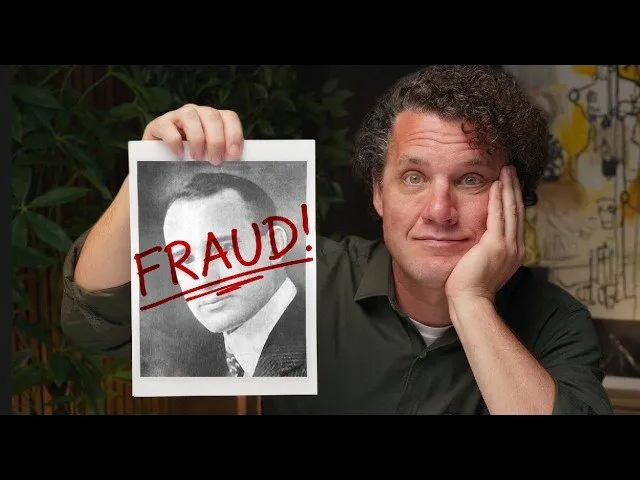
It is 1908. In a 64-room Manhattan mansion, Andrew Carnegie, the richest man in the world, sits across from a young, ambitious journalist named Napoleon Hill. Carnegie offers Hill a unpaid, 20-year commission: interview the 500 most successful men in America and distill their secrets into a "philosophy of success." It is a legendary origin story. But in that same year, another story is unfolding. A man named Oliver is fleeing through the woods of Alabama, running from police warrants for fraud. He has swindled lumber suppliers, his wife has filed for divorce citing domestic violence, and he is about to change his name to restart his life for the third time. The twist? Oliver and Napoleon are the same person. The meeting with Carnegie likely never happened, yet the resulting book, Think and Grow Rich, became the blueprint for the entire modern self-help industry.
Key Takeaways
- The Origin Myth is False: Napoleon Hill was a serial con man who likely never met Andrew Carnegie or the other famous titans he claimed to interview; his history is riddled with fraud, arrest warrants, and abandoned families.
- The Advice is Mixed: The book combines validated psychological principles (goal setting, grit, social networks) with pseudoscience (sex transmutation, telepathy).
- The Placebo Effect is Real: The book’s effectiveness largely stems from the psychological power of belief; if you believe you can succeed, your behavior changes in ways that make success more likely.
- Utility vs. Truth: The legacy of the book raises a philosophical question: if a lie leads to a useful outcome (pragmatism), does the lack of truth matter?
The Two Faces of Napoleon Hill
The Napoleon Hill Foundation tells a specific story: a poor boy from Appalachia claws his way up to interview the titans of industry. He becomes an advisor to two presidents, Woodrow Wilson and Franklin D. Roosevelt, and even claims credit for the famous phrase, "the only thing we have to fear is fear itself." It is a compelling narrative of the American Dream.
However, the historical record tells a vastly different story. David Nasaw, Andrew Carnegie’s definitive biographer, found no evidence of Hill in Carnegie’s meticulous archives—no letters, no appointment logs, no mention of a 20-year project. Hill only began making these claims after Carnegie died in 1919.
In reality, Hill spent the 1910s and 1920s cycling through business ventures that were essentially pyramid schemes. He opened schools that charged students to teach them how to open schools. He faced prosecution for securities violations in Illinois and launched a charity for prisoners that funneled donations directly into his own pockets. Perhaps most bizarrely, in the late 1930s, Hill became involved with the Royal Fraternity of Master Metaphysicians, a cult that believed they could raise a child, "Baby Jean," to be immortal by shielding her from negative thoughts.
Deconstructing the 13 Principles
Despite the fraudulence of the author, Think and Grow Rich has sold over 100 million copies. Why? Because amidst the fabrication, Hill (or his editors) stumbled upon principles that actually work. The book is a strange cocktail of legitimate organizational psychology and complete nonsense.
The Scientifically Valid Advice
Several of Hill's core tenets have been validated by modern research decades after publication:
- Goal Setting: Hill advises readers to write down a specific financial goal with a deadline. This aligns with the 1990s research of Edwin Locke and Gary Latham, whose goal-setting theory is a staple of organizational psychology. Specific, challenging goals are proven to improve performance.
- Persistence: The concept of not quitting when one encounters failure is now scientifically backed by Angela Duckworth’s research on "grit." Sustained effort is a better predictor of success than IQ.
- The Mastermind: Hill suggests surrounding yourself with a group of people who are smarter and aligned with your goals. Modern network theory confirms that you are heavily influenced by your closest social connections.
The Pseudoscience
Alongside the practical advice, the book veers into mysticism. Chapter 11, "The Mystery of Sex Transmutation," claims that successful men are those who repress their sexual energy and redirect it into business creativity. Hill claims men only hit their peak after age 40 because they finally learn to control their libido. This theory relies on outdated, pseudo-Freudian concepts with no basis in biology.
Furthermore, Hill describes the brain as a "broadcasting station" that picks up vibrations from the "ether" and connects to "Infinite Intelligence." While poetic, it reframes cognitive intuition as literal magic, claiming you can tune your mind like a radio to receive cosmic downloads.
The Power of the Placebo
If the author was a fraud and half the book is nonsense, why do legitimate titans of industry—from Tony Robbins to Oprah Winfrey—swear by it? The answer lies in the mechanics of belief. The book acts as a powerful delivery system for the placebo effect.
"The belief that something would help them, helped them. You see this often in the psychological research on motivation and resilience as well. People who believe that they are capable of achieving a task are measurably more likely to achieve that task."
Harvard studies on the placebo effect show that the ritual of treatment produces actual shifts in brain chemistry, including dopamine release. When Hill convinces a reader that they have access to secret knowledge from the world's richest men, it instills a sense of self-efficacy. This belief becomes a self-fulfilling prophecy. It is not that the universe magically shifts to align with your thoughts; rather, your thoughts shift your expectations, which changes your behavior, which ultimately changes your outcomes.
Pragmatism: Useful, Not True
This phenomenon leads to a philosophical defense of the self-help industry, rooted in the concept of Pragmatism. Popularized by philosopher William James, Pragmatism argues that the value of a belief lies not in its objective truth, but in its practical utility. If believing you are destined for wealth makes you work harder and take necessary risks, the belief is "true" in the sense that it was useful.
Derek Sivers, a modern entrepreneur and author, champions this approach, distinguishing between beliefs that are "true" and beliefs that are "useful." We do this constantly in other areas of life—religion, art, and sports fandom are all "useful" psychological frames that may not be objectively verifiable.
The Ghostwriter Revelation
There is one final layer of irony regarding the "truth" of the book. Evidence suggests Hill may not have even been the primary architect of the polished final draft. In 1936, broke and desperate, Hill met Rosa Lee Beeland. She was a talented writer who took Hill's rambling, incoherent manuscripts and spent months editing and curating them into the focused structure of Think and Grow Rich.
Smartly, she refused to marry Hill until he signed over the royalties. They eventually divorced, and she took the money, leaving Hill to return to his scams. In a way, the book itself was a product of the very "Mastermind" principle it preached—Hill provided the raw confidence, and Beeland provided the competence.
The Ethical Paradox
While the advice in Think and Grow Rich may be useful, the context of its creation poses a unique ethical problem. In art, we often separate the artist from the work; we can enjoy a Picasso painting despite his misogyny because the painting's quality stands independently of his character.
However, in self-help, the creator’s authority is the product. Hill didn’t sell the book as "Napoleon Hill’s Good Ideas"; he sold it as "The Secret Wisdom of Andrew Carnegie." The authority rests entirely on a lie. When the credentials are fabricated, the art itself is a deception.
This leaves us with a difficult conclusion. Napoleon Hill was a con artist who hurt real people, abandoned his children, and defrauded the vulnerable. Yet, his fabrication created a tool that has undeniably helped millions find motivation and success. It is the ultimate manifestation of the "useful, not true" paradox: a roadmap to success drawn by a man who couldn't find his own way without lying, yet a map that somehow still leads people to the right destination.