Table of Contents
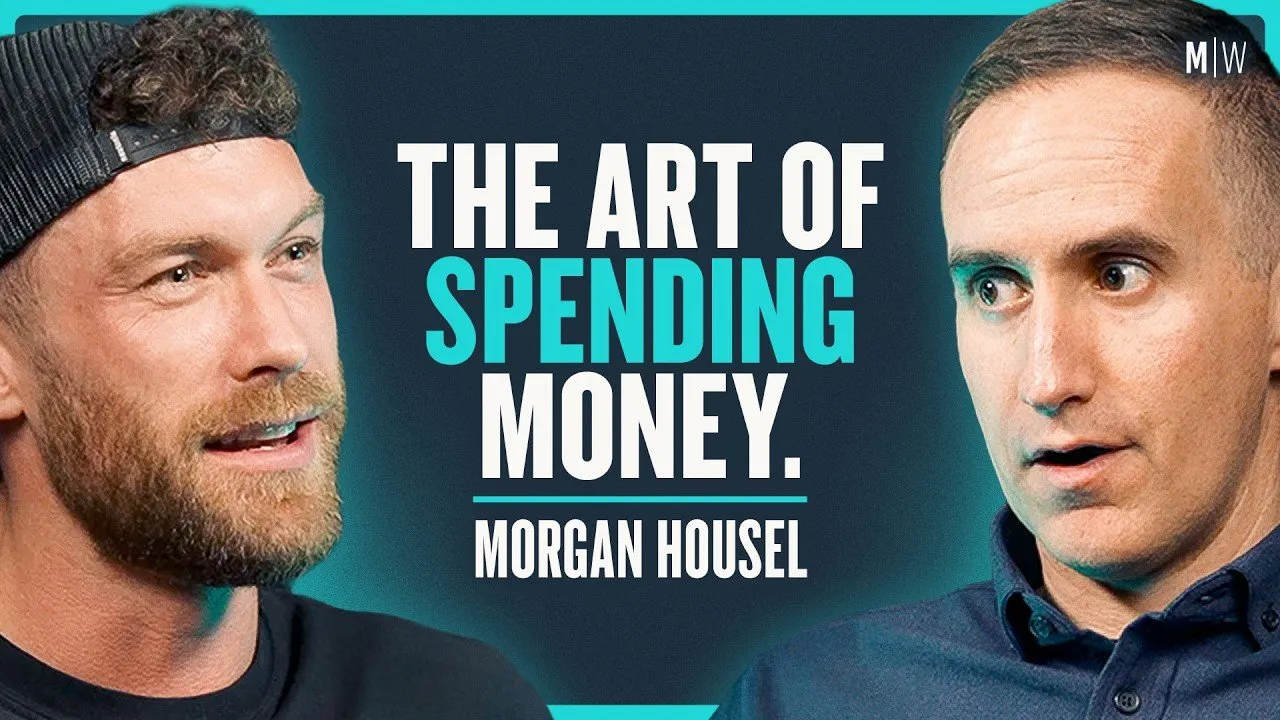
Most of us are taught that money is a math problem. We believe that if we can just master the spreadsheets, understand the interest rates, and pick the right stocks, financial success is guaranteed. However, Morgan Housel, author of the global phenomenon The Psychology of Money, argues that finance is actually a soft skill, where how you behave is more important than what you know.
In a wide-ranging discussion on the art of spending money, Housel explores the hidden emotional undercurrents that drive our financial decisions. From the "retributive materialism" that causes us to overspend, to the crucial difference between being rich and being wealthy, understanding these psychological levers is the first step toward true financial independence.
Key Takeaways
- Wealth is hidden; Rich is visible: True wealth is the option to not spend money today so you can have independence tomorrow, whereas "rich" is often just a display of high income through material goods.
- Retributive Materialism drives spending: Much of luxury spending is a psychological attempt to heal past wounds or insecurities—signaling to others (and yourself) that you have "made it."
- Independence is the ultimate goal: The highest form of wealth is the ability to wake up every morning and say, "I can do whatever I want today."
- The danger of moving goalposts: Satisfaction is difficult because expectations rise in tandem with income. Learning to cap your lifestyle expectations is a financial superpower.
- Rethink inheritance: Giving children financial help when they are 30 creates far more utility and life stability than leaving them a massive inheritance when they are 60 and you pass away.
The Psychology Behind Why We Spend
Why do people buy yellow Lamborghinis or 20,000-square-foot homes? While some genuinely appreciate engineering or architecture, Housel suggests that for many, spending is a form of social storytelling. It acts as a window into our ambitions, but more importantly, into our insecurities.
Retributive Materialism
There is a fascinating psychological concept Housel refers to as "retributive materialism." This is the idea that people spend money to get back at the world for wounds inflicted upon them in the past. If you felt powerless, ignored, or snubbed when you were younger or poorer, acquiring visible status symbols becomes a way to signal to the world—and to yourself—that you have overcome those circumstances.
"The more you were snubbed while poor, the more you enjoy displaying being rich. For a lot of people, the more you are showing off, a lot of it is a wound that was inflicted upon you and you're trying to heal it."
This behavior isn't just limited to cars and houses. You see it in people who obsess over accumulating power because they once felt helpless, or those who obsess over beautification because they once felt inadequate. While this drive can create massive success, it rarely leads to satisfaction because the internal wound cannot be healed by external purchases.
The Trap of the "Rich" Label
Society often conflates "rich" with "wealthy," but they are fundamentally different. "Rich" is a high income that is spent on visible things. When you see someone driving a $300,000 car, the only data point you have is that they have $300,000 less than they did before they bought the car—or $300,000 more in debt.
Wealth, on the other hand, is what you don't see. It is the money not spent. It is the cars not purchased. It is the option to quit a job you hate, to retire early, or to weather a financial storm without panic. Housel notes that spending money to show people how much money you have is the fastest way to have less money.
The True Definition of Financial Success
If buying status symbols leads to a treadmill of dissatisfaction, what should be the goal? Housel defines true financial success not as a number in a bank account, but as autonomy.
"Wealth without independence is a unique form of poverty."
There are billionaires who have zero control over their calendars, waking up every day to handle crises they don't want to deal with. Conversely, there are people earning modest salaries who have complete autonomy over their time, hobbies, and relationships. By this metric, the latter group is often "wealthier" in terms of life satisfaction.
The Happiness Equation
A simple formula for a good life is Independence + Purpose. You need the financial independence to choose what you do, but you also need the purpose to wake up in the morning. Many proponents of the FIRE (Financial Independence, Retire Early) movement find themselves clinically depressed after retiring at 30 because they removed the "work," which was their primary source of purpose and social connection.
Humans are designed to solve problems. The goal of wealth is not to stop working, but to gain the freedom to choose which problems you want to solve. As Housel puts it, "Money serves you best when it stops being the thing you think about."
The Comparison Game and Moving Goalposts
One of the most difficult aspects of modern finance is that there is no objective level of "enough." Wealth is almost entirely relative. A middle-class American today lives a life that would look like magic to a billionaire from 1920—antibiotics, air conditioning, and infinite information in their pocket. Yet, nobody wakes up feeling grateful for Advil or electricity.
We judge our success by looking around at our peers. In the past, your peer group was your neighbors. Today, thanks to social media, your comparison group is a curated highlight reel of the top 1% of the human population globally. This creates a distorted reality where "average" feels like failure.
This leads to a phenomenon where expectations rise as fast as income. If you get a raise, your desires almost immediately expand to consume that new income. This is why many high-earners feel broke; they are running on a treadmill that gets faster every time they make progress.
Intergenerational Wealth and Housing
The landscape of wealth accumulation has shifted drastically between generations, particularly regarding housing. Housing affordability is arguably the single biggest social issue in the modern economy, affecting everything from marriage rates to mental health.
The Housing Trap
We have convinced ourselves that rising home prices are inherently good. However, rising home prices only benefit those who are downsizing or dying. If you sell a house that has doubled in value to buy a similar house that has also doubled in value, you haven't actually gained any wealth. You have simply participated in asset inflation.
This dynamic punishes young people and first-time buyers, locking them out of the stability that previous generations enjoyed. Housel points out that this is often a supply issue caused by restrictive zoning laws—essentially, current homeowners pulling the ladder up behind them to protect their asset values at the expense of the next generation.
A New Approach to Inheritance
Given these economic headwinds, how should parents think about transferring wealth? Housel cites Bill Perkins’ philosophy from the book Die With Zero. The traditional model is to leave a large inheritance when the parents die, often when the "children" are in their 60s. By that age, the children are usually financially stable and the money has low utility.
The optimal strategy is to give the money when the children are roughly 30 years old.
- This is the "rush hour" of life when expenses are highest (buying a first home, having children).
- The marginal utility of money is highest at this age.
- It allows parents to see their children enjoy the money while they are still alive.
Conclusion: The Ultimate Financial Asset
Ultimately, the most valuable financial asset is not a stock portfolio or a rental property. It is the ability to not be impressed by things. If you can detach your self-worth from your net worth, and if you can stop trying to impress strangers who aren't paying attention to you anyway, you win the game.
As Housel concludes, the goal is contentment. Happiness is a fleeting emotion—usually a reaction to a positive surprise. Contentment, however, is a sustainable state of being where you realize that you have enough, you are enough, and you have the independence to live life on your own terms.