Table of Contents
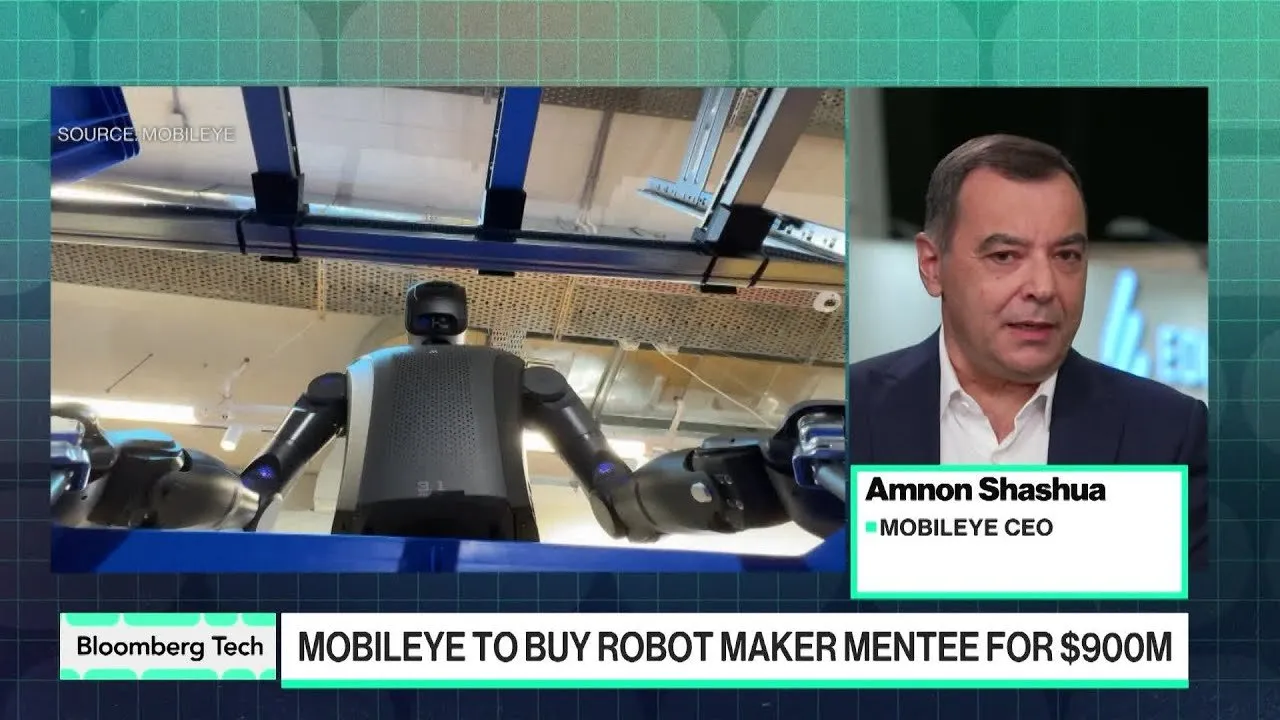
Mobileye CEO Amnon Shashua has defended the company's strategic expansion into humanoid robotics through the acquisition of Mentee, framing the move as a natural evolution of "Physical AI" rather than a departure from its core autonomous driving business. In a wide-ranging discussion on the company's future, Shashua also revealed a significant contract with a major U.S. automaker to deploy advanced driver assistance systems (ADAS) across 9 million vehicles, signaling continued strength in Mobileye’s foundational automotive sector despite growing competition.
Key Points
- Strategic Expansion: Mobileye views the acquisition of Mentee Robotics as a complementary move to leverage its computer vision and AI capabilities for "Physical AI" applications.
- Robotics Roadmap: The company targets a 2028 rollout for industrial robots in structured environments, with a projected manufacturing cost of $20,000 per unit.
- Automotive Growth: Mobileye secured a deal with a major U.S. automaker for 9 million units of "Surround ADAS," replacing traditional parking and safety sensors.
- Robotaxi Progress: In partnership with Volkswagen, the company aims to deploy 100,000 driverless vehicles within the next eight years.
Defining the Future of Physical AI
The transition from controlling cars to controlling humanoid robots represents a technological synergy that Shashua believes is essential for Mobileye’s long-term growth. According to the CEO, the core technologies powering autonomous driving—specifically computer vision and artificial intelligence—are directly applicable to robotics. He categorizes this broader field as "Physical AI," a domain where digital intelligence interacts with the physical world.
"If you are an actor in this area physically, you want to then extend it to the full scope of physical AI. And I believe that robotics, humanoids, they have a great future... For Mobileye, there are synergetic areas in infrastructure, in AI software, and in AI talents."
Shashua also addressed potential concerns regarding conflicts of interest—specifically that his son is employed by Mentee. He clarified that the acquisition was treated as a "related party transaction" with standard recusal protocols observed. He noted his son holds a negligible stake and works as a standard employee, dismissing the relationship as immaterial to the strategic value of the deal.
The Economics of Humanoid Robotics
Mobileye has outlined a clear, two-phase go-to-market strategy for its robotics division. The initial focus will be on structured environments such as warehouses, assembly plants, and retail spaces. In these settings, tasks are finite and predictable, allowing for customized fleet deployments.
Shashua offered specific projections regarding the financial viability of this rollout:
- Timeline: Commercial deployment is expected to begin in 2028.
- Cost Structure: At volume production (tens of thousands of units), the manufacturing cost is estimated at $20,000 per robot.
- Business Model: Flexibility to sell or lease hardware to enterprise clients.
The second phase targets unstructured environments, such as home use. This presents a higher technical barrier due to the open-ended nature of household tasks. To solve this, Mentee is utilizing a "mentoring" approach where robots passively watch humans perform tasks, upload the data to the cloud for simulation training, and learn new skills in minutes rather than hours.
Autonomous Driving and Market Momentum
While expanding into robotics, Mobileye continues to aggressively defend its position in the automotive sector against competitors like Nvidia. Shashua dismissed concerns regarding Nvidia’s full-stack solutions, emphasizing Mobileye’s cost-efficiency. He cited a sensor suite cost of approximately $10,000 to $12,000 and claimed Mobileye’s chips operate at one-tenth the cost of competing silicon.
The company is currently executing a significant ramp-up with Volkswagen. Shashua confirmed plans to scale to 100,000 robotaxis over the next eight years, with imminent milestones in removing human drivers from the loop entirely.
The 9-Million Unit Deal
Perhaps the most significant immediate news is the finalization of a supply agreement with a "Big Three" U.S. automaker. This deal covers 9 million vehicles equipped with "Surround ADAS."
"This 9 million units is big news because we are talking about the evolution of ADAS... You're taking a front-facing camera, parking cameras, multiple radars... It replaces multiple issues in the car: parking ECU, driving monitoring system, hands-free driving on highways."
This volume, combined with a previous deal with Volkswagen, suggests Mobileye is successfully transitioning the market from basic safety features to comprehensive, surround-vision systems that offer higher value and recurring revenue potential.
Looking Ahead
Regarding rumors of a potential acquisition of AI21 Labs (another company founded by Shashua) by Nvidia, Shashua firmly denied any concrete talks, attributing the reports to speculation in the Israeli press. For now, Mobileye remains focused on integrating Mentee’s robotics capabilities while delivering on its massive automotive backlog, betting that the convergence of driving and walking robots will define the next decade of automation.