Table of Contents
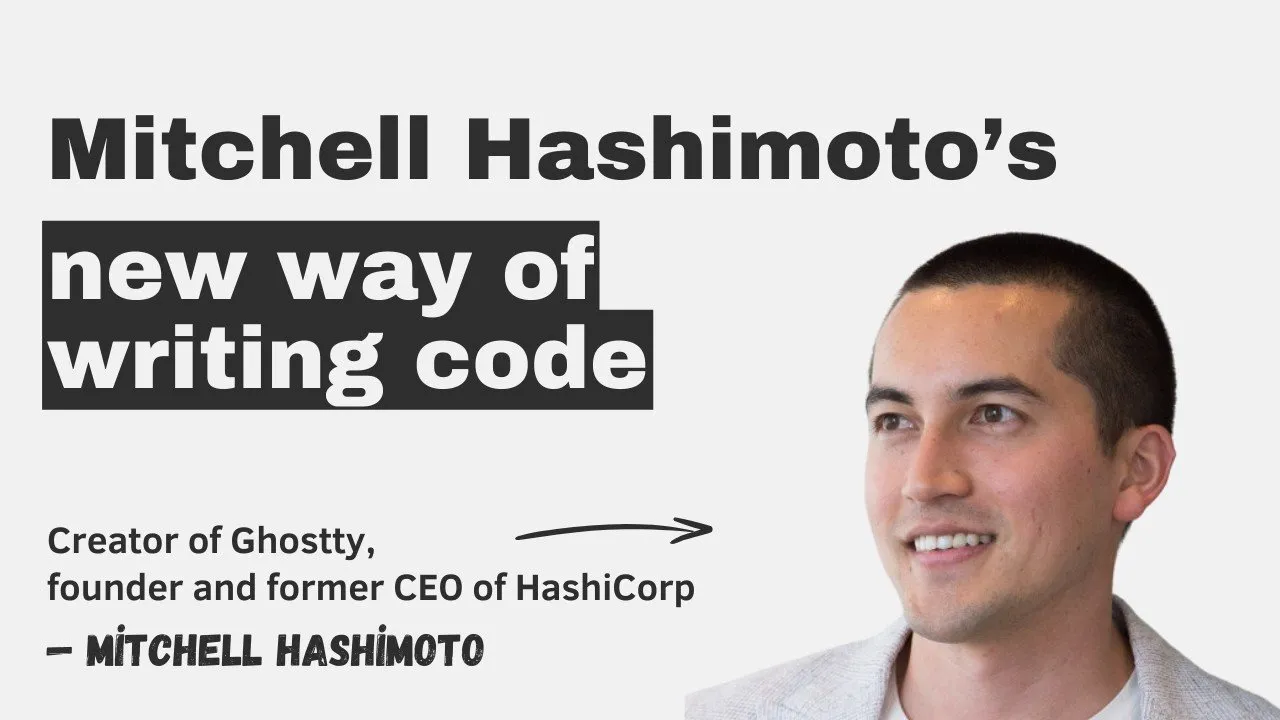
Mitchell Hashimoto is a name synonymous with the modern cloud. As the co-founder of HashiCorp, he helped define the "Infrastructure as Code" era through tools like Terraform, Vault, and Vagrant. However, his journey didn't start in a boardroom; it began with a 12-year-old boy printing out PHP manuals to read on his walk to school. In a recent, wide-ranging conversation, Hashimoto explored the history of HashiCorp, his unvarnished experiences with major cloud providers, and his provocative views on how AI is fundamentally altering the craft of software engineering.
Key Takeaways
- Constraints drive better software: Many of Hashimoto’s early tools, including Vagrant, were born out of financial necessity and the limitations of personal hardware.
- The "Friday Night Pivot": HashiCorp’s massive commercial success only followed a painful realization that their initial business model was a failure, leading to a complete weekend overhaul of their strategy.
- The Cloud Provider Spectrum: Hashimoto characterizes AWS as "arrogant," Microsoft as a "team player" with complex tech, and Google as "brilliant engineers" who lack business focus.
- AI Productivity: Mitchell maintains a "default on" agent strategy, ensuring an AI assistant is performing a "slow task" (research or planning) whenever he is away from his desk.
- Open Source Crisis: The rise of "AI slop" in pull requests is forcing maintainers to move from a system of "default trust" to "vouching-only" contributions.
The Origins of the Hashi Stack
HashiCorp’s billion-dollar success was rooted in a failed research project at the University of Washington. Working on the "Seattle Project," a distributed computing initiative, Hashimoto found himself unable to solve the technical challenges within a single academic quarter. This failure led him to keep a notebook of "unsolved problems"—a list of missing components needed to manage resources declaratively and network them privately.
The Constraint of Poverty
While many assume these tools were built on high-end enterprise hardware, the reality was the opposite. Vagrant was developed because Hashimoto, then a college student, had no money to pay for AWS EC2 instances. He used VirtualBox because it was free. This constraint forced him to think in systems and focus on reproducibility, eventually creating a tool that allowed developers to "double-click" into a development environment.
The Mentor Who Took the Mouse
A pivotal moment in Hashimoto's career occurred during his time at a Ruby on Rails consultancy. His boss, an infrastructure expert, took a radical approach to training. He unplugged Hashimoto's mouse and told him he would never use one again. This "harsh lesson" forced a deep mastery of the terminal and command-line interfaces, forming the philosophical bedrock for the tools HashiCorp would eventually build.
Commercializing a Vision: The Weekend Pivot
For the first four years of HashiCorp, there was no repeatable business model. The founders raised venture capital on the back of millions of open-source downloads, but their first commercial product, "Atlas," was a notable failure. It attempted to sell the entire "Hashi Stack" as a single unit, but customers were confused about which department should pay for it.
"AWS was really arrogant. Felt like they were doing us a favor. Subtle vibe of we will spin up a product and kill your company."
Breaking the Contract
Following a disappointing board meeting, Hashimoto and his co-founder Arman Dadgar spent a silent car ride back to the office, sat at a whiteboard, and decided to throw everything away. Over a single weekend, they decided to switch to an "Open Core" model, focusing on per-product enterprise versions starting with Vault. They expected the team to quit in protest of the move away from pure open source; instead, the office was buzzed with the clarity of a new direction.
A View from the Top: AWS, Azure, and Google
As a neutral toolmaker, Hashimoto had a front-row seat to the culture of the big three cloud providers. His assessments are blunt and evidence-based, reflecting the friction of building a multi-cloud ecosystem in the 2010s.
- AWS: Characterized as "arrogant" and "annoying" to partner with. Hashimoto noted they were often the last to provide help, only doing so when HashiCorp threatened to deprecate the AWS Terraform provider publicly.
- Microsoft Azure: Viewed as the most professional partner. While the technology was often "hairy" and complex, the organization was focused on mutual wins and business alignment.
- Google Cloud: Praised for having the most "incredible technology" and "architectural thinking," yet criticized for a total lack of business focus. Meetings would revolve around edge cases and scalability while ignoring sales quotas or co-selling agreements.
The New Craft: Engineering in the Age of AI
Since stepping down from HashiCorp, Hashimoto has returned to hands-on building with Ghosty, a high-performance terminal emulator written in Zig. This project serves as a sandbox for his new philosophy on software development: integrating AI agents without losing the spirit of craftsmanship.
Always Have an Agent Running
Hashimoto advocates for a workflow where an AI agent is constantly active. If he is driving, the agent is performing deep research. If he is sleeping, it is planning a feature. He treats AI as a way to "choose what you think about," delegating boilerplate and research tasks while focusing his human intellect on high-level design and performance optimization.
Harness Engineering
A new discipline Hashimoto identifies is "Harness Engineering." This involves building the tooling and test environments necessary for an AI agent to validate its own work. Since AI is goal-oriented, it will often "break things on its path" unless a robust harness exists to catch regressions. Success in the AI era, Hashimoto argues, depends on an engineer's ability to build these protective frameworks.
The Crisis of Trust in Open Source
The rise of LLMs has introduced a new threat to open-source maintainers: "AI slop." This refers to plausible-looking but functionally incorrect pull requests (PRs) submitted with minimal human effort. This surge in low-quality contributions has broken the traditional model of open-source participation.
"Open source has always been a system of trust. Now it's just default deny and you must get trust."
The Vouching System
To combat this, Hashimoto is implementing a "vouching" system for the Ghosty project, inspired by communities like Lobsters. Instead of allowing anyone to open a PR, new contributors must be vouched for by an existing member. If a contributor behaves badly, the person who vouched for them—and the entire tree of invitations—can be banned. This shifts the reputation burden back onto the community, protecting maintainers from the noise of agentic PRs.
Conclusion
Mitchell Hashimoto’s career illustrates a transition from the "Infrastructure as Code" revolution to an "Agentic" one. His journey emphasizes that while tools and models change—from VirtualBox to Zig, and from manual coding to AI agents—the core tenets of engineering remain constant: understanding constraints, choosing what to think about, and building systems of trust. For the modern engineer, the challenge is no longer just writing the code, but building the harness that allows the next generation of tools to function safely and efficiently.