Table of Contents
In a media landscape often dominated by soundbites and partisan narratives, the role of citizen journalism has become increasingly vital. This week’s discussion centers on a breaking investigation that has exposed hundreds of millions of dollars in potential entitlement fraud in Minnesota—a story that began with local whispers and exploded into a national conversation. Beyond the immediate scandal, this exposes deeper systemic issues regarding government oversight, political patronage, and the fiscal health of American states. From the granular details of fake daycare centers to the macroeconomic implications of California’s proposed "Billionaire Tax Act," and finally to a major breakthrough in AI hardware, we explore the intersection of policy, fraud, and innovation.
Key Takeaways
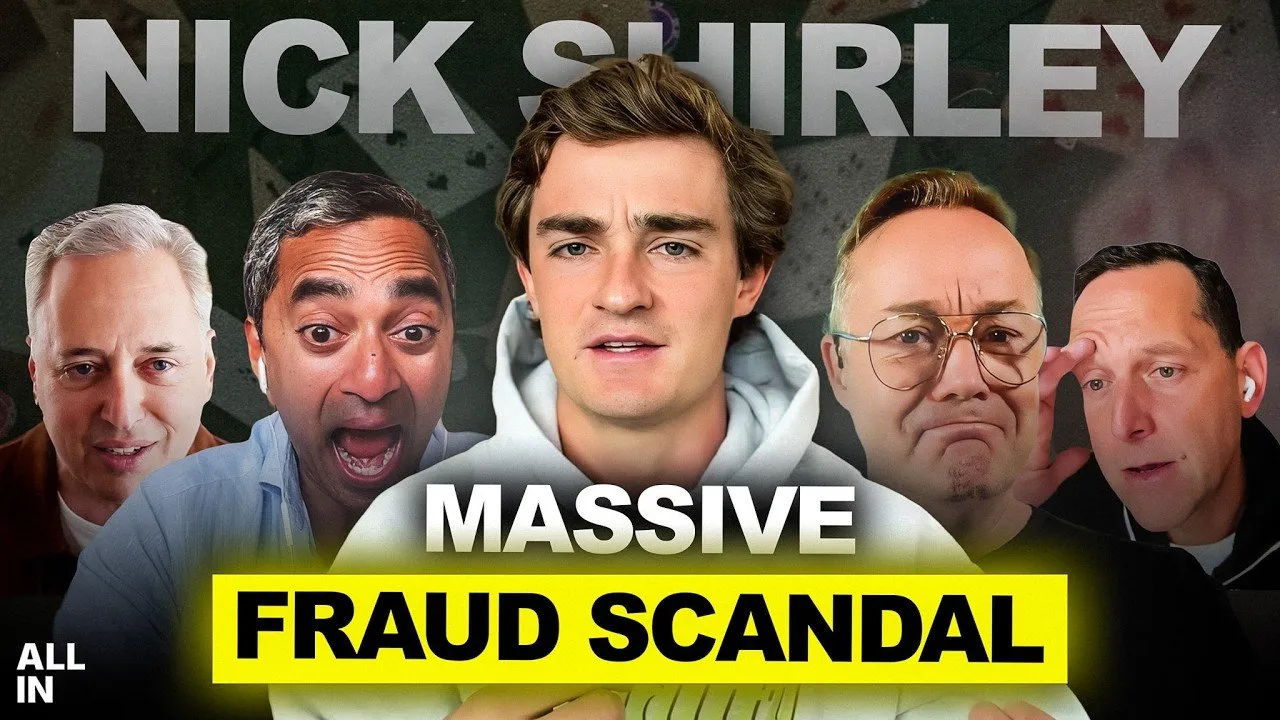
- Systemic Entitlement Fraud: Investigative journalist Nick Shirley uncovered evidence suggesting massive fraud within Minnesota’s entitlement programs, specifically regarding childcare and autism resources, potentially totaling over $110 million in just the facilities visited.
- The Patronage Ecosystem: The discussion highlights how lax oversight and "suicidal empathy" in policy may create a patronage system where government funds are siphoned to secure voting blocs, rather than aiding the intended recipients.
- California’s "Billionaire Tax Act": A new ballot proposal in California is scrutinized not merely as a tax on the wealthy, but as a precedent-setting "asset seizure" that taxes private property rather than income or realized gains.
- The Crisis of Fiscal Responsibility: With billions "lost" in California and Minnesota, the conversation turns to the urgent need for audits and the potential bond market repricing of state debt.
- Groq and Nvidia Partnership: On the technology front, a major deal was announced where Nvidia will license Groq’s technology, validating a non-consensus bet on a specific AI chip architecture designed to solve the "decode" bottleneck.
The Minnesota Investigation: Uncovering Industrial-Scale Fraud
The conversation opens with investigative journalist Nick Shirley, whose recent viral video shed light on what federal prosecutors have termed "industrial-scale fraud" within Minnesota. While local reporters like Jeff Baillon at Fox 9 have been tracking these issues since 2013, Shirley’s on-the-ground approach brought a visceral reality to the statistics. The investigation focused largely on the Child Care Assistance Program (CCAP), a state-administered, federally funded program intended to help low-income families.
The Mechanics of the Scheme
Shirley’s investigation involved physically visiting daycare centers that were receiving millions of dollars in government funding. The findings were stark. Many facilities operated with blacked-out windows, locked doors during business hours, and no visible children. In some instances, signage was misspelled (e.g., "Learing Center"), and inquiries about enrollment were met with confusion or hostility.
The scope of the alleged fraud is staggering. Since 2018, Minnesota has seen approximately $9 billion in entitlement fraud. This includes the infamous "Feeding Our Future" scheme, where $250 million meant for hungry children was stolen. Furthermore, Medicaid claims for autism services in the state spiked roughly 130x over five years—rising from $3 million in 2018 to $400 million in 2023—raising serious questions about the validity of these medical claims.
"When I saw the bank account for the business, there were large cash withdrawals on a continuous basis... A year after our investigation, Ali was arrested and charged with billing the state out of about $4 million."
A Failure of Oversight
The persistence of this fraud, despite years of red flags, points to a breakdown in governance. Critics argue that the funds are often siphoned out of the country, with reports suggesting cash moving through airports to Dubai and eventually Somalia. The investigation revealed that even after facilities were flagged or operators were indicted, new entities would often open in the exact same locations under different names, continuing the cycle of theft.
Political Patronage and the "Suicidal Empathy" of the State
Why has this fraud been allowed to fester for over a decade? The discussion posits that this is not merely incompetence, but a feature of a political patronage system. The theory is that loose purse strings allow funds to flow into specific communities, which then return the favor through organized voting blocs and campaign donations.
This dynamic creates a perverse incentive structure where politicians may turn a blind eye to corruption to avoid alienating key demographics or facing accusations of racism or Islamophobia. This creates a "blind spot" in bureaucracy where enforcement is paralyzed by cultural differences and political correctness.
"This fraud is not incidental misconduct. It is the patronage system operating exactly as designed... It requires only that patrons be paid... In return, they receive votes, campaign muscle, and money, and insulation from accusations."
The implications extend beyond Minnesota. Similar patterns are being observed in Ohio, Washington, and notably California, where billions spent on homelessness and high-speed rail have yielded little to no tangible results. The concern is that the "USS Taxpayer" is hitting an iceberg of fraud, with Minnesota being just the visible tip.
California’s Fiscal Cliff and the "Billionaire Tax Act"
Moving west, the focus shifts to California's precarious financial situation and a controversial new ballot measure dubbed the "Billionaire Tax Act" (BTA). This proposal seeks to levy a 5% tax on the net worth of residents with over $1 billion in assets.
Asset Seizure vs. Income Tax
While framed as a "tax on the rich," the panel argues this is a fundamental shift in American taxation principles. Traditionally, taxes are levied on income (labor) or realized gains (selling an asset). The BTA proposes taxing unrealized wealth—effectively an asset seizure. This means the government assesses the value of private property (stocks, real estate, businesses) and takes a percentage, regardless of whether the owner has cash on hand to pay it.
Drawing parallels to France’s failed wealth tax experiment in the 1980s—which led to massive capital flight and a net loss in tax revenue—critics warn that this policy will drive the wealthy out of California, further eroding the tax base. More concerning is the precedent it sets. Once the legal framework for asset seizure is established for billionaires, it becomes easier to lower the threshold to multi-millionaires and eventually the middle class, auditing assets like homes, cars, and jewelry.
The "Lost" Billions
The push for new taxes comes at a time when California cannot account for significant portions of its existing budget. A recent state audit revealed that $24 billion allocated for homelessness cannot be fully tracked, and the outcome—a rising homeless population—suggests the money has been wasted. The argument follows that the government does not have a revenue problem; it has a spending and accountability problem.
"It creates for the first time in American history a private property asset seizure tax... normalizing auditing every American to understand what they own and then take a percentage of it every year."
Innovation in AI: The Groq and Nvidia Deal
In a pivot from government inefficiency to private sector innovation, the discussion highlighted a major development in the artificial intelligence hardware space. Nvidia, the dominant force in AI GPUs, has entered into a licensing agreement with Groq, a company specializing in AI inference chips.
Solving the "Decode" Bottleneck
To understand the significance of this deal, one must understand how Large Language Models (LLMs) function. The process has two distinct phases:
- Prefill (Reading): The model processes the user's prompt. Nvidia’s GPUs are exceptionally good at this massive parallel processing task.
- Decode (Writing): The model generates the answer token by token. This is memory-bandwidth constrained, as the chip must constantly look back at the conversation history.
Groq’s architecture was designed specifically to excel at the "decode" phase. By licensing this technology, Nvidia can potentially integrate Groq’s strengths into their ecosystem, creating a hybrid approach that optimizes both reading and writing speeds. This partnership validates a non-consensus bet made years ago that a different architectural approach would be necessary as AI models scaled.
"Jonathan [Ross] is a volcano of technical creativity... His vision for the V2, V3, V4 chips... allowed a lot of this to happen. It wouldn't have happened without those two working together."
Conclusion
The contrast between the stories in Minnesota and the developments in Silicon Valley is stark. On one hand, we see a government sector plagued by "industrial-scale" fraud, lack of accountability, and policies that may be accelerating fiscal insolvency in states like California. On the other, we see the private sector driving efficiency and innovation through high-stakes competition and technological breakthroughs.
As the bond markets begin to sniff out the instability of state balance sheets, the pressure for fiscal responsibility will likely move from the ballot box to the balance sheet. Whether through citizen journalism exposing fraud or market forces punishing waste, the days of un-audited government expansion may be facing a reckoning.