Table of Contents
The gap between independent content creators and legacy media giants is closing, and it is reshaping how we consume entertainment. For years, we have been trained as consumers to accept a dichotomy: we pay for the high production values of Netflix or HBO, and we expect the "good enough" quality of YouTube podcasts to be free. This distinction created a moat around premium video content.
However, a new trend is dismantling this barrier. We are witnessing the rise of "micro-streamers"—independent producers creating content that rivals the production quality of major studios. This movement is not just about better cameras; it represents a fundamental shift in the economics of online media, moving away from algorithmic virality toward community-funded, high-quality art.
Key Takeaways
- The rise of micro-streamers: Independent creators are launching subscription-based platforms with production values that rival legacy streamers like Netflix.
- The Dropout model: Comedy platform Dropout TV proves that a niche streaming service can generate millions in revenue by treating talent ethically and fostering deep community ties.
- Friction vs. Features: When choosing productivity tools, minimizing the friction of entry is far more valuable than a surplus of advanced features.
- AI Realism: Current fears regarding AI "superintelligence" rely on flawed extrapolation; we lack the technology to scale AI capability exponentially from its current state.
The Rise of the Micro-Streamer
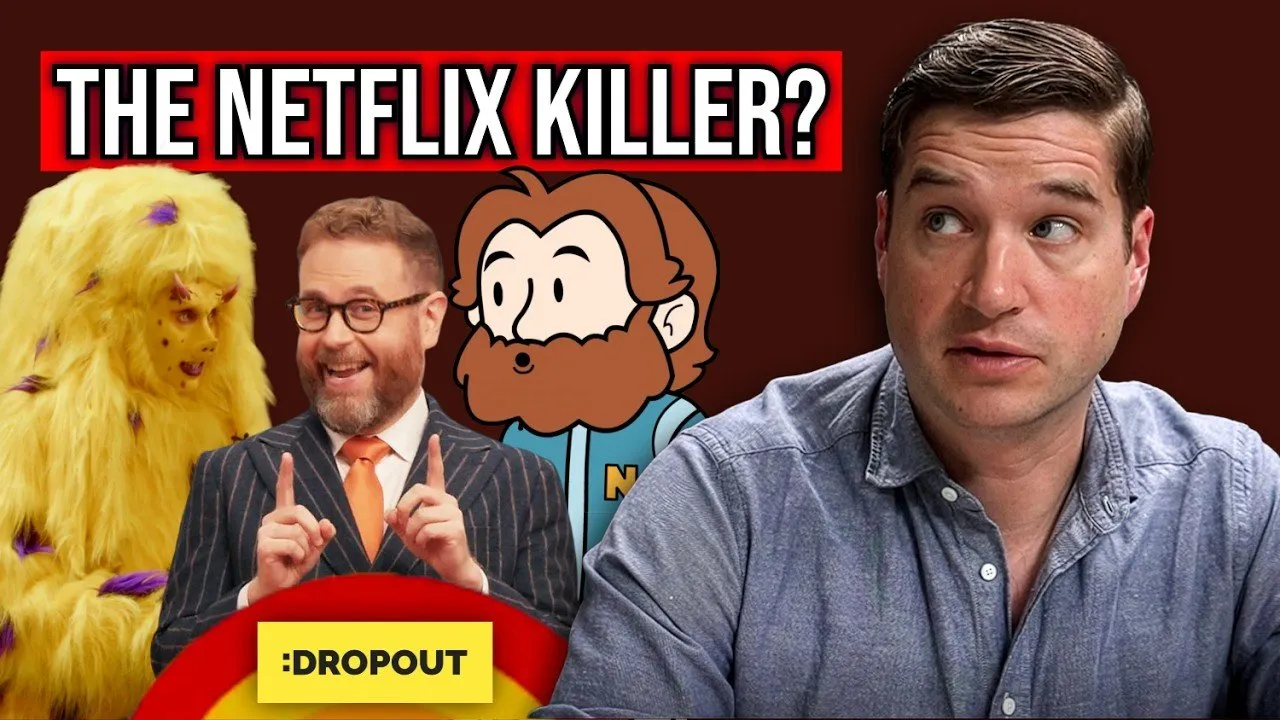
To understand the future of media, we must look at the outliers finding success today. A prime example is Dropout TV. Originally born from the ashes of the early-2000s comedy site CollegeHumor, Dropout has pivoted from chasing YouTube algorithms to building a standalone subscription service.
Dropout charges a monthly fee similar to major streamers, and in exchange, they deliver unscripted television that looks and feels like network TV. They have moved beyond the "guy with a DSLR and a microphone" aesthetic. Their shows, such as Dimension 20 or Game Changer, utilize professional lighting crews, elaborate sets, and high-end editing.
The numbers validate this strategy. While smaller than Netflix, Dropout has reported subscriber numbers in the mid-hundreds of thousands to over a million. At roughly $7 a month, this generates substantial eight-figure annual revenue. This success proves that audiences are willing to pay for independent content if the value proposition—specifically the production quality—is high enough.
The Three Ingredients for Subscription Success
Most content on YouTube does not belong behind a paywall. For a micro-streamer to succeed in a market dominated by free content, three distinct properties must be present.
1. Legacy-Level Production Values
The most obvious differentiator is the visual fidelity. Micro-streamers must offer a viewing experience indistinguishable from MasterClass or Disney+. While the cost of high-end equipment is dropping, the labor required to set up professional lighting and manage a set remains significant. This high barrier to entry is actually a feature, not a bug; it filters out the noise, ensuring that only serious, high-quality productions compete in the paid space.
2. Undeniable Content Quality
The content must pass a rigorous test: it must be significantly better than what is available for free. In the "Maker" or DIY space, for example, YouTube already offers incredible content for free, making it difficult to justify a subscription model. Dropout succeeds because their improv comedy is widely considered superior to anything found on open platforms. It fills a specific void that free algorithms are not incentivized to fill.
3. Deep Community Integration
This is perhaps the most surprising and critical factor. Successful micro-streamers dissolve the traditional wall between performer and audience. They foster a sense of community that goes beyond consumption.
"I really love the co-op model of Dropout... there is all the rewards of what art is produced when artists are paid fairly, have ownership in the things they're doing, have really healthy workplaces... it's a way of processing the zeitgeist and not feeling alone."
Viewers aren't just buying a show; they are buying into an ethical business model. Dropout is transparent about paying performers—even for auditions—and cultivating a healthy work environment. This creates a parasocial loyalty where subscribers feel they are supporting a movement rather than just paying a corporation.
Why This Shift Benefits the Media Landscape
There is a strong argument that a "micro-streamer boom" will be a net positive for society and culture. We can expect a future with a stable ecosystem of perhaps 2,000 to 5,000 successful micro-streamers, each generating healthy revenue without needing to dominate the entire globe.
This model is non-algorithmic. When a creator relies on subscriptions rather than ad revenue, the incentive shifts from maximizing "time on device" to maximizing customer satisfaction. This eliminates the need for addictive, outrage-inducing tactics common on TikTok or Instagram.
Furthermore, this economy supports a "middle class" of skilled creatives. In the current influencer economy, a tiny fraction of creators make millions while the vast majority make nothing. The micro-streamer model requires skilled tradespeople—writers, lighting technicians, editors, and producers—injecting money back into the substrate of professional creativity.
The Priority of Friction Over Features
Shifting gears to personal productivity, we see a similar principle of quality over quantity. Recently, I invested $60 in a task management app called Things 3—a significant price for software in the age of free apps. This purchase highlights a critical misunderstanding people have about organizing their lives.
Most people fail at task management not because their tools lack features, but because they stop using the system entirely. The primary enemy of consistency is friction. When you are tired, busy, or overwhelmed, even a few extra clicks to enter a task can be enough resistance to make you abandon the tool.
We often get seduced by apps promising complex integrations and AI sorting, but the highest expected value comes from the simple tool you actually use for the long term. A $60 app that reduces the friction of capturing a task to a single keystroke is worth more than a free app with a hundred features that creates drag in your workflow.
The Fallacy of AI Superintelligence
Finally, it is worth addressing a recurring anxiety in the tech world: the fear of AI superintelligence. Articles frequently circulate arguing that we are on a logical path toward extinction, based on the premise that AI will continue to scale exponentially in intelligence.
This fear is largely based on a flawed extrapolation. The argument usually posits that because AI improved from GPT-2 to GPT-4, it will simply continue to become 100 times, then 1,000 times smarter. However, looking closely at the technology, we see that "pre-training scaling"—the method of making models smarter by feeding them more data and compute—has largely stalled.
Current improvements are coming from "post-training" fine-tuning, which creates better specific performance but does not represent a systemic leap in intelligence. We simply do not possess the technology to make AI recursively self-improving. Reacting to the fear of superintelligence today is like watching early airplanes increase in speed and worrying that they will eventually travel at 100,000 miles per hour and turn us all into ghosts. Extrapolation without technological verification is storytelling, not science.
Conclusion
Whether we are looking at the future of streaming media, the tools we use to organize our work, or our understanding of artificial intelligence, the trend is moving away from noise and toward substance. In media, we are moving from algorithmic virality to paid quality. In productivity, we are moving from feature bloat to frictionless simplicity. By focusing on depth and quality, we can build a digital landscape that serves us rather than distracts us.