Table of Contents
The financial markets are currently witnessing a phenomenon that feels eerily familiar to cryptocurrency veterans, yet it is happening in one of the oldest asset classes on earth: precious metals. Gold and silver are staging a massive rally, triggering a cascade of liquidity that mimics the infamous "alt season" cycles seen in crypto. However, beneath the retail FOMO and the parabolic charts lies a complex geopolitical narrative that suggests we are witnessing a fundamental shift in how the world values sovereignty and resources.
While the immediate price action in silver and gold screams "retail panic," the longer-term thesis points toward a fractured global order where strategic commodities—not just shiny rocks—become the ultimate reserve assets. Navigating this requires distinguishing between a crowded trade and a multi-decade investment thesis.
Key Takeaways
- The "Alt Season" in Metals: Capital is flowing from gold (the major) to silver and secondary metals (the alts) in a pattern identical to crypto cycles, driven largely by retail exuberance.
- Geopolitics Over Inflation: The current rally is driven less by traditional inflation fears and more by central banks diversifying away from US Treasuries in an increasingly multipolar world.
- Bitcoin's Decoupling: Despite the "digital gold" narrative, Bitcoin is currently languishing while physical gold rips, highlighting a generational and structural divide in investor bases.
- Strategic vs. Speculative: While silver is currently a high-risk momentum trade, strategic metals like Copper, Uranium, and Rare Earths (REMX) offer a stronger 10-15 year investment case based on national security.
- The Evolution of Crypto: The industry is transitioning from "crypto" as a novelty to "fintech" as a standard, where tokens must eventually function like equity to survive.
The Metals "Alt Season" and Retail Mania
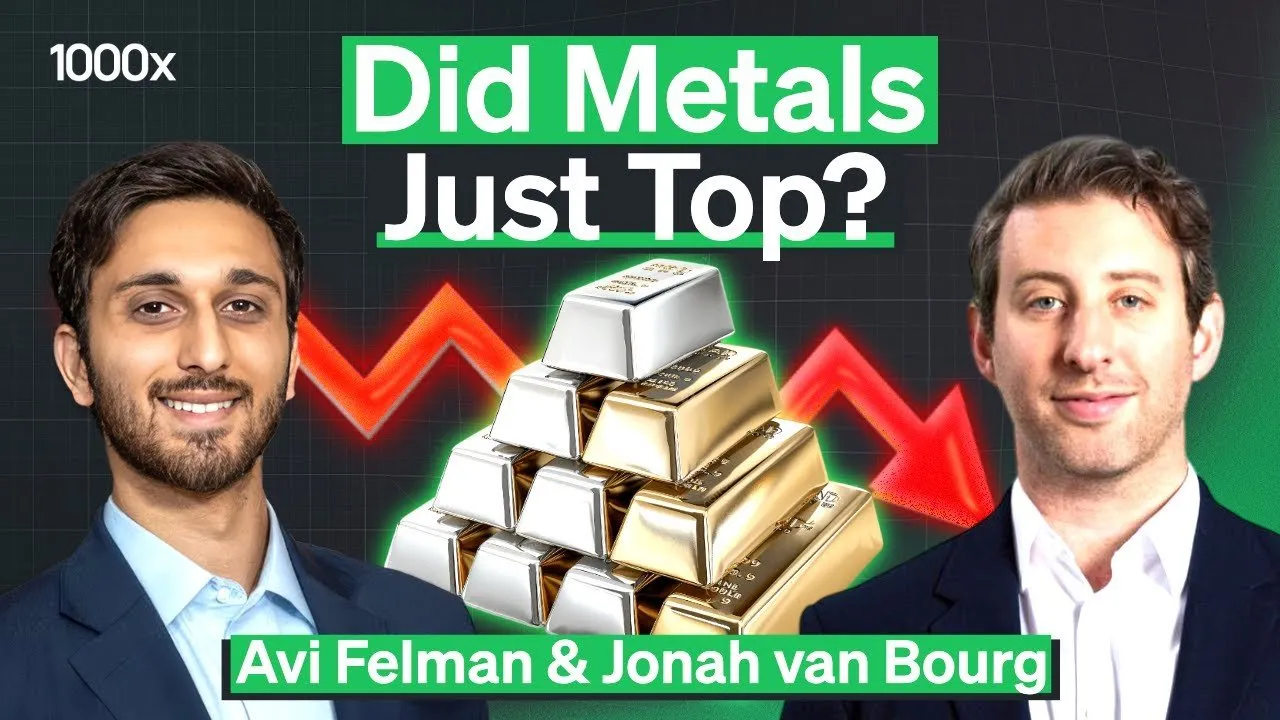
The market is currently experiencing a liquidity cascade that crypto traders know well. Typically, in a digital asset cycle, Bitcoin rallies first, followed by Ethereum, and finally, capital rotates into higher-risk altcoins. We are seeing this exact dynamic play out in the commodities sector. Gold led the charge, breaking all-time highs, which then triggered a violent catch-up trade in silver, followed by movement in tertiary metals like platinum and palladium.
This rotation indicates that precious metals have successfully penetrated retail consciousness. When everyone is focused on silver's rapid ascent, it suggests that a significant amount of retail price action is being baked into the market. While this creates explosive short-term upside, it also signals danger.
The fact that this is running and everyone is focused on this tells me that metals have successfully penetrated into retail trading... And that's a little bit scary for the short term.
Historically, when an asset class goes parabolic due to late-stage retail participation—similar to the Natural Gas blow-off top—it becomes difficult to trade. The "easy" money has been made, and entering now requires navigating extreme volatility. While the price could technically double again in this "eighth or ninth inning," the risk of a reversal is substantial. The current market structure is a mix of CTA (Commodity Trading Advisor) trend-following algorithms, sovereign buying, and retail panic.
The Geopolitical Supercycle: A Multipolar World
While the short-term price action in gold and silver feels speculative, the underlying driver is structural. We are transitioning from a unipolar world, dominated by the United States and the dollar, to a multipolar world. In a unipolar system, global trade is stable, and holding US Treasuries is sufficient for safety. In a fractured world, sovereign nations must protect their own interests and resources.
Why Central Banks Are Buying
Central banks are aggressively accumulating gold not necessarily as an inflation hedge, but as a neutral reserve asset. The weaponization of the dollar and the freezing of assets have taught nations that they need reserves that cannot be seized or debased by a foreign government. This is a diversification trade out of Western debt and into sovereign commodities.
However, this narrative supports gold far more than it supports silver. Gold is a Tier-1 central bank asset; silver is primarily an industrial metal and a retail speculation vehicle. Central banks do not hoard silver to shore up their currencies.
Strategic Resources vs. Precious Metals
If the thesis is a fracturing world where nations fight over resources, the smartest long-term plays may not be gold or silver, but the materials required for national security and energy independence. This includes:
- Rare Earth Elements (REMX): Essential for modern technology and defense systems.
- Copper: Crucial for electrification and infrastructure.
- Uranium: The backbone of energy independence via nuclear power.
These assets have a "supercycle" thesis spanning 10 to 15 years. Unlike silver, which often behaves like a high-beta meme coin attached to gold, these strategic metals have genuine demand drivers rooted in national defense and industrial reshoring.
Bitcoin vs. Gold: The Missing Rotation
A common question among digital asset investors is whether the profits from the gold rally will eventually rotate into Bitcoin. The data suggests this is unlikely in the short term. Gold and Bitcoin currently serve two very different investor bases. The gold rally is being driven by sovereigns and an older demographic (Boomers) seeking safety. Bitcoin is held by a younger demographic (Millennials/Gen Z) seeking asymmetric upside and digital sovereignty.
No, gold profits from gold will not flow into Bitcoin... Gold and Bitcoin have two very different investor bases.
Furthermore, Bitcoin’s technicals have been sluggish. While gold charts look like a rocket ship, Bitcoin has struggled to break resistance, languishing in a choppy consolidation pattern. The narrative that "Bitcoin is better gold" is currently being challenged by the reality that physical gold is outperforming digital assets in this specific geopolitical environment.
However, the long-term thesis for Bitcoin remains intact. As wealth transfers from older generations to younger ones over the next few decades, the preference for digital bearer assets over physical bars is expected to grow. But investors waiting for a direct, immediate correlation may be disappointed.
The End of "Crypto" as We Know It
Beyond the price action, there is a broader existential shift occurring in the blockchain space. The term "crypto" is becoming as antiquated as saying you work in "internet" or "radio." The technology is being subsumed into the broader financial technology (fintech) sector.
In the future, successful tokens will likely resemble equities. They will need to:
- Generate real revenue.
- Provide legally binding rights to holders.
- Integrate seamlessly with traditional brokerage platforms.
The days of speculative governance tokens with no value accrual are numbered. The market is maturing toward "programmatic equity," where tokens serve as a superior technology stack for distributing ownership and dividends, bypassing expensive legal and administrative friction.
The Privacy Niche
There is one exception to the "fintech merger" thesis: Privacy coins like Monero (XMR) and Zcash (ZEC). As long as there is a desire for unregulated commerce or protection from state surveillance, there will be a demand for true digital cash. While the broader market moves toward compliance and transparency, privacy assets remain a distinct, albeit niche, hedge against total financial surveillance.
Conclusion
The current market environment requires a disciplined approach. We are witnessing a historic run in precious metals, but chasing vertical charts driven by retail FOMO is a dangerous game. The smarter play lies in aligning with the multi-decade trend of global fracturing. This means looking past the shiny allure of silver and focusing on strategic assets like uranium, copper, and rare earth minerals that are essential for national survival in a multipolar world.
Simultaneously, the crypto market is shedding its skin. While Bitcoin works through its accumulation phase, the rest of the industry is facing a reality check: evolve into revenue-generating products or fade into obsolescence. In this "alt season" of metals, patience and thesis-driven investing are far more valuable than chasing the green candles.